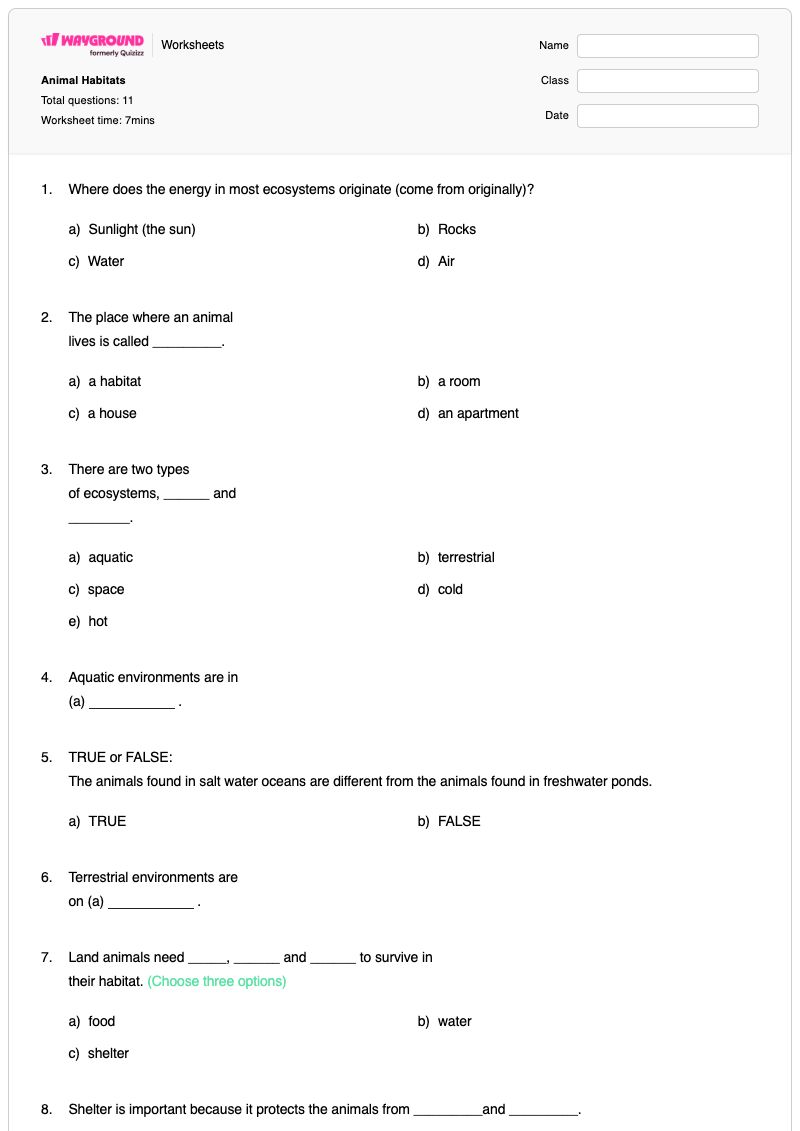
Animal Habitats is a Grade 4 science worksheet that builds understanding of how habitats and ecosystems support animal life. Students answer 11 questions about the Sun as the original energy source in most ecosystems, the meaning of habitat, and the difference between aquatic and terrestrial environments. They identify examples such as oceans, ponds, deserts, forests, and grasslands, and complete fill-in-the-blank items using land and water.
The worksheet combines six multiple-choice questions, three multiple-select questions, and two fill-in-the-blank questions. Students also identify the food, water, and shelter land animals need to survive and explain that shelter helps protect animals from harsh weather and predators. This free printable worksheet is designed for Grade 4 science instruction, independent practice, or a quick comprehension check, and it includes a complete answer key for efficient review.
Worksheet settings
Font size
S
M
L
XL
Worksheets
Animal Habitats
Total questions: 11
Name
Class
Date
1.
Where does the energy in most ecosystems originate (come from originally)?
a)
Sunlight (the sun)
b)
Rocks
c)
Water
d)
Air
2.
The place where an animal
lives is called _________.
a)
a habitat
b)
a room
c)
a house
d)
an apartment
3.
There are two types
of ecosystems, ______ and
________.
a)
aquatic
b)
terrestrial
c)
space
d)
cold
e)
hot
4.
Aquatic environments are in
(a) .
5.
TRUE or FALSE:
The animals found in salt water oceans are different from the animals found in freshwater ponds.
a)
TRUE
b)
FALSE
6.
Terrestrial environments are
on (a) .
7.
Land animals need _____, ______ and ______ to survive in
their habitat. (Choose three options)
a)
food
b)
water
c)
shelter
8.
Shelter is important because it protects the animals from _________and _________.
a)
harsh weather
b)
prey
c)
predators
d)
hugs and hot chocolate
e)
love
9.
TRUE or FALSE: Plants and animals found in
one habitat often cannot survive in another.
a)
TRUE
b)
FALSE
10.
rivers,
streams,
lakes,
ponds,
swamps,
marshes,
and
oceans
are all examples of ________ environments.
a)
aquatic
b)
terrestrial
11.
the desert,
forest,
grasslands,
tundra,
mountains and rainforest
are all examples of ________ environments.
a)
aquatic
b)
terrestrial
Answer Key
Animal Habitats
Total questions: 11
1.
a)
Sunlight (the sun)
2.
a)
a habitat
3.
b)
terrestrial
, a)
aquatic
4.
water
5.
a)
TRUE
6.
land, dirt, earth
7.
a)
food
, b)
water
, c)
shelter
8.
a)
harsh weather
, c)
predators
9.
a)
TRUE
10.
a)
aquatic
11.
b)
terrestrial
140 %
Browse by subjects
Browse by grades
Browse by format
FAQs
What does the Animal Habitats worksheet cover?
This Grade 4 science worksheet uses multiple-choice, multiple-select, and fill-in-the-blank questions to teach students to distinguish aquatic environments from terrestrial environments. It also checks whether students can identify sunlight as the original energy source in most ecosystems, classify habitat examples, and recognize food, water, and shelter as survival needs for land animals.
How can I use this worksheet to teach aquatic and terrestrial habitats?
Introduce the lesson by having students sort the worksheet’s examples—such as rivers, ponds, oceans, deserts, forests, and tundra—into aquatic or terrestrial groups. Then use the multiple-select questions to discuss why land animals need food, water, and shelter, including how shelter protects them from harsh weather and predators. Finish with the fill-in-the-blank items to check whether students can connect aquatic environments with water and terrestrial environments with land.
What mistakes should I watch for when students complete this Animal Habitats worksheet?
Students may confuse aquatic and terrestrial categories, especially when selecting whether examples such as swamps, marshes, mountains, or rainforests belong in water or on land. On the multiple-select items, watch for students choosing fewer than all three survival needs or selecting reasons for shelter that are not harsh weather and predators. Students may also leave the habitat fill-ins incomplete by writing a broad location instead of water or land.
How do I assign and grade this Animal Habitats worksheet?
You can assign Animal Habitats as a printable PDF or use it as a digital quiz on Wayground. The worksheet includes a complete answer key for checking the six multiple-choice, three multiple-select, and two fill-in-the-blank responses. For printable submissions, scan student work with the Wayground for Teachers app to streamline grading.
How can I differentiate this Animal Habitats worksheet for my students?
Use the worksheet’s Advanced Settings to adjust font spacing or increase the font size so the habitat examples, answer choices, and fill-in-the-blank prompts are easier to read. You can also apply a dyslexia-friendly font or translate the worksheet into another language when that better supports access to the aquatic and terrestrial habitat questions.
Where can I find more worksheets like this on Wayground?
Wayground offers a comprehensive collection of free printable worksheets and practice problems across subjects, with downloadable PDFs and answer keys to help students master essential skills and concepts. Browse more resources at https://wayground.com/en-us/worksheets.

 Worksheets