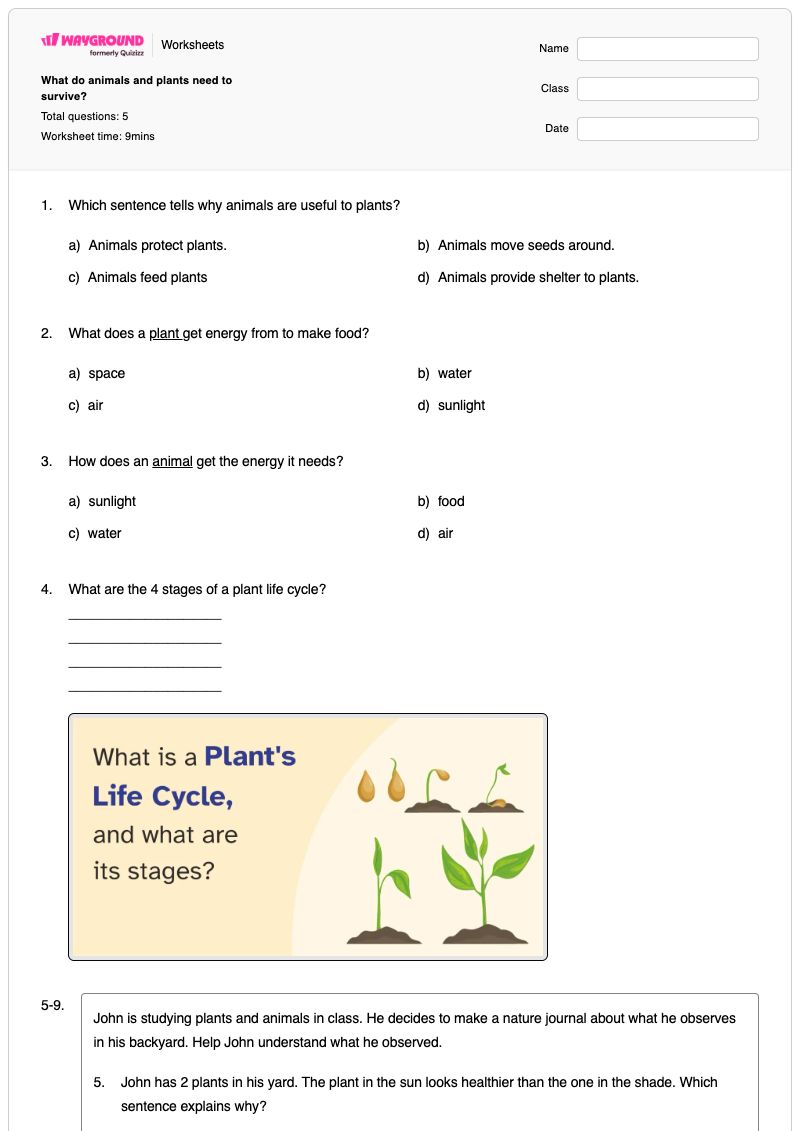
This Grade 2 science worksheet helps students explain what plants and animals need to survive and how they depend on one another. Through eight multiple-choice questions, students identify sunlight as the energy source plants use to make food, food as an animal energy source, and ways animals support plant life by moving seeds and carrying pollen. They also apply these ideas to observations from a backyard nature journal, including a plant growing in sun or shade, a bird visiting flowers, and a strawberry plant.
The worksheet includes a drawing prompt in which students record the four stages of a plant life cycle and a comprehension-based observation section. These varied formats help students connect basic needs with plant life cycles, pollination, and seed movement. It is designed for Grade 2 science instruction, independent practice, review, or a quick formative assessment. This is a free printable worksheet with a complete answer key.
Worksheet settings
Font size
S
M
L
XL
Worksheets
What do animals and plants need to survive?
Total questions: 5
Name
Class
Date
1.
Which sentence tells why animals are useful to plants?
a)
Animals protect plants.
b)
Animals move seeds around.
c)
Animals feed plants
d)
Animals provide shelter to plants.
2.
What does a plant get energy from to make food?
a)
space
b)
water
c)
air
d)
sunlight
3.
How does an animal get the energy it needs?
a)
sunlight
b)
food
c)
water
d)
air
4.
What are the 4 stages of a plant life cycle?
____________________
____________________
____________________
____________________
5-9.
John is studying plants and animals in class. He decides to make a nature journal about what he observes in his backyard. Help John understand what he observed.
5.
John has 2 plants in his yard. The plant in the sun looks healthier than the one in the shade. Which sentence explains why?
a)
Plants need shelter
b)
Plants need air
c)
Plants need water
d)
Plants need sunlight
6.
John sees a small bird flying from flower to flower. Which sentence best explains what he sees?
a)
Animals need air
b)
Animals need food
c)
Animals need shelter
d)
Animals need water
7.
When the small bird visits flowers, what is it likely carrying from flower to flower?
a)
seeds
b)
water
c)
pollen
d)
petals
8.
John sees a large caterpillar hanging upside down on twig. What is the very next thing that will happen to the caterpillar?
a)
It will lay eggs.
b)
It will turn into a butterfly.
c)
It will form a chrysalis.
d)
It will reproduce.
9.
John notices a strawberry plant. If animals eat the strawberries, what will happen to the seeds?
a)
They will be moved.
b)
They will die.
c)
They will grow.
d)
They will find food.
Answer Key
What do animals and plants need to survive?
Total questions: 5
1.
b)
Animals move seeds around.
2.
d)
sunlight
3.
b)
food
4.
n/a
5-9.
5.
d)
Plants need sunlight
6.
b)
Animals need food
7.
c)
pollen
8.
c)
It will form a chrysalis.
9.
a)
They will be moved.
140 %
Browse by subjects
Browse by grades
Browse by format
FAQs
What does this worksheet cover about what plants and animals need to survive?
This Grade 2 science worksheet uses eight multiple-choice questions, a plant life cycle drawing prompt, and a backyard-observation comprehension scenario to connect survival needs with interdependence. Students identify sunlight as the energy source plants use to make food, food as an animal energy source, and examples of animals moving seeds or carrying pollen. The questions also ask students to apply these ideas to observations involving a bird, flowers, a caterpillar, and a strawberry plant.
How can I use this worksheet to teach plant and animal needs?
Introduce the lesson by comparing how plants get energy with how animals get energy, then discuss how animals can help plants through seed movement and pollen transfer. Have students explain the backyard observations before they answer the related multiple-choice items, asking them to cite the clue that supports each choice. Finish with the drawing prompt so students organize the four stages of a plant life cycle.
What mistakes should I watch for when students complete this worksheet?
Students may choose water, air, or sunlight for an animal’s energy source instead of food, or confuse the sunlight a plant needs with the shelter or water options. In the backyard observations, they may identify seeds rather than pollen on a bird visiting flowers, or miss that a caterpillar’s next stage is forming a chrysalis. Watch also for confusion between animals moving seeds and seeds growing or dying.
How do I assign and grade this worksheet?
This worksheet is available as a printable PDF and as a digital quiz on Wayground, so you can use the same plant-and-animal survival practice for paper or online work. It includes a complete answer key for the multiple-choice items and guidance for reviewing the drawing and comprehension responses. For printable submissions, you can scan student work with the Wayground for Teachers app to help grade it.
How can I differentiate this plant and animal needs worksheet for my students?
In the worksheet’s Advanced Settings, adjust font spacing or increase the font size to make the multiple-choice options, backyard observation text, and plant life cycle drawing prompt easier to read. You can also enable a dyslexia-friendly font or translate the worksheet into another language when those options support access to the science vocabulary and directions.
Where can I find more worksheets like this on Wayground?
Wayground offers a broad collection of free printable worksheets and practice problems across subjects, with downloadable PDFs and answer keys to help students build essential skills and concepts. Browse more resources at https://wayground.com/en-us/worksheets.

 Worksheets