
Properties and Areas of Kites, Rhombi, and Trapezoids
18 questions
10th - 10th Grade
Mathematics
This Grade 10 mathematics worksheet develops students’ ability to identify and apply properties of kites, rhombi, and trapezoids. Across 18 items—17 multiple-choice questions and 1 multiple-select question—students classify quadrilaterals, recognize defining side and angle relationships, analyze diagonals, solve for unknown angles and lengths, and calculate areas from given measurements and diagrams.
The questions move from foundational vocabulary and property recognition to multi-step geometry applications, including rhombus diagonal relationships, isosceles trapezoid base angles, and area problems for rhombi and trapezoids. It is a free printable worksheet with a complete answer key, making it useful for Grade 10 math practice, independent review, homework, or a quick formative assessment of quadrilateral properties and area reasoning.
Worksheet settings
Font size
S
M
L
XL
Worksheets
Properties and Areas of Kites, Rhombi, and Trapezoids
Total questions: 18
Name
Class
Date
1.
A rhombus is a parallelogram with
a)
four congruent sides
b)
four congruent diagonals
c)
four acute angles
d)
four congruent angles
2.
What is this shape?
a)
Trapezoid
b)
Kite
c)
Rhombus
d)
Isosceles Rectangle
3.
A trapezoid is a quadrilateral with exactly one pair of _____ sides.
a)
parallel
b)
congruent
c)
perpendicular
d)
skew
4.
The diagonals of a rhombus are
a)
parallel
b)
congruent
c)
perpendicular
d)
equal to the side lengths
5.
Base angles of an isosceles trapezoid are _____.
a)
neither
b)
supplementary
c)
congruent
6.
Which of the following statements are true?
a)
BD and AC are perpendicular
b)
BD and AC are congruent
c)
∠A and ∠C are congruent
d)
AD and DC are congruent
7.
Solve for Angle 1 and Angle 2.
a)
1= 92, 2 = 46 degrees
b)
1 = 118, 2 = 118 degrees
c)
1 = 92, 2 = 92
d)
1 = 136, 2 = 100
8.
What are the lengths of the 2 diagonals?
a)
22 and 24 m
b)
5.5 and 6 m
c)
44 and 48 m
d)
14 and 12 m
9.
What is the area of the rhombus?
a)
264 m2
b)
448 m2
c)
121 m2
d)
255 m2
10.
What is the area of this trapezoid?
a)
20 in2
b)
24 in2
c)
28 in2
11.
What is x?
a)
35
b)
45
c)
55
d)
90
12.
find the area
a)
70
b)
35
c)
140
d)
60
13.
What is the area of this trapezoid?
a)
120 m2
b)
92 m2
c)
84 m2
14.
find the area
a)
19.5 m2
b)
78 m2
c)
39 m2
d)
27 m2
15.
What is the area of this rhombus?
a)
48 cm2
b)
24 cm2
c)
16 cm2
d)
32cm2
16.
What is the area of this kite?
a)
336 in 2
b)
26 in 2
c)
108 in2
d)
672 in 2
17.
What is the area of this trapezoid?
a)
42cm2
b)
213cm2
c)
422cm2
d)
21cm2
18.
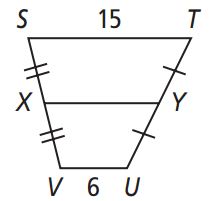
Find the measure of the midsegment XY:
a)
21
b)
9
c)
12
d)
10.5
Answer Key
Properties and Areas of Kites, Rhombi, and Trapezoids
Total questions: 18
1.
a) four congruent sides
2.
b) Kite
3.
a) parallel
4.
c) perpendicular
5.
c) congruent
6.
a)
BD and AC are perpendicular
, c)
∠A and ∠C are congruent
, d)
AD and DC are congruent
7.
b) 1 = 118, 2 = 118 degrees
8.
a)
22 and 24 m
9.
a)
264 m2
10.
c)
28 in2
11.
b) 45
12.
a)
70
13.
c)
84 m2
14.
c)
39 m2
15.
b) 24 cm2
16.
a)
336 in 2
17.
b)
213cm2
18.
d) 10.5
140 %
Browse by subjects
Browse by grades
Browse by format
FAQs
What does the Properties and Areas of Kites, Rhombi, and Trapezoids worksheet cover?
This Grade 10 worksheet uses 17 multiple-choice questions and 1 multiple-select question to assess quadrilateral classification, defining properties, diagonal relationships, angle measures, missing lengths, and area calculations. Students apply properties such as congruent rhombus sides, perpendicular rhombus diagonals, congruent isosceles trapezoid base angles, and exactly one pair of parallel trapezoid sides to solve diagram-based problems.
How can I use this worksheet to teach properties and areas of kites, rhombi, and trapezoids?
Begin by reviewing how to identify each quadrilateral from its sides, angles, and diagonals, then model how those properties support angle, length, and area solutions. Have students explain why an answer follows from a specific property before completing the multiple-choice items, and use the multiple-select question to discuss why several statements about a diagram can be true at the same time.
What mistakes should I watch for when students complete this quadrilateral worksheet?
Watch for students confusing a shape’s defining properties—for example, choosing congruent diagonals instead of congruent sides for a rhombus or treating a trapezoid as having more than one pair of parallel sides. Students may also select every plausible statement in the multiple-select item without checking each one, confuse congruent and supplementary angles, or use the wrong measurements when calculating the areas of the rhombi and trapezoids.
How do I assign and grade this worksheet?
The worksheet is available as a printable PDF and as a digital quiz on Wayground, and it includes a complete answer key for checking all 18 items. For printable submissions, you can scan student work with the Wayground for Teachers app to grade responses efficiently.
How can I differentiate this worksheet for my students?
Use the worksheet’s Advanced Settings to create a more accessible version of the quadrilateral property and area questions. You can adjust font spacing or font size, apply a dyslexia-friendly font, or translate the worksheet into another language so the shape descriptions, angle prompts, and area items are easier to read.
Where can I find more worksheets like this on Wayground?
Wayground offers a comprehensive collection of free printable worksheets and practice problems across subjects, with downloadable PDFs and answer keys to help students master essential skills and concepts. Browse more resources at https://wayground.com/en-us/worksheets.