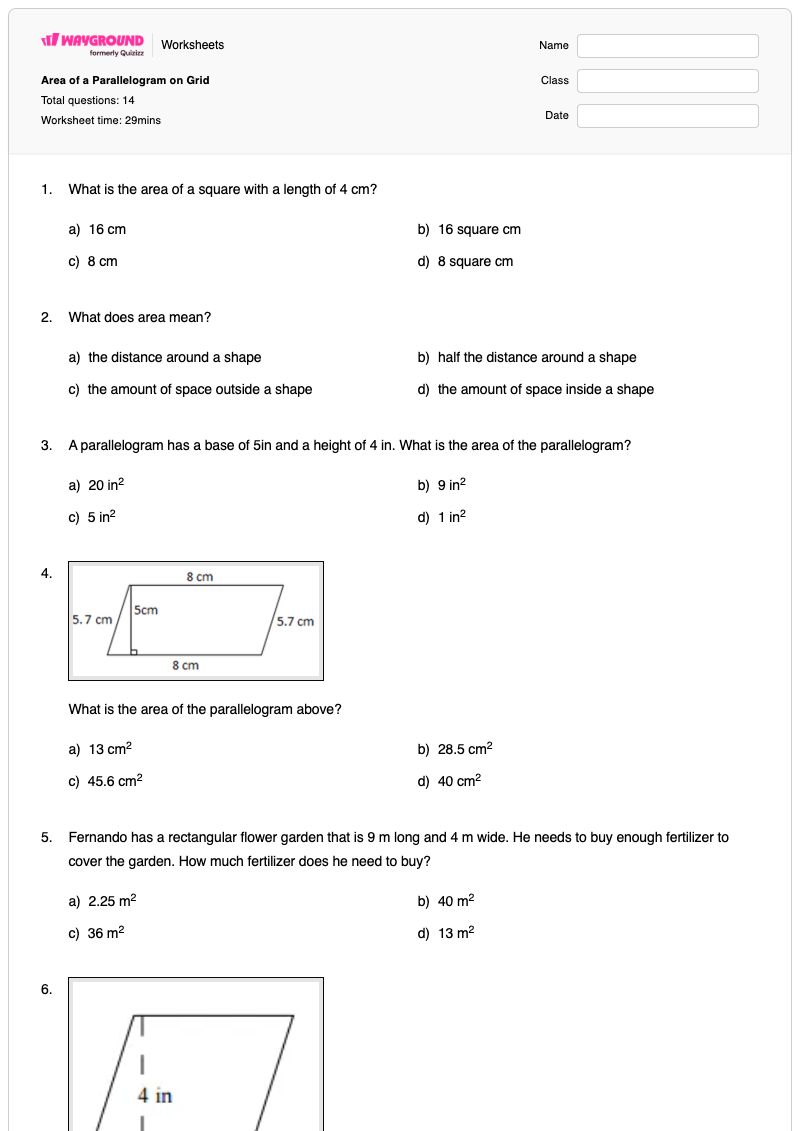
Area of a Parallelogram on Grid is a Grade 6 mathematics worksheet with 14 multiple-choice questions focused on finding area. Students review what area represents, distinguish square units from linear units, and calculate the area of squares, rectangles, and parallelograms using base and height measurements shown in the questions and grid-based diagrams.
The worksheet also asks students to identify a parallelogram’s height and apply area calculations to practical situations, such as determining fertilizer coverage for a rectangular garden. It helps teachers check whether students can select the relevant dimensions, multiply correctly, and interpret an answer in square units. This free printable worksheet includes a complete answer key for efficient review and assessment.
Worksheet settings
Font size
S
M
L
XL
Worksheets
Area of a Parallelogram on Grid
Total questions: 14
Name
Class
Date
1.
What is the area of a square with a length of 4 cm?
a)
16 cm
b)
16 square cm
c)
8 cm
d)
8 square cm
2.
What does area mean?
a)
the distance around a shape
b)
half the distance around a shape
c)
the amount of space outside a shape
d)
the amount of space inside a shape
3.
A parallelogram has a base of 5in and a height of 4 in. What is the area of the parallelogram?
a)
20 in2
b)
9 in2
c)
5 in2
d)
1 in2
4.
What is the area of the parallelogram above?
a)
13 cm2
b)
28.5 cm2
c)
45.6 cm2
d)
40 cm2
5.
Fernando has a rectangular flower garden that is 9 m long and 4 m wide. He needs to buy enough fertilizer to cover the garden. How much fertilizer does he need to buy?
a)
2.25 m2
b)
40 m2
c)
36 m2
d)
13 m2
6.
a)
2 in2
b)
32 m2
c)
32 in
d)
32 in2
7.
a)
40 in2
b)
40
c)
40 in
d)
4 in2
8.
What is the area?
a)
28 square units
b)
35 square units
c)
14 square units
d)
35 square units
9.
Which of these numbers is the height?
a)
10
b)
5
c)
4
10.
What is the area of the parallelogram?
a)
10 square units
b)
24 square units
c)
12 square units
d)
96 square units
11.
What is the area of the parallelogram?
a)
63 cm2
b)
72 cm2
c)
56 cm2
12.
The rectangle below has side measures of 6 cms and 5 cms. What is the area of the rectangle?
a)
11 cm2
b)
20 cm2
c)
30 cm2
13.
a)
B, D, E
b)
B, D
c)
A, C
d)
A, C, E
14.
What is the area of the parallelogram?
a)
150 square units
b)
120 square units
c)
180 square units
Answer Key
Area of a Parallelogram on Grid
Total questions: 14
1.
b) 16 square cm
2.
d) the amount of space inside a shape
3.
a)
20 in2
4.
d)
40 cm2
5.
c)
36 m2
6.
d) 32 in2
7.
a) 40 in2
8.
a)
28 square units
9.
c)
4
10.
b)
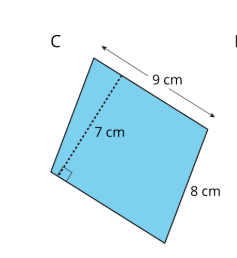
24 square units
11.
a)
63 cm2
12.
c)
30 cm2
13.
b)
B, D
14.
b)
120 square units
140 %
Browse by subjects
Browse by grades
Browse by format
FAQs
What does this worksheet cover, and how does it help students learn area of parallelograms?
This Grade 6 worksheet uses 14 multiple-choice questions to practice finding the area of parallelograms from their base and height, including grid-based and measurement-based diagrams. It also connects the skill to the meaning of area and to square and rectangle examples, helping students identify the correct dimensions, multiply them, and report answers in square units.
How can I use this worksheet to teach finding the area of a parallelogram?
Begin by reviewing that area measures the space inside a shape and that parallelogram area is found by multiplying base by height. As students work through the multiple-choice items, have them point out which measurement is the base or height before calculating, then discuss why the answer must be expressed in square units. Use the garden word problem to connect the formula to coverage in a real setting.
What mistakes should I watch for when students complete this area worksheet?
Watch for students choosing a side length instead of the perpendicular height, especially in the item that asks them to identify the height of a parallelogram. Other common errors include adding the dimensions, multiplying the wrong pair of measurements, confusing area with perimeter, or selecting linear units such as centimeters instead of square centimeters. The rectangle and square questions can also reveal whether students understand that area is measured in square units.
How do I assign and grade this Area of a Parallelogram on Grid worksheet?
Wayground provides this worksheet as a printable PDF and as a digital quiz, and it includes a complete answer key for all 14 multiple-choice questions. You can review students’ selected answers against the key, or scan printable student work with the Wayground for Teachers app to help grade submissions. The printable format can also support classrooms that are reducing screen time.
How can I differentiate this worksheet for my students?
Use the worksheet’s Advanced Settings to adjust font spacing or choose a larger font size so the multiple-choice area questions and their measurement labels are easier to read. You can also enable a dyslexia-friendly font or translate the worksheet into another language when those options support access to the parallelogram, rectangle, and square area practice.
Where can I find more free worksheets like this on Wayground?
Wayground offers a comprehensive collection of free printable worksheets and practice problems across subjects, with downloadable PDFs and answer keys to support mastery of essential skills and concepts. Browse more resources at https://wayground.com/en-us/worksheets.

 Worksheets