Area and Perimeter of Composite Figures is a Grade 8 mathematics worksheet that helps students calculate the perimeter and area of composite figures. The 14 multiple-choice questions include figures with straight and curved parts, shaded regions, and an isosceles trapezoid. Students use given measurements, apply 3.14 for problems involving pi, and round perimeter or area values as directed. The worksheet includes both square-unit area problems and perimeter problems using units such as feet, inches, centimeters, and meters.
This free printable worksheet is useful for guided practice, independent work, homework, or a short skills check after instruction on composite figures. Its answer choices help teachers identify whether students are confusing area with perimeter, selecting an incorrect operation, mishandling curved sections, or rounding too early. An answer key is included so teachers can review the 14 multiple-choice items efficiently and discuss the calculation steps behind each result.
Worksheet settings
Font size
S
M
L
XL
Worksheets
Area and Perimeter of Composite Figures
Total questions: 14
Name
Class
Date
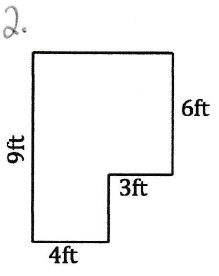
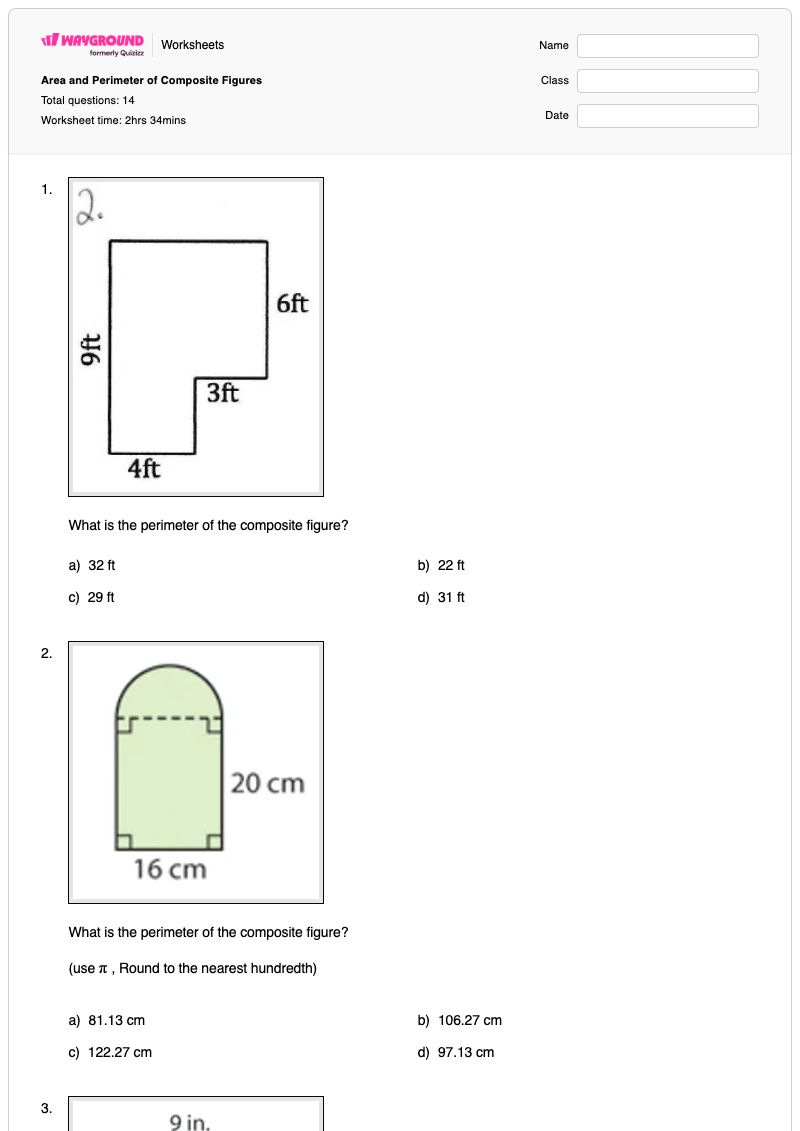
1.
What is the perimeter of the composite figure?
a)
32 ft
b)
22 ft
c)
29 ft
d)
31 ft
2.
What is the perimeter of the composite figure?
(use π , Round to the nearest hundredth)
a)
81.13 cm
b)
106.27 cm
c)
122.27 cm
d)
97.13 cm
3.
What is the perimeter of the composite figure? (round to the nearest hundredth)
a)
40.85 in
b)
40 in
c)
49.85 in
d)
44.85 in
4.
Find the Perimeter
a)
74 in2
b)
69 in2
c)
82 in2
d)
67 in2
5.
Find the perimeter
a)
3 inches
b)
8.28 inches
c)
3.57 inches
d)
5 inches
6.
Find the perimeter of the figure. Use 3.14 for pi.
a)
20.56 in.
b)
17.3 in.
c)
17.8 in.
d)
31.88 in.
7.
Calculate the area. Use 3.14 for pi. Round to the nearest tenth if needed.
a)
61.2325 cm 2
b)
61.2 cm 2
c)
195.9 cm 2
d)
90.1 cm 2
8.
Calculate the area.
a)
336 cm 2
b)
172 cm 2
c)
459 cm 2
d)
522 cm 2
9.
Calculate the area. Use 3.14 for pi. Round to the nearest tenth if needed.
a)
1582.8 cm 2
b)
1476.4 cm 2
c)
586.2 cm 2
d)
602.5 cm 2
10.
Calculate the area.
a)
200 in. 2
b)
400 in. 2
c)
250 in. 2
d)
300 in. 2
11.
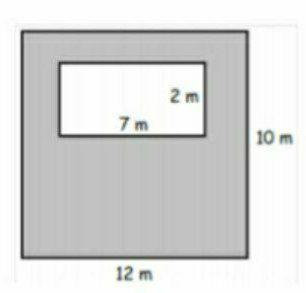
What is the area of the shaded region?
a)
14 m2
b)
120 m2
c)
106 m2
d)
134 m2
12.
a)
625
b)
134.13
c)
490.87
d)
228.4
13.
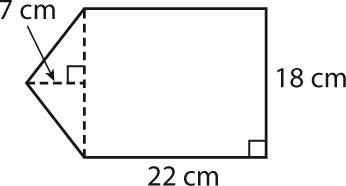
Determine the area of the composite figure.
a)
52.8m2
b)
53.8m2
c)
50.8m2
d)
51.8m2
14.
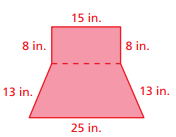
This is an Isosceles Trapezoid. Find the perimeter. (round answers to the nearest hundredth)
a)
40.12 m
b)
40.00 m
c)
35.48 m
d)
58.00 m
Answer Key
Area and Perimeter of Composite Figures
Total questions: 14
1.
a)
32 ft
2.
a)
81.13 cm
3.
a)
40.85 in
4.
c) 82 in2
5.
c)
3.57 inches
6.
a) 20.56 in.
7.
b)
61.2 cm 2
8.
c)
459 cm 2
9.
c)
586.2 cm 2
10.
d)
300 in. 2
11.
c)
106 m2
12.
b) 134.13
13.
c) 50.8m2
14.
a)
40.12 m
140 %
Browse by subjects
Browse by grades
Browse by format
FAQs
What does this Area and Perimeter of Composite Figures worksheet cover?
This Grade 8 worksheet provides 14 multiple-choice problems on finding the area and perimeter of composite figures. Students work with straight and curved sections, shaded regions, an isosceles trapezoid, pi approximated as 3.14, and directions to round answers to the nearest tenth or hundredth. Completing the items builds skill in selecting and combining the appropriate measurements for each figure.
How can I use this worksheet to teach area and perimeter of composite figures?
Introduce the worksheet by modeling how to separate a composite figure into familiar parts, identify whether the question asks for area or perimeter, and label the units before calculating. Then solve one straight-edged example and one problem involving pi, discussing why curved measurements require 3.14 and why some answers must be rounded. Use the multiple-choice options to ask students to explain which step could produce each distractor.
What mistakes should I watch for on this composite figures worksheet?
Watch for students using an area formula when a problem asks for perimeter, or reporting square units for a perimeter answer. Students may also omit an outer or curved section, add areas without accounting for a shaded or missing region, use the wrong value for pi, or round before completing the calculation. The isosceles trapezoid item may reveal errors in including both equal legs when finding perimeter.
How do I assign and grade this Area and Perimeter of Composite Figures worksheet?
The worksheet is available as a printable PDF and as a digital quiz on Wayground, and it includes a complete answer key for all 14 multiple-choice questions. Assign the PDF for written work or use the digital quiz for online responses and grading. Printable submissions can also be graded by scanning student work with the Wayground for Teachers app.
How can I differentiate this composite figures worksheet for my students?
Use the worksheet’s Advanced Settings to adjust font spacing and font size so the measurement labels and multiple-choice options around each figure are easier to read. You can also enable a dyslexia-friendly font or translate the worksheet into another language. These options modify the worksheet file while preserving its composite-figure area and perimeter problems.
Where can I find more worksheets like this on Wayground?
Wayground offers a broad collection of free printable worksheets and practice problems across subjects, with downloadable PDFs and answer keys to support mastery of essential skills and concepts. Browse more resources at https://wayground.com/en-us/worksheets.

 Worksheets