

Wayground
Polygon Problems (A) - Printable Mathematics Worksheets year 6 - Wayground

Polygon Problems (A)

10 questions

6th - 6th Grade

Mathematics

Polygon Problems (A) is a free printable Grade 6 mathematics worksheet that builds students’ understanding of polygons and measurement. Across 10 items, students identify parallelograms, rectangles, and quadrilaterals; compare polygon areas using thresholds; calculate a polygon’s area; distinguish area, perimeter, and volume; select a valid rectangle-perimeter formula; and connect each measurement type with appropriate units. Multiple-select, multiple-choice, and matching questions require students to classify shapes, interpret formulas, compare values, and recognize square and cubic units. This worksheet is useful for introducing or reviewing how polygon attributes and measurement concepts are related. Students must pay attention to whether a question asks for area, perimeter, or volume, and whether more than one answer may be correct. The included answer key supports efficient checking, reteaching, and independent practice. Teachers can use the free printable worksheet for Grade 6 math lessons, review activities, or formative assessment.

Worksheet settings

Font size

S
M
L
XL
Worksheets

Polygon Problems (A)

Total questions: 10

Name
Class
Date
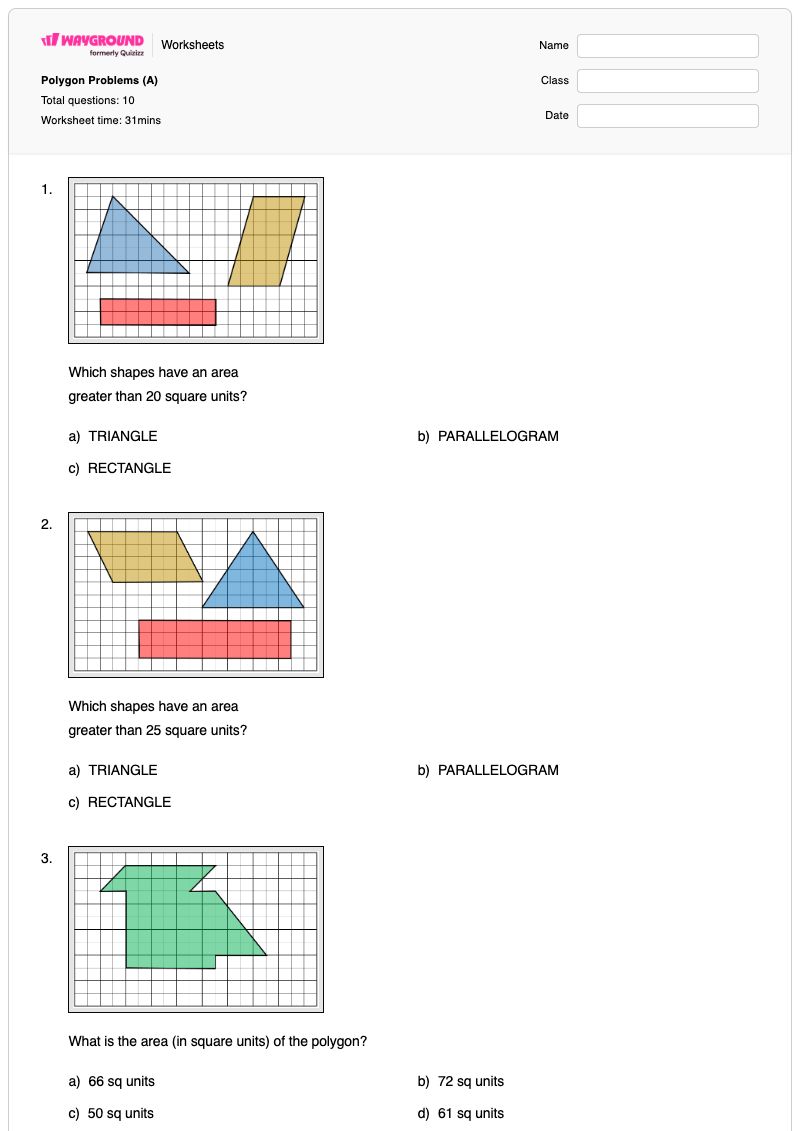
1.

Which shapes have an area

greater than 20 square units?

a)

TRIANGLE

b)

PARALLELOGRAM

c)

RECTANGLE

2.

Which shapes have an area

greater than 25 square units?

a)

TRIANGLE

b)

PARALLELOGRAM

c)

RECTANGLE

3.

What is the area (in square units) of the polygon?

a)

66 sq units

b)

72 sq units

c)

50 sq units

d)

61 sq units

e)

58 sq units

4.

Match the following

AREA of RECTANGLE

l x w

AREA of PARALLELOGRAM

b x h

VOLUME of RECTANGULAR PRISM

l x w x h

PERIMETER of RECTANGLE

l + w + l + w

AREA of TRIANGLE

b x h ÷ 2

5.

Which formula is NOT a method of finding perimeter of a rectangle?

a)

l + w + l + w

b)

2 (l + w)

c)

2l + 2w

d)

2l x 2w

6.

Match the following

inches, feet, yards

Perimeter

square inches, square feet, square yards

Area

cubic inches, cubic feet, cubic yards

Volume

7.

Click on ANY parallelograms!

a)
b)
c)
d)
e)
8.

Click on ANY rectangles!

a)
b)
c)
d)
e)
9.

Click on ANY quadrilaterals!

a)
b)
c)
d)
e)
10.

The blue parallelogram is larger than the orange parallelogram by 12 square units.

a)

TRUE

b)

FALSE

Answer Key

Polygon Problems (A)

Total questions: 10

1.
a)

TRIANGLE

, b)

PARALLELOGRAM

2.
b)

PARALLELOGRAM

, c)

RECTANGLE

3.
a)

66 sq units

4.

AREA of RECTANGLE

 - 

l x w

, 

AREA of PARALLELOGRAM

 - 

b x h

, 

VOLUME of RECTANGULAR PRISM

 - 

l x w x h

, 

PERIMETER of RECTANGLE

 - 

l + w + l + w

, 

AREA of TRIANGLE

 - 

b x h ÷ 2

5.
d)

2l x 2w

6.

inches, feet, yards

 - 

Perimeter

, 

square inches, square feet, square yards

 - 

Area

, 

cubic inches, cubic feet, cubic yards

 - 

Volume

7.
a) , d) , e)
8.
a)
9.
a) , b) , c) , d) , e)
10.
a)

TRUE

FAQs

What does the Polygon Problems (A) worksheet cover?

Polygon Problems (A) helps Grade 6 students classify rectangles, parallelograms, and quadrilaterals while applying area and perimeter concepts. Its 10 questions use multiple-select, multiple-choice, and matching formats to compare polygon areas, identify a perimeter formula that does not work, connect measurement types with units, and distinguish square units from cubic units.

How can I use this worksheet to teach polygon area and measurement concepts?

Begin by having students sort the pictured shapes in the multiple-select items, discussing how a rectangle can also be a quadrilateral and how a parallelogram is identified. Then model the area comparison and perimeter-formula questions, asking students to explain why area uses square units while volume uses cubic units. Use the matching items as a quick check before students complete the remaining questions independently.

What mistakes should I watch for on this polygon worksheet?

Students may select only one option on the multiple-select area and shape-classification questions, even when several shapes qualify. Watch for confusion between area, perimeter, and volume, especially choosing a perimeter expression that multiplies instead of adding side lengths or matching linear units with area or volume. Students may also overlook that rectangles and parallelograms can belong to the broader quadrilateral category.

How do I assign and grade Polygon Problems (A)?

Polygon Problems (A) is available as a printable PDF and as a digital quiz on Wayground, with a complete answer key for all 10 area, formula, classification, and measurement items. You can grade printable submissions by scanning student work with the Wayground for Teachers app, or review responses from the digital quiz.

How can I differentiate this polygon worksheet for my students?

Under the worksheet’s Advanced Settings, adjust font spacing or choose a larger font size to make the area comparisons, formulas, and shape-selection items easier to read. You can also enable a dyslexia-friendly font or translate the worksheet into another language while preserving its multiple-select, multiple-choice, and matching format.

Where can I find more worksheets like this on Wayground?

Wayground offers a comprehensive collection of free printable worksheets and practice problems across subjects, including downloadable PDFs and answer keys to support essential skills and concepts. Browse more resources at https://wayground.com/en-us/worksheets.