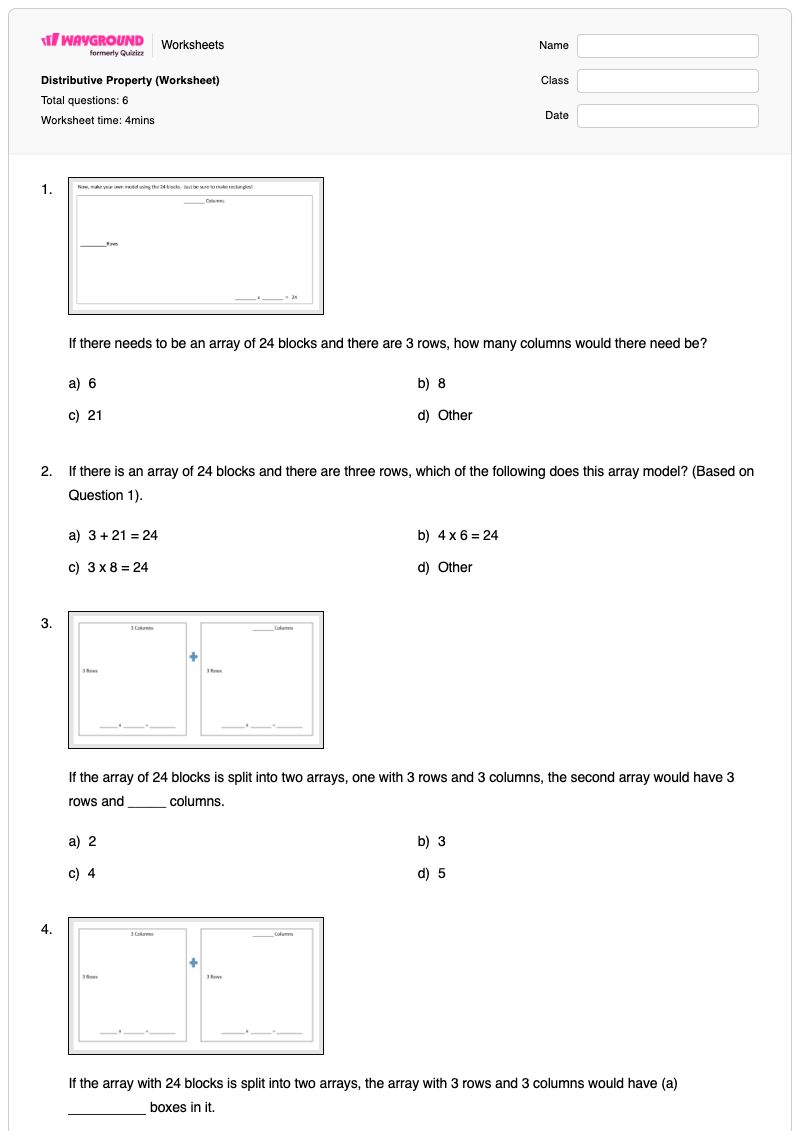
This free printable Distributive Property worksheet is designed for students in Grades 5–6 mathematics. It uses a 24-block array to connect multiplication with partitioning: students determine missing dimensions, identify multiplication equations represented by an array, and split a 3-by-8 array into 3-by-3 and 3-by-5 sections. Five multiple-choice questions and one fill-in-the-blank item ask students to reason from the array before identifying the matching partial products.
Students then assemble the parts into the distributive-property equation 3 × 8 = 3 × 3 + 3 × 5 = 24. The sequence reinforces how a whole array can be decomposed into smaller arrays while preserving the total, helping learners connect visual models to equations rather than relying only on symbolic rules. Use this free printable worksheet for guided practice, independent work, or a quick check of understanding. It includes a complete answer key for efficient review and grading.
Worksheet settings
Font size
S
M
L
XL
Worksheets
Distributive Property (Worksheet)
Total questions: 6
Name
Class
Date
1.
If there needs to be an array of 24 blocks and there are 3 rows, how many columns would there need be?
a)
6
b)
8
c)
21
d)
Other
2.
If there is an array of 24 blocks and there are three rows, which of the following does this array model? (Based on Question 1).
a)
3 + 21 = 24
b)
4 x 6 = 24
c)
3 x 8 = 24
d)
Other
3.
If the array of 24 blocks is split into two arrays, one with 3 rows and 3 columns, the second array would have 3 rows and _____ columns.
a)
2
b)
3
c)
4
d)
5
4.
If the array with 24 blocks is split into two arrays, the array with 3 rows and 3 columns would have (a) boxes in it.
5.
If the array of 24 blocks is split into two arrays, the second array (the one on the right) would model which equation?
a)
3 x 3 = 9
b)
3 x 4 = 12
c)
3 x 5 = 15
d)
Other
6.
Which is the correct equation to match the "Put it Together" section. Remember, this is meant to model the original array which has 24 blocks.
a)
3 x 8 = 3 (3 + 5) = 3 x 3 + 3 x 5 = 24
b)
3 x 6 = 3 (3 + 3) = 3 x 3 + 3 x 3 = 18
c)
3 x 8 = 3 (3 + 3) = 3 x 3 + 3 x 3 = 18
Answer Key
Distributive Property (Worksheet)
Total questions: 6
1.
b)
8
2.
c)
3 x 8 = 24
3.
d)
5
4.
9, nine
5.
c)
3 x 5 = 15
6.
a)
3 x 8 = 3 (3 + 5) = 3 x 3 + 3 x 5 = 24
140 %
Browse by subjects
Browse by grades
Browse by format
FAQs
What does this Distributive Property worksheet cover?
This Grade 5–6 math worksheet uses five multiple-choice questions and one fill-in-the-blank item to model the distributive property with a 24-block array. Students find missing array dimensions, identify the equations represented by a 3-by-8 array and its 3-by-3 and 3-by-5 sections, and combine the partial products to show that 3 × 8 = 3 × 3 + 3 × 5 = 24.
How can I use this worksheet to teach the distributive property?
Begin with the 24-block array and ask students to identify its three rows and eight columns. Guide them to split the array into a 3-by-3 section and a 3-by-5 section, then have them write the two partial products and combine them to recover the original total. Use the final equation as a discussion prompt about why partitioning an array does not change the product.
What mistakes should I watch for when students complete this worksheet?
Watch for students reversing rows and columns when finding the missing dimension, choosing an equation that does not match the 3-by-8 array, or treating the two smaller arrays as separate from the original total. Students may also identify 3 × 3 as the entire split array instead of recognizing the second 3-by-5 section, or omit one partial product when writing the final distributive-property equation.
How do I assign and grade this Distributive Property worksheet?
The worksheet is available as a printable PDF and as a digital quiz on Wayground, and it includes a complete answer key for all six items. For printable submissions, you can scan student work with the Wayground for Teachers app to help grade responses efficiently.
How can I differentiate this array-based worksheet for my students?
Under the worksheet’s Advanced Settings, adjust font spacing or choose a larger font size so the array prompts and equations are easier to follow. You can also enable a dyslexia-friendly font or translate the worksheet into another language while students work through the 24-block array and distributive-property equations.
Where can I find more worksheets like this on Wayground?
Wayground offers a comprehensive collection of free printable worksheets and practice problems across subjects, including downloadable PDFs and answer keys to support essential skills and concepts. Browse more resources at https://wayground.com/en-us/worksheets.


 Worksheets


