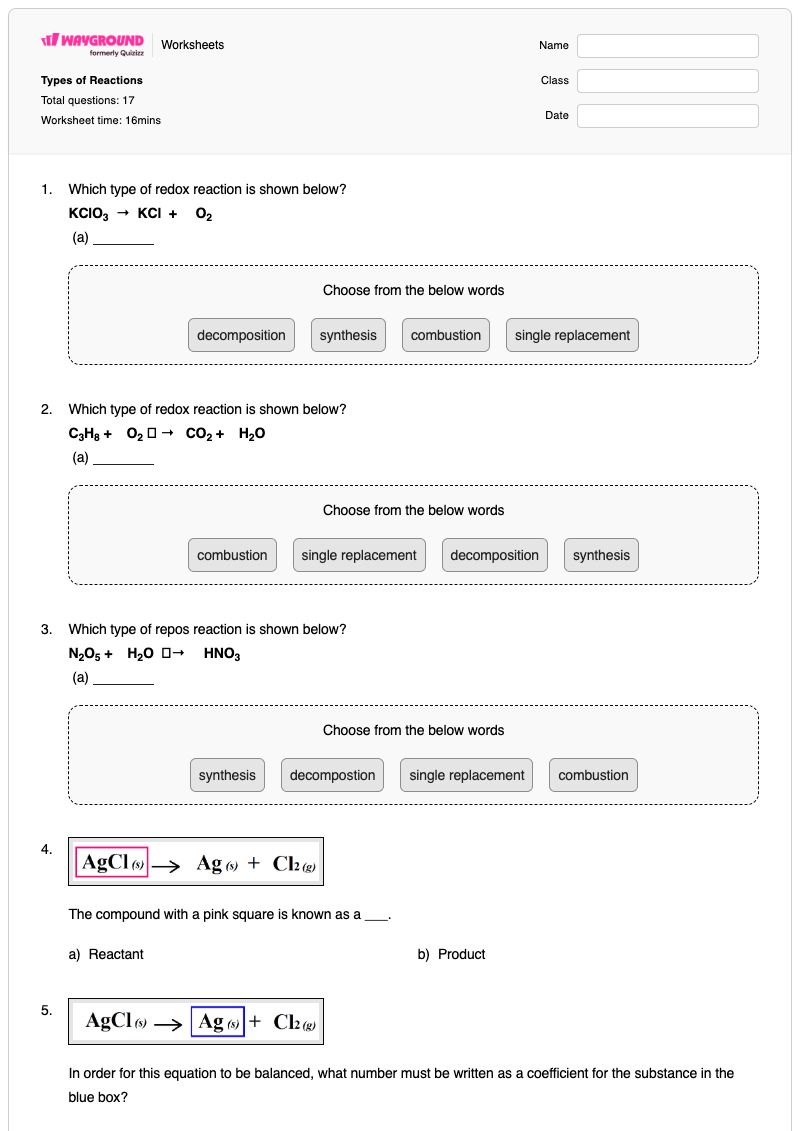
Types of Reactions is a free printable Grade 9 science worksheet with an answer key that helps students classify chemical reactions and balance equations. Across 17 questions, including drag-and-drop and multiple-choice items, students identify synthesis, decomposition, combustion, and other reaction types from chemical equations, distinguish reactants from products, and determine the correct coefficients needed for balanced equations.
The worksheet also checks students’ understanding of reaction patterns, including synthesis as the formation of one complex compound and combustion as a reaction involving oxygen that produces carbon dioxide and water. Use it for independent practice, a classroom review, or an assessment after introducing reaction classification and balancing. The answer key supports efficient checking and helps teachers identify whether students need more practice reading equations, recognizing reaction structures, or applying coefficients without changing subscripts.
Worksheet settings
Font size
S
M
L
XL
Worksheets
Types of Reactions
Total questions: 17
Name
Class
Date
1.
Which type of redox reaction is shown below?
KClO3→ KCl + O2
(a)
Choose from the below words
decomposition
synthesis
combustion
single replacement
2.
Which type of redox reaction is shown below?
C3H8 + O2 🡪 → CO2 + H2O
(a)
Choose from the below words
combustion
single replacement
decomposition
synthesis
3.
Which type of repos reaction is shown below?
N2O5 + H2O 🡪→ HNO3
(a)
Choose from the below words
synthesis
decompostion
single replacement
combustion
4.
The compound with a pink square is known as a ___.
a)
Reactant
b)
Product
5.
In order for this equation to be balanced, what number must be written as a coefficient for the substance in the blue box?
a)
1
b)
2
c)
4
d)
0
6.
Which type of reaction is shown?
a)
Combustion
b)
single replacement
c)
double replacement
d)
decomposition
7.
What must be done to this equation for it to be balanced?
a)
change the subscript to 3 in the reactants
b)
change the subscript to 3 in the products
c)
no change; it's balanced as is
d)
change the coefficients to 2
8.
What type of reaction is shown?
a)
Decomposition
b)
Single replacement
c)
Combustion
d)
Synthesis
9.
To balance this equation, what coefficient belongs in the red box?
a)
3
b)
2
c)
1
d)
0
10.
Which type of reaction is shown?
a)
Combustion
b)
Combination (or Synthesis)
c)
Decomposition
d)
Double replacement
11.
Which type of chemical reaction involves the production of a single complex compound from several simpler reactants?
a)
Decomposition
b)
Combustion
c)
Synthesis
d)
Single replacement
12.
What are the products of a combustion reaction?
a)
a single complex compound
b)
several simpler elements
c)
carbon dioxide and water
d)
carbon dioxide and hydrogen
13.
Which element is always present in the reactants of a combustion reaction?
a)
oxygen
b)
hydrogen
c)
carbon
d)
water
14.
To balance this equation, what coefficient must be written in the red box?
a)
1
b)
2
c)
4
d)
5
15.
Identify the type of chemical reaction
a)
Synthesis
b)
Decomposition
c)
Single replacement
d)
Double replacement
e)
Combustion
16.
Identify the type of chemical reaction
a)
Synthesis
b)
Decomposition
c)
Single replacement
d)
Double replacement
e)
Combustion
17.
Identify the type of chemical reaction
a)
Synthesis
b)
Decomposition
c)
Single replacement
d)
Double replacement
e)
Combustion
Answer Key
Types of Reactions
Total questions: 17
1.
decomposition
2.
combustion
3.
synthesis
4.
a)
Reactant
5.
b)
2
6.
d)
decomposition
7.
c)
no change; it's balanced as is
8.
d)
Synthesis
9.
b)
2
10.
a)
Combustion
11.
c)
Synthesis
12.
c)
carbon dioxide and water
13.
a)
oxygen
14.
b)
2
15.
e)
Combustion
16.
a)
Synthesis
17.
b)
Decomposition
140 %
Browse by subjects
Browse by grades
Browse by format
FAQs
What does the Types of Reactions worksheet cover?
This Grade 9 science worksheet uses three drag-and-drop items and multiple-choice questions to practise classifying chemical equations as synthesis, decomposition, combustion, or related reaction types. Students also identify reactants and products, recognize combustion patterns, and select coefficients to balance equations without changing chemical subscripts.
How can I use this worksheet to teach types of chemical reactions?
Introduce the worksheet by modelling how to compare the arrangement of reactants and products: one complex product suggests synthesis, one compound breaking apart suggests decomposition, and a reaction with oxygen producing carbon dioxide and water suggests combustion. Then have students complete the drag-and-drop classification items before using the coefficient questions to discuss why coefficients, rather than subscripts, balance an equation.
What mistakes should I watch for when students complete this worksheet?
Students may confuse synthesis with decomposition by overlooking whether substances combine or split apart, or misidentify combustion when they fail to look for oxygen and the carbon dioxide-and-water products. In the balancing questions, watch for students changing subscripts instead of coefficients, miscounting atoms, or treating an already balanced equation as needing a change. They may also reverse the roles of reactants and products.
How do I assign and grade this Types of Reactions worksheet?
Wayground provides this worksheet as a printable PDF and as a digital quiz, and it includes a complete answer key for the drag-and-drop and multiple-choice questions. Printable submissions can be graded by scanning student work with the Wayground for Teachers app. The PDF option can also support schools that are reducing screen time.
How can I differentiate this worksheet for my students?
Use the worksheet’s Advanced Settings to adjust font spacing or choose a larger font size so the chemical equations, reaction labels, and coefficient options are easier to read. You can also enable a dyslexia-friendly font or translate the worksheet into another language when those options support access to the reaction-classification and balancing tasks.
Where can I find more worksheets like this on Wayground?
Wayground offers a comprehensive collection of free printable worksheets and practice problems across subjects, with downloadable PDFs and answer keys to help students build essential skills and concepts. Browse more resources at https://wayground.com/en-us/worksheets.

 Worksheets


