

Wayground
Weather Review - Molecules - Printable Science Worksheets year 6 - Wayground

Weather Review - Molecules

Diane Bacon

By Diane Bacon

22 questions

6th - 6th Grade

Science

40 plays

Updated May 2025

Weather Review - Molecules is a free Grade 6 science printable worksheet that reviews how molecular motion, kinetic energy, heating, cooling, and density explain weather-related processes. Students answer 22 questions—21 multiple-choice items and one multiple-select item—covering conduction, convection, radiation, closed systems, air movement, precipitation, wind speed, and weather conditions. The worksheet helps students connect particle-level changes to observable weather patterns. They identify how warming and cooling affect molecular speed and spacing, distinguish the three methods of thermal energy transfer, and apply ideas about density and rising air. The final evidence item asks students to recognize observations and information that support a claim, reinforcing basic scientific reasoning. A complete answer key is included, making this free printable worksheet useful for review, independent practice, homework, or a formative check of understanding.

Worksheet settings

Font size

S
M
L
XL
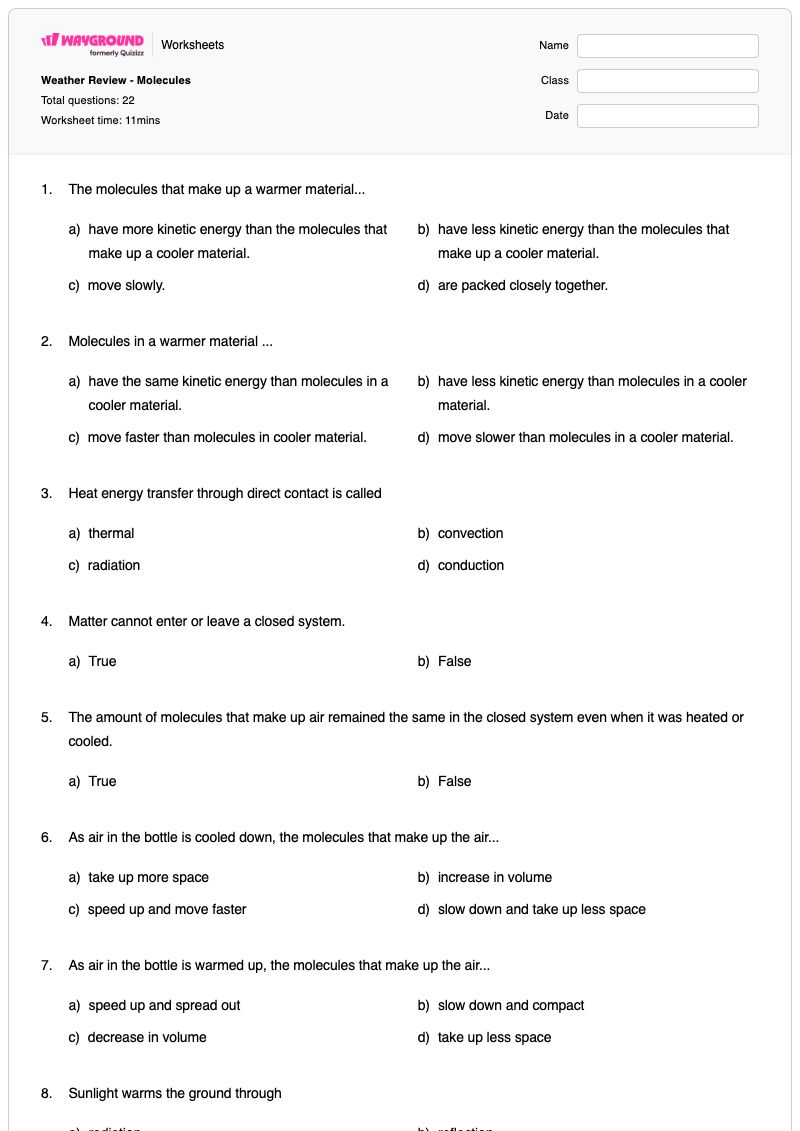
WaygroundWorksheets

Weather Review - Molecules

Total questions: 22

Name
Class
Date
1.

The molecules that make up a warmer material...

a)

have more kinetic energy than the molecules that make up a cooler material.

b)

have less kinetic energy than the molecules that make up a cooler material.

c)

move slowly.

d)

are packed closely together.

2.

Molecules in a warmer material ...

a)

have the same kinetic energy than molecules in a cooler material.

b)

have less kinetic energy than molecules in a cooler material.

c)

move faster than molecules in cooler material.

d)

move slower than molecules in a cooler material.

3.

Heat energy transfer through direct contact is called

a)

thermal

b)

convection

c)

radiation

d)

conduction

4.

Matter cannot enter or leave a closed system.

a)

True

b)

False

5.

The amount of molecules that make up air remained the same in the closed system even when it was heated or cooled.

a)

True

b)

False

6.

As air in the bottle is cooled down, the molecules that make up the air...

a)

take up more space

b)

increase in volume

c)

speed up and move faster

d)

slow down and take up less space

7.

As air in the bottle is warmed up, the molecules that make up the air...

a)

speed up and spread out

b)

slow down and compact

c)

decrease in volume

d)

take up less space

8.

Sunlight warms the ground through

a)

radiation

b)

reflection

c)

conduction

d)

temperature

9.

Less dense air rises.

a)

True

b)

False

10.

Heating the air makes the particles move faster and spread out, making it

a)

cooler

b)

more compact

c)

more dense

d)

less dense

11.

Thermal energy is transferred from the ground to the air right above it by

a)

thermal energy

b)

conduction

c)

radiation

d)

convection

12.

Precipitation is not

a)

rain

b)

snow

c)

hail

d)

lightning

13.

Wind speed is an example of a weather condition.

a)

True

b)

False

14.

Conditions on days when it hails could include.

a)

An increase in temperature, decrease in humidity and no wind.

b)

A lack of wind and decrease in humidity.

c)

A drop in temperature, increase in humidity, and increase in wind speed.

15.

Evidence

a)

Answers a question.

b)

Supports the claim.

c)

Explains why or how

d)

Can be observations.

16.

Heat transfers from the ground to the air above by radiation.

a)

True

b)

False

17.

The weather balloon data showed

a)

temperature increased as the altitude increased.

b)

temperature decreased as the altitude increased.

c)

it got warmer as the balloon went higher.

18.

Heat increases kinetic energy.

a)

True

b)

False

19.

When air molecules are cooled they

a)

become more dense and move closer together.

b)

become more dense and move further apart.

c)

become less dense and move further apart.

d)

become less dense and move close together.

20.

A claim

a)

provides supporting evidence.

b)

explains why or how something is true

c)

Starts with "I think"

d)

answers the question.

21.

What happens to the volume of air when it is heated?

a)

It increases

b)

It decreases

c)

It remains the same

d)

It becomes zero

22.

When air is cooled, the molecules that make up the air...

a)

move faster and spread out

b)

slow down and move closer together

c)

increase in volume

d)

take up more space

WaygroundAnswer Key

Weather Review - Molecules

Total questions: 22

1.
a)

have more kinetic energy than the molecules that make up a cooler material.

2.
c)

move faster than molecules in cooler material.

3.
d)

conduction

4.
a)

True

5.
a)

True

6.
d)

slow down and take up less space

7.
a)

speed up and spread out

8.
a)

radiation

9.
a)

True

10.
d)

less dense

11.
b)

conduction

12.
d)

lightning

13.
a)

True

14.
c)

A drop in temperature, increase in humidity, and increase in wind speed.

15.
b)

Supports the claim.

, d)

Can be observations.

16.
b)

False

17.
b)

temperature decreased as the altitude increased.

18.
a)

True

19.
a)

become more dense and move closer together.

20.
d)

answers the question.

21.
a)

It increases

22.
b)

slow down and move closer together

FAQs

What does the Weather Review - Molecules worksheet cover?

This Grade 6 science worksheet uses 21 multiple-choice questions and one multiple-select question to assess how molecular motion explains heating, cooling, air density, and weather. Students identify conduction, convection, and radiation; explain how air molecules change speed and spacing in a closed system; connect less dense air with rising air; and distinguish precipitation from other weather conditions. The final multiple-select item also asks students to identify evidence that supports a claim.

How can I use this worksheet to teach molecular motion and weather?

Use the worksheet after modeling that warmer molecules have greater kinetic energy, move faster, and spread out, while cooler molecules move more slowly and occupy less space. Have students explain the closed-bottle items with a particle sketch, then sort the examples of sunlight warming the ground, ground-to-air heating, and rising air by radiation, conduction, or convection. Finish by discussing how temperature, humidity, and wind conditions relate to hail and how evidence supports a scientific claim.

What mistakes should I watch for when students complete this worksheet?

Students may confuse temperature with molecular motion, select that warmer molecules move more slowly, or assume heating adds or removes molecules from the closed system. Watch for confusion among radiation from sunlight, conduction through direct contact, and convection associated with rising less dense air. Students may also classify lightning as precipitation or choose only one option in the final multiple-select question, even though both supporting a claim and being observations are correct.

How do I assign and grade this Weather Review - Molecules worksheet?

On Wayground, you can assign this worksheet as a printable PDF or use it as a digital quiz. It includes a complete answer key for the 21 multiple-choice items and the multiple-select evidence question, and printable student work can be graded by scanning it with the Wayground for Teachers app. The printable format can also support schools that are reducing screen time.

How can I differentiate this molecular motion and weather worksheet for my students?

In Advanced Settings, adjust font spacing and font size to make the question text and answer choices easier to read, or enable a dyslexia-friendly font for the molecular-motion and weather items. You can also translate the worksheet into another language so students can focus on interpreting concepts such as conduction, density, precipitation, and evidence rather than decoding unfamiliar language.

Where can I find more worksheets like this on Wayground?

Wayground offers a comprehensive collection of free printable worksheets and practice problems across all subjects, with downloadable PDFs and answer keys to help students master essential skills and concepts. Browse more resources at https://wayground.com/en-us/worksheets.