Blood and Blood Typing Quiz is a Grade 11 science worksheet that checks students’ understanding of blood components, blood typing, and transfusion compatibility. Through 13 multiple-choice questions and one multiple-select question, students identify the functions of red and white blood cells, platelets, plasma, hemoglobin, and leukocytes; recognize where red blood cells are produced; and connect the Rh factor with positive or negative blood types.
The worksheet also asks students to apply blood-type compatibility rules, identify antigens and antibodies, interpret serum clumping in blood-typing tests, and classify blood evidence as class evidence. It includes a blood-typing identification item and requires students to select all compatible donors for a patient with B+ blood, supporting both vocabulary recall and application of transfusion concepts. This free printable worksheet is designed for Grade 11 science instruction, review, or assessment and includes a complete answer key.
Worksheet settings
Font size
S
M
L
XL
Worksheets
Blood and Blood Typing Quiz
Total questions: 14
Name
Class
Date
1.
What blood type is the universal recipient?
a)
O+
b)
O-
c)
AB+
d)
AB-
2.
A patient with B+ blood needs a transfusion. Which of the following types can donate to the patient? Select all that apply.
a)
B-
b)
O+
c)
AB-
d)
O-
3.
Someone with Type A blood has...
a)
A antigens
b)
A antibodies
c)
B antigens
d)
A & B antigens
4.
This determines whether a person's blood type is positive or negative...
a)
Rh factor
b)
platelets
c)
D antibodies
d)
plasma
5.
The serum will __________ if the protein is present in the blood.
a)
Clump
b)
Not Clump
6.
Blood typing is less expensive and quicker for analyzing blood evidence than DNA profiling. Since many different people share the same type, this blood evidence is considered to be:
a)
trace evidence
b)
biological evidence
c)
individual evidence
d)
class evidence
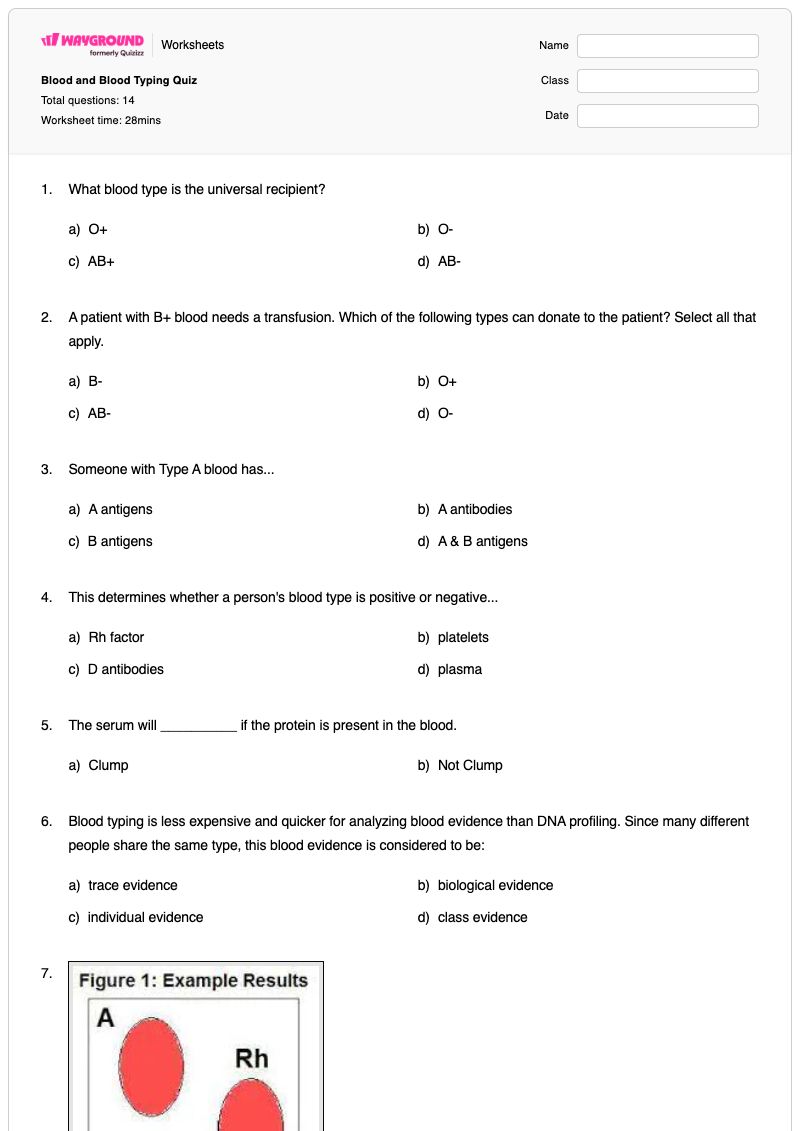
7.
What type of blood is shown here?
a)
A positive
b)
A negative
c)
B positive
d)
B negative
8.
These are found in blood and help the blood to clot...
a)
white blood cells
b)
platelets
c)
plasma
d)
red blood cells
9.
These are found in blood and help fight infections...
a)
white blood cells
b)
platelets
c)
plasma
d)
red blood cells
10.
What protein is found in red blood cells that binds to and transports oxygen?
a)
peptidoglycan
b)
iron
c)
hemoglobin
d)
plasma
11.
What is the main funtion of red blood cells
a)
transport oxygen
b)
fight infection
c)
clot blood
12.
What is the scientific name of white blood cells
a)
leukocytes
b)
erythrocytes
c)
lymphocytes
d)
fibrocytes
13.
Where are red blood cells produced?
a)
bone marrow
b)
from other red blood cells
c)
spleen
d)
liver
14.
____________ is a yellowish liquid portion of blood that contains electrolytes, nutrients, and vitamins, hormones, clotting factors, and proteins.
a)
Plasma
b)
White Blood Cells
c)
Red Blood Cells
d)
Platelets
Answer Key
Blood and Blood Typing Quiz
Total questions: 14
1.
c)
AB+
2.
a)
B-
, b)
O+
, d)
O-
3.
a)
A antigens
4.
a)
Rh factor
5.
a)
Clump
6.
d)
class evidence
7.
d)
B negative
8.
b)
platelets
9.
a)
white blood cells
10.
c)
hemoglobin
11.
a)
transport oxygen
12.
a)
leukocytes
13.
a)
bone marrow
14.
a)
Plasma
140 %
Browse by subjects
Browse by grades
Browse by format
FAQs
What does the Blood and Blood Typing Quiz cover?
This Grade 11 science worksheet covers blood components, blood-type identification, Rh factor, antigens and antibodies, serum agglutination, and transfusion compatibility. Its 13 multiple-choice and one multiple-select item require students to recall blood functions and apply compatibility rules, including selecting all donor types that can give blood to a B+ patient.
How can I use this worksheet to teach blood typing and blood components?
Introduce the blood components first by having students connect red blood cells with oxygen transport, white blood cells with infection defense, platelets with clotting, and plasma with the liquid portion of blood. Then model how antigens, antibodies, the Rh factor, and serum clumping identify blood types before students solve the compatibility and blood-typing questions. Ask students to explain why more than one donor choice may be correct in the B+ multiple-select item.
What mistakes should I watch for when students complete this blood-typing worksheet?
Watch for students confusing antigens with antibodies, or treating the Rh factor as a blood cell or blood component rather than the feature that determines positive or negative status. In the transfusion question, students may select only one compatible donor instead of all three correct choices, and in the serum item they may miss that clumping indicates the tested protein is present. Students may also confuse platelets, plasma, white blood cells, and red blood cells when matching each component to its function.
How do I assign and grade the Blood and Blood Typing Quiz?
The Blood and Blood Typing Quiz is available on Wayground as a printable PDF and as a digital quiz, with a complete answer key for all 14 questions. You can grade printable submissions by scanning student work with the Wayground for Teachers app, or review responses through the digital version. The printable option can also support classrooms that are reducing screen time.
How can I differentiate this blood-typing worksheet for my students?
Use the worksheet’s Advanced Settings to adjust font spacing and font size so the blood-component definitions, compatibility options, and blood-typing questions are easier to navigate. You can also apply a dyslexia-friendly font or translate the worksheet into another language when that better supports access to the science vocabulary.
Where can I find more worksheets like this on Wayground?
Wayground offers a comprehensive collection of free printable worksheets and practice problems across all subjects, with downloadable PDFs and answer keys to help students master essential skills and concepts. Browse more resources at https://wayground.com/en-us/worksheets.

 Worksheets