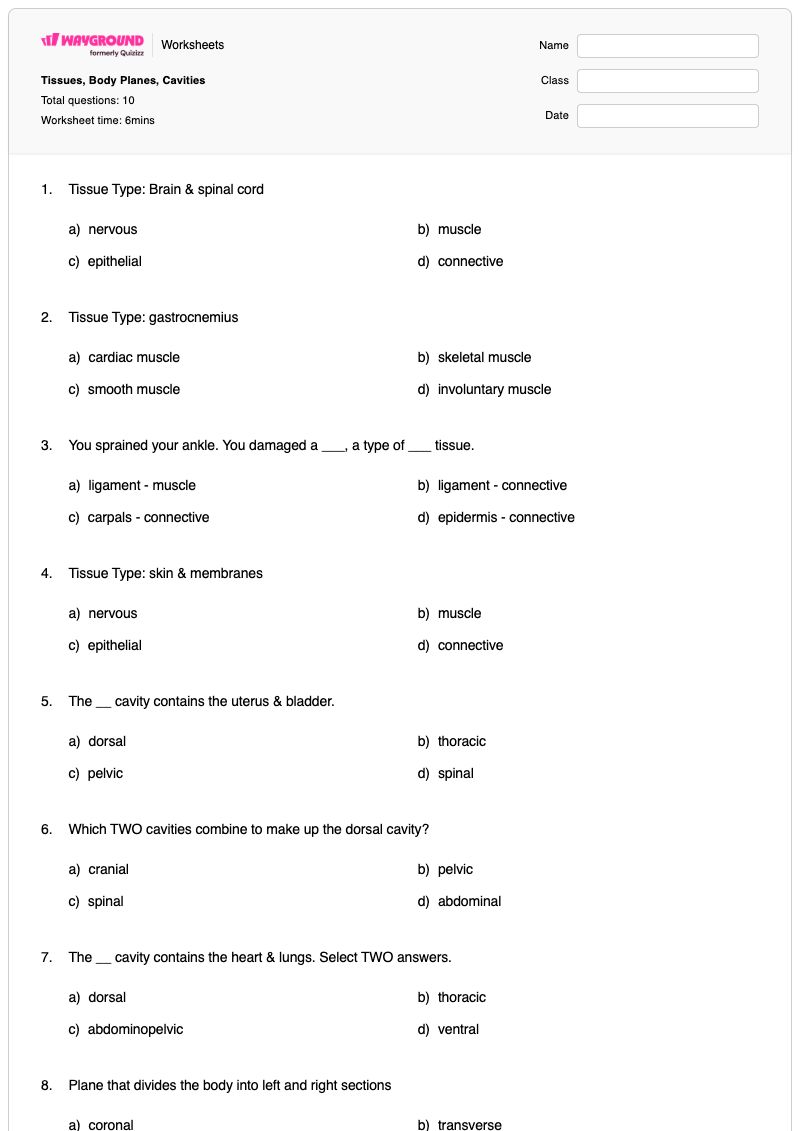
Tissues, Body Planes, Cavities is a free printable science worksheet for students in Grades 9–12. It uses 8 multiple-choice and 2 multiple-select questions to check understanding of three related anatomy concepts: identifying tissue types, locating organs within major body cavities, and naming the anatomical planes that divide the body. Students classify the brain and spinal cord, gastrocnemius, ligaments, and skin or membranes; identify pelvic, dorsal, thoracic, and ventral cavity relationships; and distinguish sagittal, transverse, and frontal planes.
The worksheet is useful for introducing or reviewing foundational human anatomy vocabulary before a unit assessment. Its multiple-select items require students to recognize that the dorsal cavity includes the cranial and spinal cavities and that the heart and lungs are in the thoracic and ventral cavities, while the multiple-choice items reinforce precise term selection. A complete answer key is included for efficient checking, and the worksheet is available as a free printable resource for classroom practice, homework, or review.
Worksheet settings
Font size
S
M
L
XL
Worksheets
Tissues, Body Planes, Cavities
Total questions: 10
Name
Class
Date
1.
Tissue Type: Brain & spinal cord
a)
nervous
b)
muscle
c)
epithelial
d)
connective
2.
Tissue Type: gastrocnemius
a)
cardiac muscle
b)
skeletal muscle
c)
smooth muscle
d)
involuntary muscle
3.
You sprained your ankle. You damaged a ___, a type of ___ tissue.
a)
ligament - muscle
b)
ligament - connective
c)
carpals - connective
d)
epidermis - connective
4.
Tissue Type: skin & membranes
a)
nervous
b)
muscle
c)
epithelial
d)
connective
5.
The __ cavity contains the uterus & bladder.
a)
dorsal
b)
thoracic
c)
pelvic
d)
spinal
6.
Which TWO cavities combine to make up the dorsal cavity?
a)
cranial
b)
pelvic
c)
spinal
d)
abdominal
7.
The __ cavity contains the heart & lungs. Select TWO answers.
a)
dorsal
b)
thoracic
c)
abdominopelvic
d)
ventral
8.
Plane that divides the body into left and right sections
a)
coronal
b)
transverse
c)
frontal
d)
sagittal
9.
Plane that divides the body into top and bottom sections
a)
coronal
b)
transverse
c)
frontal
d)
sagittal
10.
Plane that divides the body into front and back sections
a)
horizontal
b)
transverse
c)
frontal
d)
sagittal
Answer Key
Tissues, Body Planes, Cavities
Total questions: 10
1.
a)
nervous
2.
b)
skeletal muscle
3.
b)
ligament - connective
4.
c)
epithelial
5.
c)
pelvic
6.
c)
spinal
, a)
cranial
7.
d)
ventral
, b)
thoracic
8.
d)
sagittal
9.
b)
transverse
10.
c)
frontal
140 %
Browse by subjects
Browse by grades
Browse by format
FAQs
What does the Tissues, Body Planes, Cavities worksheet cover?
This Grade 9–12 science worksheet covers tissue classification, body-cavity organization, and anatomical planes through 8 multiple-choice and 2 multiple-select questions. Students identify nervous, skeletal muscle, connective, and epithelial tissues; match organs to cavities such as pelvic, dorsal, thoracic, and ventral; and distinguish sagittal, transverse, and frontal planes. The questions build accuracy with anatomy vocabulary while requiring students to select one or, when indicated, two correct relationships.
How can I use this worksheet to teach tissue types, body cavities, and anatomical planes?
Introduce the worksheet by reviewing the four tissue examples and asking students to explain why a ligament is connective tissue rather than muscle tissue. Then have students use a body diagram or class model to locate the uterus and bladder, heart and lungs, and the cranial and spinal regions before completing the cavity questions. Finish by modeling how sagittal, transverse, and frontal planes divide the body, using the worksheet’s left-right, top-bottom, and front-back descriptions as checks for understanding.
What mistakes should I watch for when students complete this anatomy worksheet?
Students may confuse the gastrocnemius with cardiac or smooth muscle, or mistake a sprained ankle’s ligament for a muscle or a bone. In the multiple-select items, watch for students choosing only one part of the dorsal cavity or overlooking that the thoracic cavity is within the ventral cavity. Students may also reverse sagittal, transverse, and frontal planes, especially when distinguishing left-right from top-bottom divisions.
How do I assign and grade this Tissues, Body Planes, Cavities worksheet?
Wayground provides this worksheet as both a printable PDF and a digital quiz, and it includes a complete answer key for all 10 questions. You can assign the digital version through Wayground or print the PDF for written practice; printable submissions can be graded by scanning student work with the Wayground for Teachers app. The printable format can also support classrooms that are reducing screen time.
How can I differentiate this worksheet for my students?
Use the worksheet’s Advanced Settings to adjust font spacing or increase the font size so the tissue, cavity, and body-plane choices are easier to read. You can also select a dyslexia-friendly font for the anatomy terms and translate the worksheet into another language when language access is needed. These options modify the worksheet file while preserving its multiple-choice and multiple-select format.
Where can I find more worksheets like this on Wayground?
Wayground offers a comprehensive collection of free printable worksheets and practice problems across subjects, with downloadable PDFs and answer keys to help students master essential skills and concepts. Browse more resources at https://wayground.com/en-us/worksheets.

 Worksheets