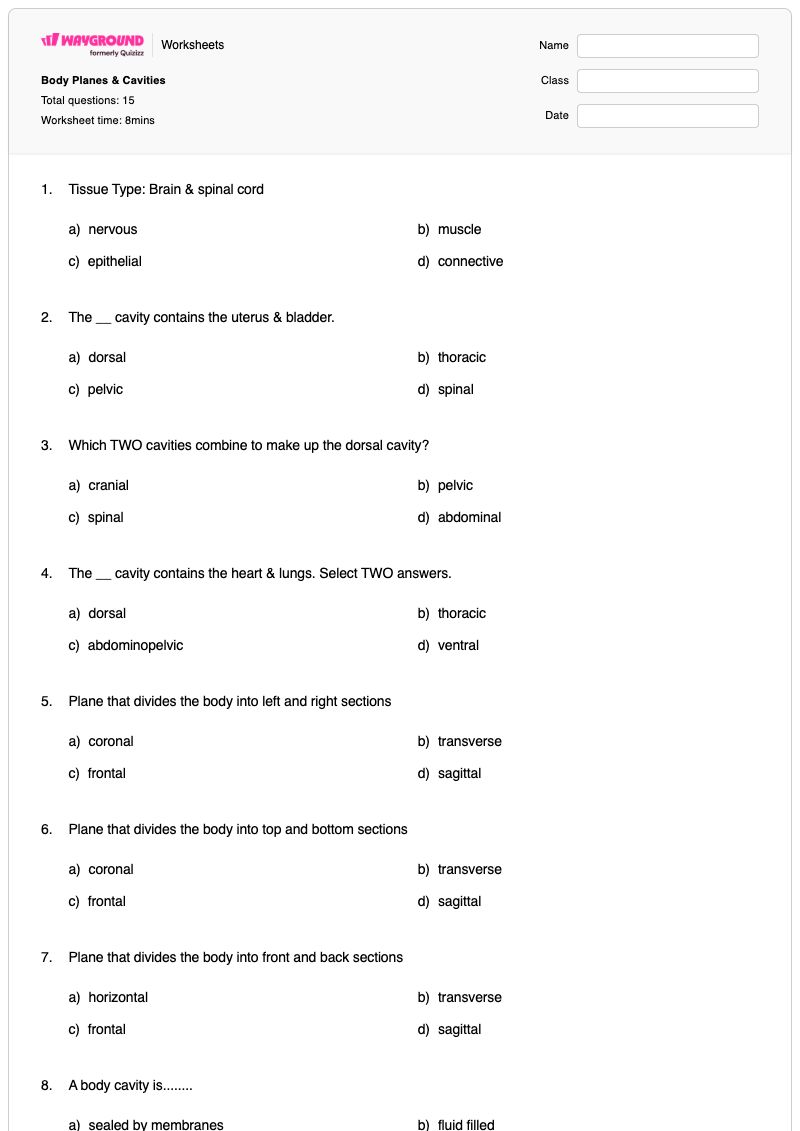
Body Planes & Cavities is a free printable worksheet for Grade 9–12 students in anatomy and other specialty courses. It uses 12 multiple-choice questions and 3 multiple-select questions to practice identifying sagittal, transverse, and frontal planes; locating organs in the cranial, spinal, thoracic, pelvic, abdominopelvic, dorsal, and ventral cavities; and recognizing key cavity characteristics. Students also identify the nervous tissue associated with the brain and spinal cord and the femoral body region.
The worksheet combines terminology recall with application: students match anatomical planes to the sections they create, determine which cavities contain specific organs, select the subdivisions of the dorsal cavity, and interpret labeled anatomy items. This format helps teachers check whether students can distinguish closely related anatomical terms and select all correct responses when more than one answer applies. The worksheet includes a complete answer key for efficient review, reteaching, or assessment.
Worksheet settings
Font size
S
M
L
XL
Worksheets
Body Planes & Cavities
Total questions: 15
Name
Class
Date
1.
Tissue Type: Brain & spinal cord
a)
nervous
b)
muscle
c)
epithelial
d)
connective
2.
The __ cavity contains the uterus & bladder.
a)
dorsal
b)
thoracic
c)
pelvic
d)
spinal
3.
Which TWO cavities combine to make up the dorsal cavity?
a)
cranial
b)
pelvic
c)
spinal
d)
abdominal
4.
The __ cavity contains the heart & lungs. Select TWO answers.
a)
dorsal
b)
thoracic
c)
abdominopelvic
d)
ventral
5.
Plane that divides the body into left and right sections
a)
coronal
b)
transverse
c)
frontal
d)
sagittal
6.
Plane that divides the body into top and bottom sections
a)
coronal
b)
transverse
c)
frontal
d)
sagittal
7.
Plane that divides the body into front and back sections
a)
horizontal
b)
transverse
c)
frontal
d)
sagittal
8.
A body cavity is........
a)
sealed by membranes
b)
fluid filled
c)
air filled
d)
a way to organize organs
9.
Name the plane
a)
coronal
b)
sagittal
c)
transverse
10.
Name the plane
a)
coronal
b)
sagittal
c)
transverse
11.
What is K?
a)
abdominal
b)
thoracic
c)
abdominopelvic
d)
ventral/anterior
12.
Name this body region:
a)
gluteal
b)
inguinal
c)
femoral
d)
pelvic
13.
The heart, lungs, and mediastinum are located in what body cavity?
a)
cranial
b)
spinal
c)
abdominopelvic
d)
thoracic
14.
Which anatomical plane divides the body into anterior and posterior
a)
frontal
b)
transverse
c)
sagittal
d)
midsagittal
15.
Which anatomical plane is the ONLY horizontal plane?
a)
sagittal
b)
transverse
c)
frontal
Answer Key
Body Planes & Cavities
Total questions: 15
1.
a)
nervous
2.
c)
pelvic
3.
c)
spinal
, a)
cranial
4.
d)
ventral
, b)
thoracic
5.
d)
sagittal
6.
b)
transverse
7.
c)
frontal
8.
a)
sealed by membranes
, b)
fluid filled
, d)
a way to organize organs
9.
b)
sagittal
10.
c)
transverse
11.
c)
abdominopelvic
12.
c)
femoral
13.
d)
thoracic
14.
a)
frontal
15.
b)
transverse
140 %
Browse by subjects
Browse by grades
Browse by format
FAQs
What does the Body Planes & Cavities worksheet cover?
This Grade 9–12 worksheet builds identification skills for sagittal, transverse, and frontal anatomical planes, along with the locations and subdivisions of major body cavities. Its 12 multiple-choice and 3 multiple-select questions ask students to connect planes with the body sections they create, identify cavities containing organs such as the heart, lungs, uterus, and bladder, and recognize related regions and tissue terminology.
How can I use this worksheet to teach anatomical planes and body cavities?
Introduce the three planes with a body model or diagram, then have students explain whether each plane separates left/right, top/bottom, or front/back sections before completing the plane-identification questions. Next, organize the cavity questions by hierarchy—cranial and spinal within dorsal, and thoracic and abdominopelvic within ventral—and ask students to justify why each listed organ belongs in its selected cavity. Use the multiple-select items for students to verbalize why every correct option fits.
What mistakes should I watch for when students complete this worksheet?
Students may confuse sagittal, transverse, and frontal planes, especially when recalling that transverse is the horizontal plane and frontal separates anterior from posterior. They may also select only one part of the dorsal cavity instead of both cranial and spinal, or confuse the thoracic cavity with the broader ventral cavity when locating the heart and lungs. Review the instruction on multiple-select questions as well, since several items require every correct choice rather than a single response.
How do I assign and grade this Body Planes & Cavities worksheet?
On Wayground, you can assign this worksheet as a printable PDF or as a digital quiz, and it includes a complete answer key for checking all 15 responses. For printable submissions, scan student work with the Wayground for Teachers app to streamline grading. The PDF option also supports instruction in settings where teachers want to reduce screen time.
How can I differentiate this worksheet for my students?
Use the worksheet’s Advanced Settings to increase font size or adjust font spacing when students need more room to read the anatomical-plane and body-cavity options. You can also enable a dyslexia-friendly font for the terminology-heavy questions or translate the worksheet into another language to support access to terms such as sagittal, thoracic, and abdominopelvic.
Where can I find more worksheets like this on Wayground?
Wayground offers a broad collection of free printable worksheets and practice problems across subjects, with downloadable PDFs and answer keys to help students master essential skills and concepts. Browse more resources at https://wayground.com/en-us/worksheets.


 Worksheets


