

Wayground
Fundamental Theorem of Calculus - Printable Mathematics Worksheets - Wayground

Fundamental Theorem of Calculus

18 questions

12th - 12th Grade

Mathematics

This Grade 12 mathematics worksheet provides 18 multiple-choice questions on applying the Fundamental Theorem of Calculus. Students connect derivatives, antiderivatives, and definite integrals to evaluate function values, determine net change, calculate average rates of change and average values, and interpret relationships shown in graphs. The questions also ask students to analyze where functions are increasing, concave down, or have points of inflection, and to identify absolute extrema using derivative information and graph behavior. This free printable worksheet is useful for calculus review, independent practice, or an assessment of students’ ability to select the correct theorem and interpret its result. A complete answer key is included for efficient checking and feedback.

Worksheet settings

Font size

S
M
L
XL
Worksheets

Fundamental Theorem of Calculus

Total questions: 18

Name
Class
Date
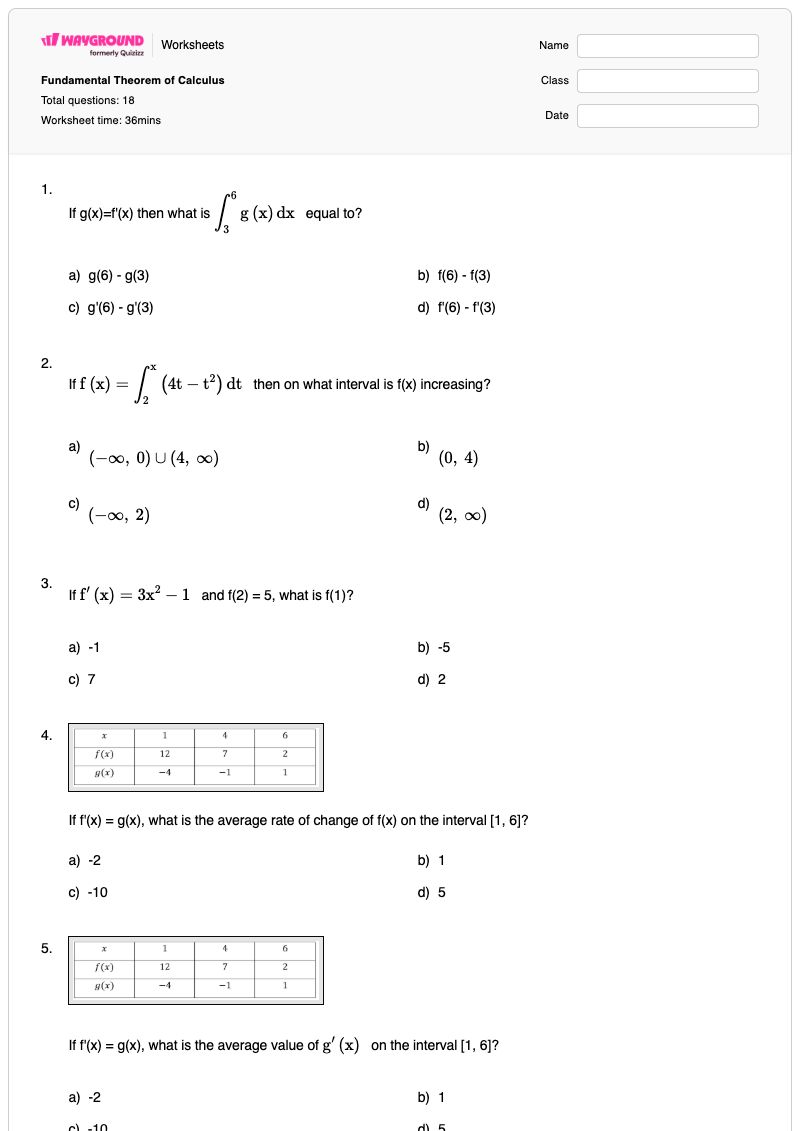
1.

If g(x)=f'(x) then what is ∫36g(x)dx\int_3^6g\left(x\right)dx   equal to?

a)

g(6) - g(3)

b)

f(6) - f(3)

c)

g'(6) - g'(3)

d)

f'(6) - f'(3)

2.

If f(x)=∫2x(4t−t2)dtf\left(x\right)=\int_2^x\left(4t-t^2\right)dt   then on what interval is f(x) increasing?

a)

(−∞, 0)∪(4, ∞)\left(-\infty,\ 0\right)\cup\left(4,\ \infty\right)  

b)

(0, 4)\left(0,\ 4\right)  

c)

(−∞, 2)\left(-\infty,\ 2\right)  

d)

(2, ∞)\left(2,\ \infty\right)  

3.

If f′(x)=3x2−1f'\left(x\right)=3x^2-1   and f(2) = 5, what is f(1)?

a)

-1

b)

-5

c)

7

d)

2

4.

If f'(x) = g(x), what is the average rate of change of f(x) on the interval [1, 6]?

a)

-2

b)

1

c)

-10

d)

5

5.

If f'(x) = g(x), what is the average value of g′(x)g'\left(x\right)   on the interval [1, 6]?

a)

-2

b)

1

c)

-10

d)

5

6.

If ∫412f′(x)dx=18\int_4^{12}f'\left(x\right)dx=18   then what is f(12)f\left(12\right)  ?

a)

11

b)

25

c)

30

d)

17

7.

If f(0)=0f\left(0\right)=0   and f′(x)f'\left(x\right)   is shown, what is f(12)?f\left(12\right)?  

a)

−6π-6\pi  

b)

−12π-12\pi  

c)

−20π-20\pi  

d)

−8π-8\pi  

8.

If g(x) is the antiderivative of f(x), which is graphed. If g(2) = 8, what is the absolute minimum of g(x) on [0,7]?

a)

4

b)

8

c)

11

d)

-1

9.

If y=∫3x2sin⁡(t)dty=\int_3^{x^2}\sin\left(t\right)dt   what is dydx?\frac{dy}{dx}?  

a)

−cos⁡(x2)⋅2x-\cos\left(x^2\right)\cdot2x  

b)

−cos⁡(x2)-\cos\left(x^2\right)  

c)

sin⁡(x2)⋅2x\sin\left(x^2\right)\cdot2x  

d)

sin⁡(x2)\sin\left(x^2\right)  

10.

Given that g'(x) = f(x) and f(x) is shown in the graph, on what interval is g(x) concave down?

a)

(4, 6)

b)

(5, 8)

c)

(5, 6)

d)

(6, 8)

11.

If g(x)=∫2x(3t2−12t)dtg\left(x\right)=\int_2^x\left(3t^2-12t\right)dt  , at what values of x does g(x)g\left(x\right)   have points of inflection?

a)

x = 0 and x = 4

b)

x = 2

c)

x = -2 and 2

d)

x = 0

12.

What is the average value of f(x)=3x2+3f\left(x\right)=3x^2+3   on the interval [0, 2]?

a)

7

b)

14

c)

7.5

d)

15

13.

If ∫28f(x)dx=9\int_2^8f\left(x\right)dx=9  , what is ∫82(f(x)−1)dx\int_8^2\left(f\left(x\right)-1\right)dx  ?

a)

8

b)

-8

c)

-3

d)

-15

14.

If ∫04f(x)dx=10\int_0^4f\left(x\right)dx=10  , what is ∫04(2⋅f(x)−x)dx\int_0^4\left(2\cdot f\left(x\right)-x\right)dx  

a)

12

b)

16

c)

4

d)

2

15.

If f(3)=10f\left(3\right)=10   and f′(x)=2x−1f'\left(x\right)=2x-1  , what is f(4)?f\left(4\right)?  

a)

16

b)

6

c)

17

d)

7

16.

If h(x)=∫2x(3t+2)dth\left(x\right)=\int_2^x\left(3t+2\right)dt  , what is the equation of the tangent to h(x)h\left(x\right)   at x = 4?

a)

y−22=5(x−4)y-22=5\left(x-4\right)  

b)

y−5=22(x−4)y-5=22\left(x-4\right)  

c)

y−14=5(x−4)y-14=5\left(x-4\right)  

d)

y−5=14(x−4)y-5=14\left(x-4\right)  

17.

If f(x)f\left(x\right)   is graphed to the right and g(x)g\left(x\right)   is the antiderivative of f(x)f\left(x\right)   then what is g′′(4)g''\left(4\right) ? 

a)

4

b)

2

c)

-4

d)

-2

18.

Evaluate the average value of y=2xy=2x   on the interval [2, 6].

a)

8

b)

32

c)

16

d)

2

Answer Key

Fundamental Theorem of Calculus

Total questions: 18

1.
b)

f(6) - f(3)

2.
b)

(0, 4)\left(0,\ 4\right)  

3.
a)

-1

4.
a)

-2

5.
b)

1

6.
b)

25

7.
a)

−6π-6\pi  

8.
a)

4

9.
c)

sin⁡(x2)⋅2x\sin\left(x^2\right)\cdot2x  

10.
a)

(4, 6)

11.
b)

x = 2

12.
a)

7

13.
c)

-3

14.
a)

12

15.
a)

16

16.
a)

y−22=5(x−4)y-22=5\left(x-4\right)  

17.
d)

-2

18.
a)

8

FAQs

What does this Fundamental Theorem of Calculus worksheet cover?

This Grade 12 worksheet uses 18 multiple-choice questions to assess how students apply the Fundamental Theorem of Calculus and related derivative and integral relationships. Students evaluate function values and net change, calculate average rates of change and average values, and use graphs or derivative information to identify increasing intervals, concavity, absolute minima, and points of inflection.

How can I use this worksheet to teach applications of the Fundamental Theorem of Calculus?

Introduce the worksheet after reviewing how a derivative and an antiderivative connect a function to its accumulated change. Have students explain whether each item requires net change, division by interval length for an average value or rate, or sign analysis from a graph before selecting an answer. Use the graph-based questions to prompt discussion about how the sign of a derivative indicates increasing behavior and how changes in that sign relate to extrema, concavity, and inflection points.

What mistakes should I watch for when students complete this calculus worksheet?

Students may confuse a function with its derivative or antiderivative, especially when the questions define relationships such as f'(x) = g(x). They may also calculate a definite integral correctly but forget to divide by the interval length when finding an average value, or misread graph intervals when identifying where a function is increasing, concave down, or at an absolute minimum. The multiple-choice distractors are useful for identifying these sign, notation, and interval errors.

How do I assign and grade this Fundamental Theorem of Calculus worksheet?

On Wayground, assign this worksheet as a printable PDF or as a digital quiz, depending on whether students will complete the 18 multiple-choice questions on paper or online. It includes a complete answer key, and printable submissions can be graded by scanning student work with the Wayground for Teachers app. The printable format also gives schools an option for reducing screen time during calculus practice.

How can I differentiate this calculus worksheet for my students?

Use the worksheet’s Advanced Settings to adjust font size or spacing so the notation, answer choices, and graph-based questions are easier to read. You can also apply a dyslexia-friendly font or translate the worksheet into another language when appropriate. These changes preserve the original multiple-choice practice with derivatives, integrals, and graph interpretation while creating a more accessible worksheet version.

Where can I find more worksheets like this on Wayground?

Wayground offers a broad collection of free printable worksheets and practice problems across subjects, with downloadable PDFs and answer keys to support mastery of essential skills and concepts. Browse more resources at https://wayground.com/en-us/worksheets.