

Wayground
World War 1-5th grade - Printable Social Studies Worksheets year 5 - Wayground

World War 1-5th grade

20 questions

5th - 5th Grade

Social Studies

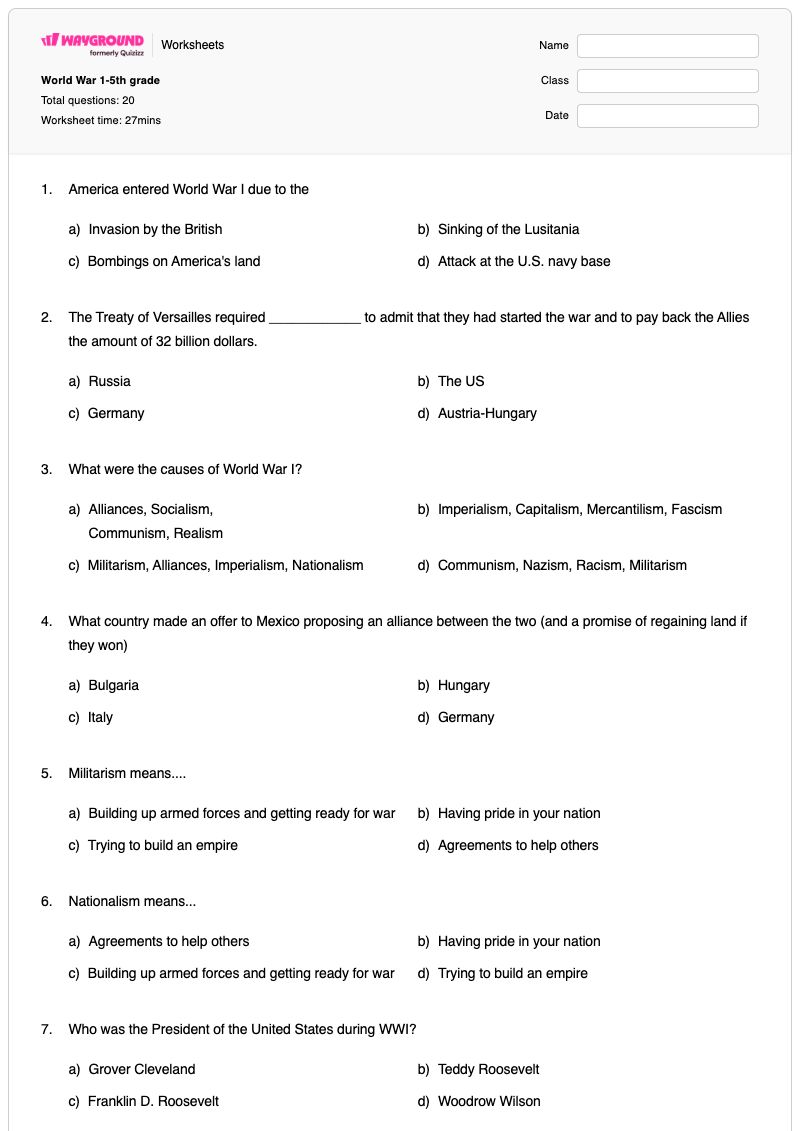
World War 1-5th grade is a free printable Social Studies worksheet for Grade 5 students. It uses 20 questions—17 multiple-choice and 3 multiple-select—to assess students’ understanding of the major causes, events, people, terms, and alliances connected to World War I. Students identify militarism, alliances, imperialism, and nationalism; connect the assassination of Franz Ferdinand and the sinking of the Lusitania to the war; and recognize the roles of Woodrow Wilson, Germany, Mexico, and the major powers. The worksheet also asks students to distinguish the Allied Powers from the Central Powers, define terms such as armistice and alliance, interpret why the United States initially remained neutral, and identify the meaning of the Zimmermann Telegram and Treaty of Versailles. The multiple-select items require students to evaluate several options rather than choose a single response, reinforcing careful reading and historical classification. A complete answer key is included for efficient review, grading, or independent practice.

Worksheet settings

Font size

S
M
L
XL
Worksheets

World War 1-5th grade

Total questions: 20

Name
Class
Date
1.

America entered World War I due to the

a)

Invasion by the British

b)

Sinking of the Lusitania

c)

Bombings on America's land

d)

Attack at the U.S. navy base

2.

The Treaty of Versailles required ____________ to admit that they had started the war and to pay back the Allies the amount of 32 billion dollars.

a)

Russia

b)

The US

c)

Germany

d)

Austria-Hungary

3.

What were the causes of World War I?

a)

Alliances, Socialism,

Communism, Realism

b)

Imperialism, Capitalism, Mercantilism, Fascism

c)

Militarism, Alliances, Imperialism, Nationalism

d)

Communism, Nazism, Racism, Militarism

4.

What country made an offer to Mexico proposing an alliance between the two (and a promise of regaining land if they won)

a)

Bulgaria

b)

Hungary

c)

Italy

d)

Germany

5.

Militarism means....

a)

Building up armed forces and getting ready for war

b)

Having pride in your nation

c)

Trying to build an empire

d)

Agreements to help others

6.

Nationalism means...

a)

Agreements to help others

b)

Having pride in your nation

c)

Building up armed forces and getting ready for war

d)

Trying to build an empire

7.

Who was the President of the United States during WWI?

a)

Grover Cleveland

b)

Teddy Roosevelt

c)

Franklin D. Roosevelt

d)

Woodrow Wilson

8.

Armistice means:

a)

Direct vote in which electors give their opinion

b)

Agreement to end fighting

c)

Living Space

d)

An act on behalf of the League of Nations

9.

Which is NOT true about the Zimmermann Telegram?

a)

Germany promised to help Mexico recover lost territory in the U.S.

b)

Germany sent it to Mexico

c)

Britain intercepted it and told the U.S. about it

d)

Mexico sent it to Germany

10.

Who was assassinated which led to the outbreak of WWI?

a)

Wilhelm II

b)

Franz Ferdinand

c)

Nicolas II

d)

George V

11.

Why did the US not enter the war in the beginning?

a)

Militarism

b)

Isolationism

c)

Nationalism

d)

Alliances

12.

Which countries were the Allied Powers? (Answer has multiple answers)

a)

Russia

b)

Great Britian

c)

USA

d)

Germany

13.

Who were the Central Powers? (Answer has multiple answers)

a)

Germany

b)

Austria-Hungary

c)

The Ottoman Empire

d)

USA

14.

What is an alliance?

a)

Being mean to each other

b)

Two countries fighting

c)

A formal agreement between two or more states for mutual support in case of war.

15.

Who had alliances? (Choose more than one answer)

a)

Germany and Bulgaria

b)

Germany and the US

c)

US and France

d)

Great Britian and Germany

16.

What year did the war begin?

a)

2020

b)

1912

c)

1914

d)

1900

17.

What year did the war end?

a)

1900

b)

2020

c)

1914

d)

1918

18.

What new technologies were discovered during the war?

(Choose more than one answer)

a)

Planes, trains, automobiles

b)

Grenades, tanks, chemical gases

c)

Gas mask, fighter planes, uboats

d)

Nothing was discovered

19.

Soldiers lived in trenches during the war.

a)

True

b)

Falso

20.

The Treaty of Versailles was signed on what date?

a)

December 4, 1975

b)

January 11, 1919

c)

June 28, 1918

d)

June 4, 1914

Answer Key

World War 1-5th grade

Total questions: 20

1.
b)

Sinking of the Lusitania

2.
c)

Germany

3.
c)

Militarism, Alliances, Imperialism, Nationalism

4.
d)

Germany

5.
a)

Building up armed forces and getting ready for war

6.
b)

Having pride in your nation

7.
d)

Woodrow Wilson

8.
b)

Agreement to end fighting

9.
d)

Mexico sent it to Germany

10.
b)

Franz Ferdinand

11.
b)

Isolationism

12.
a)

Russia

, b)

Great Britian

, c)

USA

13.
a)

Germany

, b)

Austria-Hungary

, c)

The Ottoman Empire

14.
c)

A formal agreement between two or more states for mutual support in case of war.

15.
a)

Germany and Bulgaria

, c)

US and France

16.
c)

1914

17.
d)

1918

18.
c)

Gas mask, fighter planes, uboats

19.
a)

True

20.
c)

June 28, 1918

FAQs

What does this World War I worksheet help Grade 5 students learn?

This Grade 5 Social Studies worksheet helps students identify the four listed causes of World War I—militarism, alliances, imperialism, and nationalism—and connect key events such as Franz Ferdinand’s assassination, the sinking of the Lusitania, and the Zimmermann Telegram to U.S. involvement. Its 17 multiple-choice and 3 multiple-select questions also require students to define terms, identify Woodrow Wilson, and classify the Allied and Central Powers.

How can I use this worksheet to teach the causes and major events of World War I?

Introduce the four causes and preteach the worksheet’s vocabulary—militarism, nationalism, alliance, and armistice—before students begin. After completion, have students explain how the assassination of Franz Ferdinand, the Lusitania, the Zimmermann Telegram, and U.S. isolationism relate to America’s decision to enter the war. Review the multiple-select items by asking students to justify each country they place in the Allied or Central Powers.

What mistakes should I watch for when students complete this World War I worksheet?

Students may confuse militarism, nationalism, imperialism, and alliances because the terms describe different causes of the war. Watch for students selecting only one country on the Allied Powers, Central Powers, or alliance questions, overlooking that these are multiple-select items. Students may also misread the Zimmermann Telegram question, which asks for the statement that is not true, or confuse the Lusitania with the attack that brought the United States into World War II.

How do I assign and grade this World War I worksheet?

You can assign this World War I worksheet as a printable PDF or as a digital quiz on Wayground. It includes a complete answer key for the 17 multiple-choice and 3 multiple-select questions, and printable submissions can be graded by scanning student work with the Wayground for Teachers app. The printable format also supports schools that are reducing screen time.

How can I differentiate this World War I worksheet for my students?

Use the worksheet’s Advanced Settings to adjust font spacing and font size so the historical vocabulary and answer choices are easier to read. You can also apply a dyslexia-friendly font or translate the worksheet into another language, helping students access the questions about World War I causes, terms, and alliances.

Where can I find more worksheets like this on Wayground?

Wayground offers a comprehensive collection of free printable worksheets and practice problems across subjects, with downloadable PDFs and answer keys to help students master essential skills and concepts. Browse more resources at https://wayground.com/en-us/worksheets.