

Wayground
Compromises over Slavery - Printable Social Studies Worksheets year 8 - Wayground

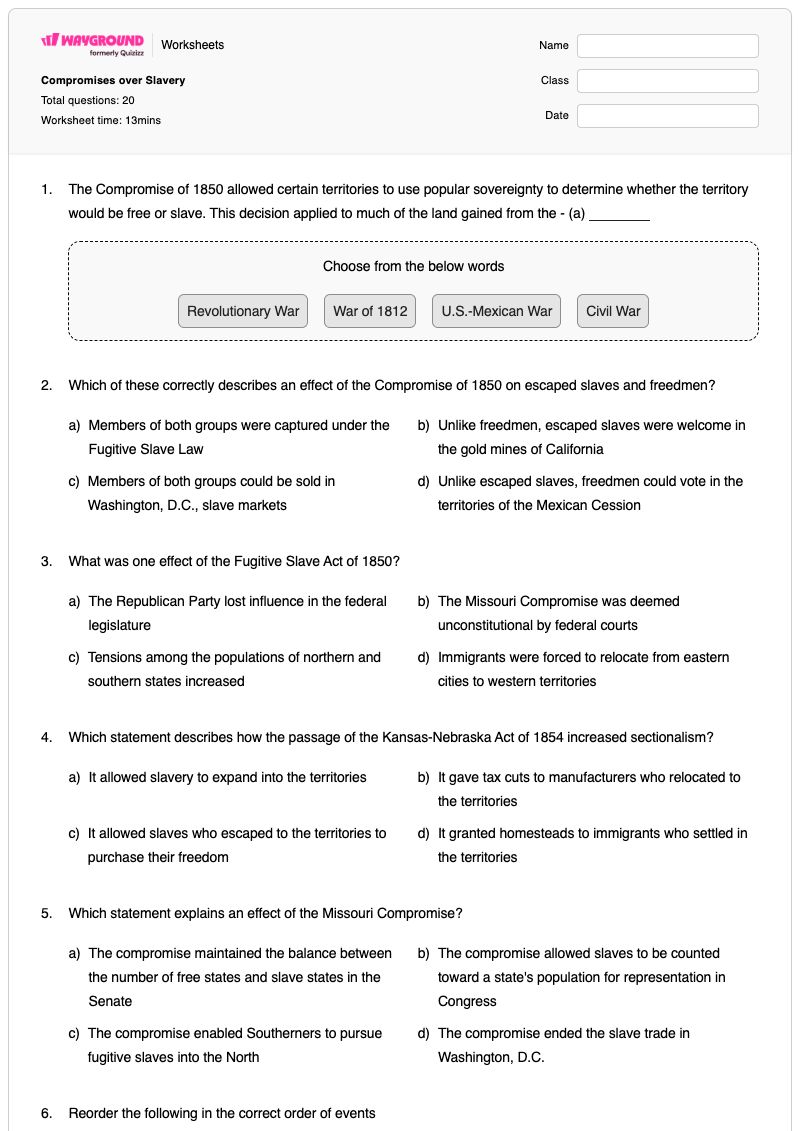
Compromises over Slavery

20 questions

8th - 8th Grade

Social Studies

Compromises over Slavery is a Grade 8 social studies worksheet that examines how the Missouri Compromise, Compromise of 1850, and Kansas-Nebraska Act addressed the expansion of slavery into western territories. Students identify the effects of each compromise, including sectional balance in the Senate, popular sovereignty, the Fugitive Slave Act, and increased tensions between Northern and Southern states. The 20-item worksheet uses dropdown questions, multiple-choice questions, and one ordering task. Students connect territorial expansion to the growing conflict over slavery, explain why Southern leaders sought influence in the Senate, and place the Missouri Compromise, Compromise of 1850, and Kansas-Nebraska Act in chronological order. It is designed for Grade 8 social studies instruction, review, or assessment. This free printable worksheet includes a complete answer key for efficient checking and feedback.

Worksheet settings

Font size

S
M
L
XL
Worksheets

Compromises over Slavery

Total questions: 20

Name
Class
Date
1.

The Compromise of 1850 allowed certain territories to use popular sovereignty to determine whether the territory would be free or slave. This decision applied to much of the land gained from the - (a)  

Choose from the below words
Revolutionary War
War of 1812
U.S.-Mexican War
Civil War
2.

Which of these correctly describes an effect of the Compromise of 1850 on escaped slaves and freedmen?

a)

Members of both groups were captured under the Fugitive Slave Law

b)

Unlike freedmen, escaped slaves were welcome in the gold mines of California

c)

Members of both groups could be sold in Washington, D.C., slave markets

d)

Unlike escaped slaves, freedmen could vote in the territories of the Mexican Cession

3.

What was one effect of the Fugitive Slave Act of 1850?

a)

The Republican Party lost influence in the federal legislature

b)

The Missouri Compromise was deemed unconstitutional by federal courts

c)

Tensions among the populations of northern and southern states increased

d)

Immigrants were forced to relocate from eastern cities to western territories

4.

Which statement describes how the passage of the Kansas-Nebraska Act of 1854 increased sectionalism?

a)

It allowed slavery to expand into the territories

b)

It gave tax cuts to manufacturers who relocated to the territories

c)

It allowed slaves who escaped to the territories to purchase their freedom

d)

It granted homesteads to immigrants who settled in the territories

5.

Which statement explains an effect of the Missouri Compromise?

a)

The compromise maintained the balance between the number of free states and slave states in the Senate

b)

The compromise allowed slaves to be counted toward a state's population for representation in Congress

c)

The compromise enabled Southerners to pursue fugitive slaves into the North

d)

The compromise ended the slave trade in Washington, D.C.

6.

Reorder the following in the correct order of events

a)

Missouri Compromise

b)

Compromise of 1850

c)

Kansas-Nebraska Act

1)
2)
3)
7.

How did the Missouri Compromise of 1820 end the crisis over representation in Congress?

a)

Slavery was allowed throughout the Louisiana Territory

b)

New territories delayed requests for statehood for ten years

c)

Two new states were admitted to maintain a sectional balance

d)

Popular sovereignty determined the issue of slavery in new states

8.

Which of these statements describes one effect of the Missouri Compromise?

a)

Slavery was prohibited in the Missouri territory

b)

The Union Army was put in charge of the Confederacy

c)

Power between slave states and free states was balanced in the Senate

d)

The United States was allowed to peacefully expand into the western frontier

9.

During the period 1820-1860, the major concerns in the United States dealt with issues related to ​ (a)  

Choose from the below words
determining the future of slavery
imposing immigration quotas
developing big business
acquiring an overseas empire
10.

In the period between 1820 and 1860, Southerners wanted slavery extended to the Western territories so that the South could

a)

continue to elect Southern Presidents

b)

continue to dominate the Supreme Court

c)

keep enough strength in the Senate to protect Southern interests

d)

use slave labor to expand Southern manufacturing

11.

Which issue is reflected in these headlines?

a)

enactment of protective tariffs

b)

extension of slavery

c)

voting rights for minorities

d)

universal public education

12.

Which problem did the Missouri Compromise, the Compromise of 1850, and the Kansas-Nebraska Act attempt to solve?

a)

extension of slavery into the western territories

b)

equitable distribution of frontier lands to the owners of small farms

c)

placement of protective tariffs on foreign imports

d)

need for international improvements in transportation

13.

As the United States acquired more land between 1803 and 1850, controversy over these territories focused on the

a)

need for schools and colleges

b)

failure to conserve natural resources

c)

expansion of slavery

d)

construction of transcontinental railroads

14.

Before the Civil War, slavery expanded in the South rather than in the North because

a)

the Constitution contained a clause that outlawed the importation of slaves into the Northern states

b)

Congress passed a law forbidding slavery in the North

c)

Northern states passed affirmative action legislation

d)

geographic conditions in the South encouraged the development of large plantations

15.

During the first half of the 19th century, territorial expansion led to

a)

increased tensions over slavery

b)

improved relations with bordering nations

c)

fewer conflicts with Native American Indians

d)

decreased domestic demand for manufactured goods

16.

Both the Missouri Compromise of 1820 and the Compromise of 1850 settled conflicts between the North and South over

a)

admission of states to the Union

b)

Supreme Court decisions

c)

presidential election results

d)

voting rights

17.

This poster from the 1850s appeared in response to the

a)

passage of the Fugitive Slave Law

b)

start of the Civil War

c)

issuance of the Emancipation Proclamation

d)

enactment of the 13th Amendment

18.

The Missouri Compromise (1820), the Compromise of 1850, and the Kansas-Nebraska Act (1854) were all efforts to

a)

end fighting between midwestern farmers and Native American Indians

b)

encourage manufacturing in the West

c)

increase the number of people who voted in presidential elections

d)

settle disputes over the spread of slavery to the western territories

19.

In the Compromise of 1850 and the Kansas-Nebraska Act of 1854, popular sovereignty was proposed as a way to

a)

allow northern states the power to ban slavery

b)

deny southern states the legal right to own slaves

c)

allow settlers in territories to vote on the issue of slavery

d)

overturn previous Supreme Court decisions on slavery

20.

Which term refers to the idea that settlers had the right to decide whether slavery would be legal in their territory?

a)

popular sovereignty

b)

nullification

c)

secession

d)

sectionalism

Answer Key

Compromises over Slavery

Total questions: 20

1.
U.S.-Mexican War
2.
a)

Members of both groups were captured under the Fugitive Slave Law

3.
c)

Tensions among the populations of northern and southern states increased

4.
a)

It allowed slavery to expand into the territories

5.
a)

The compromise maintained the balance between the number of free states and slave states in the Senate

6.
a, b, c
7.
c)

Two new states were admitted to maintain a sectional balance

8.
c)

Power between slave states and free states was balanced in the Senate

9.
determining the future of slavery
10.
c)

keep enough strength in the Senate to protect Southern interests

11.
b)

extension of slavery

12.
a)

extension of slavery into the western territories

13.
c)

expansion of slavery

14.
d)

geographic conditions in the South encouraged the development of large plantations

15.
a)

increased tensions over slavery

16.
a)

admission of states to the Union

17.
a)

passage of the Fugitive Slave Law

18.
d)

settle disputes over the spread of slavery to the western territories

19.
c)

allow settlers in territories to vote on the issue of slavery

20.
a)

popular sovereignty

FAQs

What does the Compromises over Slavery worksheet cover?

This Grade 8 social studies worksheet covers how the Missouri Compromise, Compromise of 1850, and Kansas-Nebraska Act responded to the expansion of slavery into western territories. Through 17 multiple-choice questions, two dropdown questions, and one ordering task, students identify each measure’s effects, explain sectional balance and popular sovereignty, and sequence the compromises chronologically.

How can I use this worksheet to teach the compromises over slavery?

Introduce the worksheet by creating a timeline from 1820 to 1854 and briefly defining sectionalism, popular sovereignty, and the balance between free and slave states in the Senate. Have students complete the multiple-choice and dropdown items after reviewing each compromise, then use the ordering item and questions about the Fugitive Slave Act to discuss how temporary solutions increased tensions rather than resolving the slavery issue.

What mistakes should I watch for when students complete this worksheet?

Students may confuse the Missouri Compromise’s role in maintaining Senate balance with the Compromise of 1850’s use of popular sovereignty, or treat the Kansas-Nebraska Act as reducing rather than expanding the possibility of slavery in the territories. They may also overlook that the Fugitive Slave Act increased tensions and confuse the chronological order of the three compromises. Review the wording of each item for the specific act, effect, and date being tested.

How do I assign and grade this Compromises over Slavery worksheet?

The worksheet is available as a printable PDF and as a digital quiz on Wayground, so you can choose paper or online completion for the 20 questions. It includes a complete answer key, and printable submissions can be graded by scanning student work with the Wayground for Teachers app. The printable option can also support schools that are reducing screen time.

How can I differentiate this worksheet for my students?

In the worksheet’s Advanced Settings, adjust font spacing or font size to make the multiple-choice, dropdown, and ordering items easier to read. You can also select a dyslexia-friendly font or translate the worksheet into another language, helping students access the questions while working with the same content about slavery-related compromises.

Where can I find more worksheets like this on Wayground?

Wayground offers a comprehensive collection of free printable worksheets and practice problems across subjects, with downloadable PDFs and answer keys to help students master essential skills and concepts. Browse more resources at https://wayground.com/en-us/worksheets.