
Wayground
Graph  Characteristics Practice - Printable Math Worksheets year 8 - Wayground

Graph Characteristics Practice

Brittany Gantt

Created by Brittany Gantt

20 questions

8th Grade

Math

Updated Oct 2026

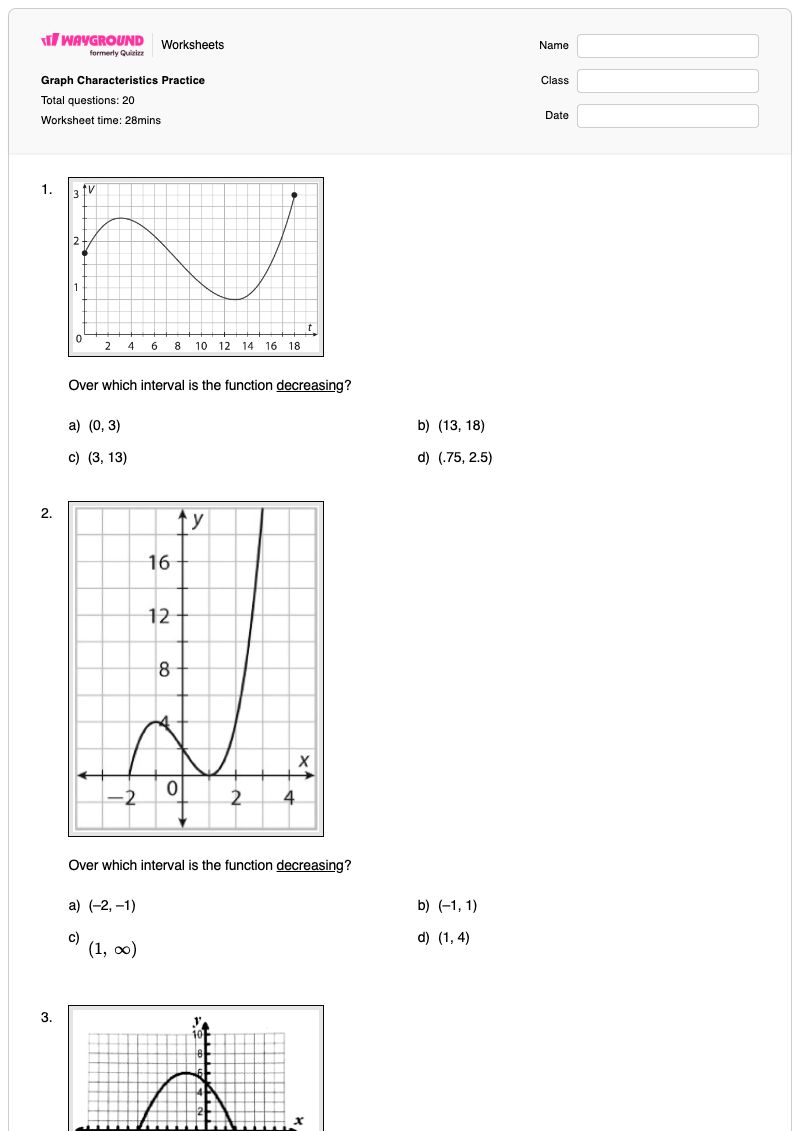
Graph Characteristics Practice is a Grade 8 mathematics worksheet that develops students’ ability to interpret key features of functions from their graphs. Across 20 questions—19 multiple choice and 1 multiple select—students identify increasing, decreasing, positive, and negative intervals; determine domain and range; locate x- and y-intercepts; and recognize lines of symmetry. The items require students to read graph behavior and express answers using interval notation and coordinate pairs. This free printable worksheet is useful for guided practice, independent review, or a formative check after introducing graph characteristics. Students must distinguish horizontal behavior from vertical values, select all applicable intervals in a multiple-select item, and connect graphical features to precise mathematical language. The worksheet includes a complete answer key, making it practical for Grade 8 instruction and assessment.

Worksheet settings

Font size

S
M
L
XL
WaygroundWorksheets

Graph Characteristics Practice

Total questions: 20

Name
Class
Date
1.
Over which interval is the function decreasing ?

Over which interval is the function decreasing?

a)

(0, 3)

b)

(13, 18)

c)

(3, 13)

d)

(.75, 2.5)

2.
Over which interval is the function decreasing ?

Over which interval is the function decreasing?

a)

(–2, –1)

b)

(–1, 1)

c)

(1, ∞)\left(1,\ \infty\right)

d)

(1, 4)

3.
What is the Domain?

What is the Domain?

a)

y ≥ 6

[6,infinity)

b)

-10 ≤ x ≤ 6

[-10,6]

c)

y≤ 6

(-infinity, 6]

d)

All real numbers

4.
What is the Range?

What is the Range?

a)

y ≥ 6

b)

y≤6y\le6  

c)

-10 ≤ y ≤ 6

d)

-10 ≤ x ≤ 6

5.
Does this graph have line symmetry? If so, name the line.

Does this graph have line symmetry? If so, name the line.

a)

no line symmetry

b)

yes, x=2

c)

yes, y=2

d)

yes, x=0

6.
Determine the domain and range of the function

Determine the domain and range of the function

a)

Domain: All real numbers

Range: All real numbers

b)

Domain: x ≥ -4

Range: All real numbers

c)

Domain: All real numbers

Range: y ≥ -4

d)

Domain: -1 ≤ x ≤ 5

Range: y ≥ -4

7.
Where does the function have a negative interval?

Where does the function have a negative interval?

a)

(−2,0)∪(−1,0)∪(1,0)\left(-2,0\right)\cup\left(-1,0\right)\cup\left(1,0\right)  

b)

(−∞,−2)∪(−1,1)\left(-\infty,-2\right)\cup\left(-1,1\right)  

c)

(−2,−1)∪(1,∞)\left(-2,-1\right)\cup\left(1,\infty\right)  

d)

(−2,−1)∪(−∞,1)\left(-2,-1\right)\cup\left(-\infty,1\right)  

8.
The interval (- ∞, 1) describes what interval?

The interval (-∞, 1) describes what interval?

a)

Negative Interval

b)

Increasing interval

c)

Positive Interval

d)

Decreasing Interval

9.
What is the positive interval of the function?

What is the positive interval of the function?

a)

(−9,−5)\left(-9,-5\right)  

b)

(−9,2)\left(-9,2\right)  

c)

(−5,2)\left(-5,2\right)  

d)

(3,0)\left(3,0\right)  

10.
When is this function increasing?
a)
−2.5 < x < 2.5
b)
0 < x < 5
c)
0 < x < 55
d)
−5 < x < 0
11.
What is the interval of increase and decrease in the following function.

What is the interval of increase and decrease in the following function.

a)

Decreasing at (5, 0) and (0, 2)

b)

Decreasing at (-5, -2) and (0, 2)

c)

Increasing at (2,∞)\left(2,\infty\right)

d)

Increasing at (2, 6)

e)

Increasing at (-2, 0) and (2,∞)\left(2,\infty\right)

12.
What is the increasing interval on the function shown?

What is the increasing interval on the function shown?

a)

(−∞, 1)\left(-\infty,\ 1\right)

b)

(−∞, 2)\left(-\infty,\ 2\right)

c)

(2, ∞)\left(2,\ \infty\right)

d)

(1, ∞)\left(1,\ \infty\right)

13.
What are the x- and y -intercepts on this graph?
a)
(0,5), (0,5)
b)
(5,0), (5,0)
c)
(5,0), (0,5)
d)
(0,0), (5,0)
14.
What is the y-intercept shown on the graph?
a)
(0, -2)
b)
(3, 0)
c)
(0, 3)
d)
None of these.
15.
Identify the line of symmetry if the graph has one.

Identify the line of symmetry if the graph has one.

a)

This graph does not have line symmetry.

b)

x=1

c)

y=1

16.
Best identify the point (4,-4)

Best identify the point (4,-4)

a)

relative minimum

b)

relative maximum

c)

absolute minimum

d)

absolute maximum

17.
True or False: This graph has an absolute minimum and an absolute maximum.

True or False: This graph has an absolute minimum and an absolute maximum.

a)

True

b)

False

18.
In the above graph complete the following end behavior: As x --> -∞, f(x) --> ____ As x --> +∞, f(x) --> ____
In the above graph complete the following end behavior:
As x --> -∞, f(x) --> ____
As x --> +∞, f(x) --> ____
a)
-∞
-∞
b)
+∞
-∞
c)
-∞
+∞
d)
+∞
+∞
19.
Describe the end behavior of the graph.
a)
x → ∞, y→ ∞ and
x→ ∞, y→⁻∞
b)
x → ∞, y→ ∞ and
x→⁻∞, y→∞
c)
None of these
d)
x →∞,y→⁻∞ and
x→∞, y→⁻∞
20.
Describe the end behavior of the graph.
a)
x → ∞, y→ ∞ and x→∞, y→⁻∞
b)
x → ∞, y→ ∞ and x→⁻∞, y→∞
c)
x → ∞, y→ ∞ and x→⁻∞, y→ 0
d)
x → ∞,y→ ∞and x→ ⁻∞, y→ ⁻∞
WaygroundAnswer Key

Graph Characteristics Practice

Total questions: 20

1.
c)

(3, 13)

2.
b)

(–1, 1)

3.
d)

All real numbers

4.
b)

y≤6y\le6  

5.
b)

yes, x=2

6.
c)

Domain: All real numbers

Range: y ≥ -4

7.
c)

(−2,−1)∪(1,∞)\left(-2,-1\right)\cup\left(1,\infty\right)  

8.
a)

Negative Interval

9.
a)

(−9,−5)\left(-9,-5\right)  

10.
a) −2.5 < x < 2.5
11.
b)

Decreasing at (-5, -2) and (0, 2)

, c)

Increasing at (2,∞)\left(2,\infty\right)

12.
b)

(−∞, 2)\left(-\infty,\ 2\right)

13.
c) (5,0), (0,5)
14.
c) (0, 3)
15.
b)

x=1

16.
c)

absolute minimum

17.
b)

False

18.
a) -∞
-∞
19.
b) x → ∞, y→ ∞ and
x→⁻∞, y→∞
20.
d) x → ∞,y→ ∞and x→ ⁻∞, y→ ⁻∞

FAQs

What does this Graph Characteristics Practice worksheet cover?

This Grade 8 worksheet uses 19 multiple-choice questions and 1 multiple-select question to practise reading function graphs. Students identify increasing, decreasing, positive, and negative intervals; determine domain and range; find x- and y-intercepts; and identify lines of symmetry using interval notation and coordinate pairs.

How can I use this worksheet to teach graph characteristics?

Have students first mark where each graph rises or falls from left to right, then connect those regions to increasing and decreasing intervals. Next, ask them to distinguish x-values for domain and interval behavior from y-values for range, and finish by checking intercept coordinates and possible symmetry lines before completing the multiple-select item.

What mistakes should I watch for when students complete this worksheet?

Students may reverse domain and range, report a y-value where an x-interval is required, or confuse positive and negative intervals with increasing and decreasing intervals. Also watch for reversed intercept coordinates, such as writing (0, 5) instead of (5, 0), and for selecting only one correct interval in the multiple-select question.

How do I assign and grade this Graph Characteristics Practice worksheet?

On Wayground, you can assign this worksheet as a printable PDF or as a digital quiz, and it includes a complete answer key for checking the interval, domain-and-range, intercept, and symmetry responses. Printable submissions can also be graded by scanning student work with the Wayground for Teachers app.

How can I differentiate this function-graph worksheet for my students?

Use the worksheet’s Advanced Settings to adjust font spacing or choose a larger font size so interval notation, coordinate pairs, and graph questions are easier to read. You can also enable a dyslexia-friendly font or translate the worksheet into another language when appropriate.

Where can I find more worksheets like this on Wayground?

Wayground offers a broad collection of free printable worksheets and practice problems across subjects, with downloadable PDFs and answer keys to support essential skills and concepts. Browse more resources at https://wayground.com/en-us/worksheets.