

Wayground
graphing in factored/intercept form - Printable Mathematics Worksheets year 12 - Wayground

graphing in factored/intercept form

22 questions

9th - 12th Grade

Mathematics

Graphing in Factored/Intercept Form is a Grade 9–12 mathematics worksheet that develops students’ ability to connect polynomial equations with their graphs. Across 22 items, students identify zeros and x-intercepts, interpret the multiplicity of a zero, determine degree and leading coefficient, describe end behavior, find y-intercepts, and select factored equations or graphs that match given features. The worksheet also includes ordering terms into standard form, identifying possible relative extrema, and completing polynomial-feature statements. The varied format—7 multiple-choice questions, 11 multiple-select questions, an ordering item, 2 fill-in-the-blank questions, and a dropdown item—requires students to recognize relationships rather than rely on one response method. It is designed for algebra students studying polynomial functions in factored, intercept, and standard forms. Use this free printable worksheet with an answer key for guided practice, independent work, review, or formative assessment of polynomial graph interpretation.

Worksheet settings

Font size

S
M
L
XL
Worksheets

graphing in factored/intercept form

Total questions: 22

Name
Class
Date
1.
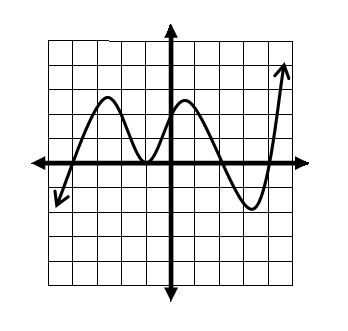
Which of the following could be the equation of this graph in factored form? (Careful-pay attention to multiplicity.)
a)
f(x) = (x-4)(x-1)2(x+2)(x+4)
b)
f(x) = (x-4)(x+1)2(x+2)(x+4)
c)
f(x) = (x-4)(x-1)2(x-2)(x+4)
d)
f(x) = (x+4)(x+1)2(x-2)(x-4)
2.
What does multiplicity of a zero mean?
a)
Look at the number of terms
b)
How many times the zero repeats
c)
Find the sum of all the coefficients
d)
Ratio your x and y
3.

Which statements are true about y=2(x-3)(x+1)2?

a)

3 is a zero of the function.

b)

The function will cross the x-axis at x = -1.

c)

As x gets larger the function increases.

d)

The function has a degree of 3.

e)

The function has an x-intercept at x = -3.

4.
Which of the following could be the factored form for the equation representing the graph shown?
a)
(x+3)(x-2)(x-5)
b)
(x-5)2(x-2)(x+3)
c)
(x-3)(x+2)(x+5)2
d)
none of these
5.

Which roots have even multiplicity?

a)

-3

b)

0

c)

2

d)

Cannot be determined

6.

Select all true statements:

g(x)=−(x−5)(x−4)2(x+1)(x+3)2g\left(x\right)=-\left(x-5\right)\left(x-4\right)^2\left(x+1\right)\left(x+3\right)^2

a)

The degree is 4.

b)

The roots are:

-5, -4, 1, 3

c)

The lead coefficient is negative.

d)

The end behaviors are both -∞.

e)

The y-intercept is (0,0)

7.

Identify the zeros.

a)

-2

b)

-1.25

c)

0

d)

0.6

e)

1

8.

Reorder the terms so they are in Standard Form:

y=−5+4x7−8x2+5x3−7x5y=-5+4x^7-8x^2+5x^3-7x^5

a)

+ 4x7+\ 4x^7

b)

−7x5-7x^5

c)

+ 5x3+\ 5x^3

d)

−8x2-8x^2

e)

−5-5

1)
2)
3)
4)
5)
9.

Describe the end behaviors of the polynomial.

a)

x→∞x\rightarrow\infty

h(x)→∞h\left(x\right)\rightarrow\infty

b)

x→∞x\rightarrow\infty

h(x)→−∞h\left(x\right)\rightarrow-\infty

c)

x→−∞x\rightarrow-\infty

h(x)→∞h\left(x\right)\rightarrow\infty

d)

x→−∞x\rightarrow-\infty

h(x)→−∞h\left(x\right)\rightarrow-\infty

e)

None of the above

10.

Describe the end behaviors of the polynomial.

a)

x→∞x\rightarrow\infty

y→∞y\rightarrow\infty

b)

x→∞x\rightarrow\infty

y→−∞y\rightarrow-\infty

c)

x→−∞x\rightarrow-\infty

y→∞y\rightarrow\infty

d)

x→−∞x\rightarrow-\infty

y→−∞y\rightarrow-\infty

e)

None of the above

11.

Determine the y-intercept: 

f(x) = x3 - 5x2 - 25x + 125

(a)  

12.

What is the highest amount of relative extrema the function can have?

d(x)=−3x7+4x5−10x2+22d\left(x\right)=-3x^7+4x^5-10x^2+22  

(a)  

13.

Select all true statements for:

f(x)=x3+4x2−9xf\left(x\right)=x^3+4x^2-9x  

a)

The lead coefficient is positive.

b)

The degree is even.

c)

There are 5 terms

d)

The constant term is 0.

e)

The y-int is (0,0)

14.

This polynomial can have ​ (a)   Turns At Most.

This polynomial's leading term is ​ (b)   .

Choose from the below words
2

x3x^3  

1
0
3

4x24x^2  

−9x-9x  

−36-36  

15.

Select the graph of the function:

f(x)=−3x3+7x2+x−9f\left(x\right)=-3x^3+7x^2+x-9  

a)
b)
c)
d)
e)

16.

Select all true statements about the graph.

a)

There are 2 relative minimums.

b)

The degree is even.

c)

The lead coefficient is positive.

d)

There are 5 roots.

e)

The degree can be 3.

17.

Identify the zeros.

a)

-2

b)

-1.25

c)

0

d)

0.6

e)

1

18.

Select all true statements:

g(x)=−(x−5)(x−4)2(x+1)(x+3)2g\left(x\right)=-\left(x-5\right)\left(x-4\right)^2\left(x+1\right)\left(x+3\right)^2

a)

The degree is 4.

b)

The roots are:

-5, -4, 1, 3

c)

The lead coefficient is negative.

d)

The end behaviors are both -∞.

e)

The y-intercept is (0,0)

19.

Which roots have even multiplicity?

a)

-3

b)

0

c)

2

d)

Cannot be determined

20.

Which of the following could be the equation of this graph in factored form?

a)

f(x) = (x-4)(x-1)2(x+2)(x+4)

b)

f(x) = (x-4)(x+1)2(x+2)(x+4)

c)

f(x) = (x-4)(x-1)2(x-2)(x+4)

d)

f(x) = (x+4)(x+1)2(x-2)(x-4)

21.

Select the graph of the function:

f(x)=−(x+2)(x+1)2(x−1)(x−2)2f\left(x\right)=-\left(x+2\right)\left(x+1\right)^2\left(x-1\right)\left(x-2\right)^2  

a)
b)
c)
d)
e)
22.

f(x)=(x+4)(x-3)(x-2)

List the zeros for this function.

a)

x= -4, x=3, x= -2

b)

x= -4, x=3, x=2

c)

x= -4, x=-3, x=2

d)

x=4, x= -3, x= -2

Answer Key

graphing in factored/intercept form

Total questions: 22

1.
d) f(x) = (x+4)(x+1)2(x-2)(x-4)
2.
b) How many times the zero repeats
3.
a)

3 is a zero of the function.

, c)

As x gets larger the function increases.

, d)

The function has a degree of 3.

4.
b) (x-5)2(x-2)(x+3)
5.
a)

-3

, c)

2

6.
c)

The lead coefficient is negative.

, d)

The end behaviors are both -∞.

7.
a)

-2

, c)

0

, e)

1

8.
a, b, c, d, e
9.
a)

x→∞x\rightarrow\infty

h(x)→∞h\left(x\right)\rightarrow\infty

, d)

x→−∞x\rightarrow-\infty

h(x)→−∞h\left(x\right)\rightarrow-\infty

10.
b)

x→∞x\rightarrow\infty

y→−∞y\rightarrow-\infty

, d)

x→−∞x\rightarrow-\infty

y→−∞y\rightarrow-\infty

11.
125, (0,125), y=125
12.
6, six
13.
a)

The lead coefficient is positive.

, d)

The constant term is 0.

, e)

The y-int is (0,0)

14.
2,

x3x^3  

15.
d)
16.
a)

There are 2 relative minimums.

, c)

The lead coefficient is positive.

, d)

There are 5 roots.

17.
a)

-2

, c)

0

, e)

1

18.
c)

The lead coefficient is negative.

, d)

The end behaviors are both -∞.

19.
a)

-3

, c)

2

20.
d)

f(x) = (x+4)(x+1)2(x-2)(x-4)

21.
c)
22.
b)

x= -4, x=3, x=2

FAQs

What does this graphing in factored/intercept form worksheet cover?

This worksheet helps students connect polynomial graphs with factored equations by identifying zeros, x-intercepts, and the multiplicity of roots. Its 22 questions also ask students to determine degree, leading coefficient, end behavior, y-intercepts, relative extrema, standard form, and matching graphs or equations through multiple-choice, multiple-select, ordering, fill-in-the-blank, and dropdown items.

How can I use this worksheet to teach graphing in factored or intercept form?

Introduce the worksheet by modeling how each factor, such as (x − r), identifies a zero and how an exponent reveals its multiplicity and behavior at the x-axis. Then have students annotate a few graph-and-equation examples for zeros, degree, leading coefficient, and end behavior before completing the multiple-select items independently. Use the graph-selection and factored-equation questions for discussion, asking students to justify each choice with specific polynomial features.

What mistakes should I watch for when students complete this polynomial graphing worksheet?

Watch for students reading a zero incorrectly from a factor, treating an even-multiplicity root as a crossing point, or confusing a root with the y-intercept. Students may also select every statement that seems familiar instead of checking all conditions, misread end behavior from the degree and leading coefficient, or give only the y-value instead of the coordinate when finding a y-intercept. In the ordering item, check that students distinguish standard form from factored form.

How do I assign and grade this worksheet?

This graphing in factored/intercept form worksheet is available as a printable PDF and as a digital quiz on Wayground, with a complete answer key for all 22 items. Assign the PDF for written practice or use the digital version for online responses and grading; printable submissions can also be graded by scanning student work with the Wayground for Teachers app. The printable option can support classrooms that are reducing screen time.

How can I differentiate this polynomial graphing worksheet for my students?

Use the worksheet’s Advanced Settings to adjust font spacing or choose a larger font size so students can more easily read the factored equations, graph labels, and multiple-select choices. You can also enable a dyslexia-friendly font or translate the worksheet into another language when appropriate. These options can make the graph-analysis and polynomial-feature items easier to access without changing the concepts assessed.

Where can I find more worksheets like this on Wayground?

Wayground offers a comprehensive collection of free printable worksheets and practice problems across all subjects, with downloadable PDFs and answer keys to support mastery of essential skills and concepts. Browse more resources at https://wayground.com/en-us/worksheets.