

Wayground
Physical/Chemical Properties and Changes - Printable Science Worksheets year 4 - Wayground

Physical/Chemical Properties and Changes

13 questions

4th - 4th Grade

Science

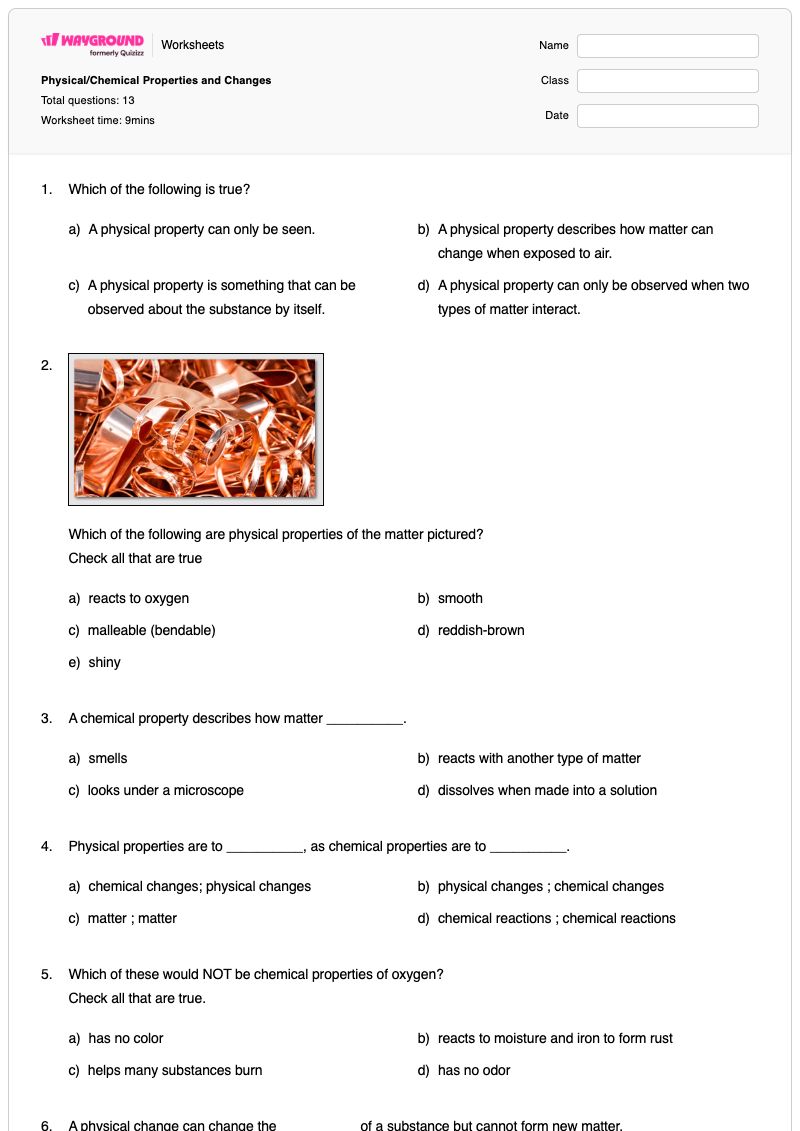
This Grade 4 science worksheet helps students distinguish physical properties from chemical properties and classify physical and chemical changes. Across 13 questions—9 multiple-choice and 4 multiple-select—students identify observable properties such as color, texture, shine, and malleability; recognize that chemical properties describe how matter reacts with other matter; and connect physical properties to physical changes and chemical properties to chemical changes. Students also apply these ideas to melting butter, mixtures, solutions, evaporation, fireworks, rusting, cooking, and burning. The questions reinforce that physical changes may alter a substance’s state, size, color, or shape without creating new matter, while chemical changes can create new matter. This free printable worksheet is designed for Grade 4 science instruction, independent practice, review, or assessment, and includes a complete answer key for efficient checking.

Worksheet settings

Font size

S
M
L
XL
Worksheets

Physical/Chemical Properties and Changes

Total questions: 13

Name
Class
Date
1.

Which of the following is true?

a)

A physical property can only be seen.

b)

A physical property describes how matter can change when exposed to air.

c)

A physical property is something that can be observed about the substance by itself.

d)

A physical property can only be observed when two types of matter interact.

2.

Which of the following are physical properties of the matter pictured?

Check all that are true

a)

reacts to oxygen

b)

smooth

c)

malleable (bendable)

d)

reddish-brown

e)

shiny

3.

A chemical property describes how matter __________.

a)

smells

b)

reacts with another type of matter

c)

looks under a microscope

d)

dissolves when made into a solution

4.

Physical properties are to __________, as chemical properties are to __________.

a)

chemical changes; physical changes

b)

physical changes ; chemical changes

c)

matter ; matter

d)

chemical reactions ; chemical reactions

5.

Which of these would NOT be chemical properties of oxygen?

Check all that are true.

a)

has no color

b)

reacts to moisture and iron to form rust

c)

helps many substances burn

d)

has no odor

6.

A physical change can change the __________ of a substance but cannot form new matter.

Check all that are true.

a)

state

b)

size

c)

color

d)

shape

7.

Which statement best describes what is happening in the images?

a)

a physical change

b)

a chemical change

c)

both a physical and a chemical change

d)

dissolving

8.

Jack leaves solid butter near a warm surface. When Jack returns, the butter has turned into a liquid. Jack's friend Elijah insists this is a chemical change. Is Elijah right?

a)

no, because no new matter was formed

b)

yes, because the matter changed states

c)

no, because the butter didn’t have enough time to go through a chemical change

d)

yes, because melted butter is a new type of matter

9.

Imagine the substances below are combined. None of them dissolve and no new matter is created. What happened?

a)

A physical change that is a solution.

b)

A physical change that is a mixture.

c)

A chemical change that is a mixture.

d)

A chemical change that is a solution.

10.

When combined, the powder and water create a solution because the powder dissolves evenly into the water. This is an example of a __________. If the water were evaporated from the solution, the powder would __________.

a)

physical change ; have disappeared

b)

physical change ; remain

c)

chemical change ; be a new matter

d)

chemical change ; remain

11.

Fireworks can be many different colors. The color depends on the mix of chemicals inside the fireworks. When the different chemicals ignite, they each produce different colors. Which of the following is true about fireworks?

a)

The fireworks’ color is caused by matter dissolving.

b)

A chemical change causes the fireworks’ color.

c)

Neither a physical nor a chemical change causes the fireworks’ color.

d)

A physical change causes the fireworks’ color.

12.

Which of these are most likely to cause a chemical change?

Check all that are true.

a)

folding

b)

rusting

c)

cooking

d)

burning

13.

True or false?

Clues like color change, bubbles, and odors guarantee a chemical change has occurred.

a)

False, these are all clues to only physical changes.

b)

True, all are signs that a chemical change has definitely occurred.

c)

False, some of these clues can be either physical or chemical changes.

d)

False, no clues to chemical changes exist.

Answer Key

Physical/Chemical Properties and Changes

Total questions: 13

1.
c)

A physical property is something that can be observed about the substance by itself.

2.
b)

smooth

, c)

malleable (bendable)

, d)

reddish-brown

, e)

shiny

3.
b)

reacts with another type of matter

4.
b)

physical changes ; chemical changes

5.
a)

has no color

, d)

has no odor

6.
a)

state

, b)

size

, c)

color

, d)

shape

7.
a)

a physical change

8.
a)

no, because no new matter was formed

9.
b)

A physical change that is a mixture.

10.
b)

physical change ; remain

11.
b)

A chemical change causes the fireworks’ color.

12.
b)

rusting

, c)

cooking

, d)

burning

13.
c)

False, some of these clues can be either physical or chemical changes.

FAQs

What does this worksheet cover about physical and chemical properties and changes?

This Grade 4 science worksheet uses 9 multiple-choice and 4 multiple-select questions to distinguish physical properties, chemical properties, physical changes, and chemical changes. Students apply the distinctions to examples such as melting butter, mixtures and solutions, fireworks, rusting, cooking, and burning, while evaluating whether observations indicate that new matter formed.

How can I use this worksheet to teach physical and chemical changes?

Introduce the worksheet by having students sort examples into properties, physical changes, and chemical changes before they work independently. Use the butter-melting, mixture-and-solution, and fireworks scenarios as discussion prompts, asking students whether the substance changed state or whether a reaction created new matter. Review the multiple-select items together so students explain why each selected characteristic or example belongs in its category.

What mistakes should I watch for when students complete this worksheet?

Students may confuse a physical property, which can be observed about a substance by itself, with a chemical property, which describes how it reacts with another type of matter. They may also treat melting, dissolving, or forming a mixture as chemical changes, or select only one answer on multiple-select questions. Remind students that color, bubbles, and odors are clues but do not guarantee that a chemical change occurred.

How do I assign and grade this physical and chemical properties worksheet?

On Wayground, you can assign this worksheet as a digital quiz or download it as a printable PDF for students to complete on paper. It includes a complete answer key, and printable submissions can be graded by scanning student work with the Wayground for Teachers app. The PDF option can also support classrooms that are reducing screen time.

How can I differentiate this worksheet for my students?

Use the worksheet’s Advanced Settings to adjust font spacing and font size so the property-and-change questions and multi-select options are easier to read. You can also apply a dyslexia-friendly font or translate the worksheet into another language when that better supports access to the science vocabulary and scenarios.

Where can I find more worksheets like this on Wayground?

Wayground offers a comprehensive collection of free printable worksheets and practice problems across subjects, with downloadable PDFs and answer keys to help students master essential skills and concepts. Browse more resources at https://wayground.com/en-us/worksheets.