

Wayground
War of 1812 Test - Printable Social Studies Worksheets year 7 - Wayground

War of 1812 Test

23 questions

7th - 7th Grade

Social Studies

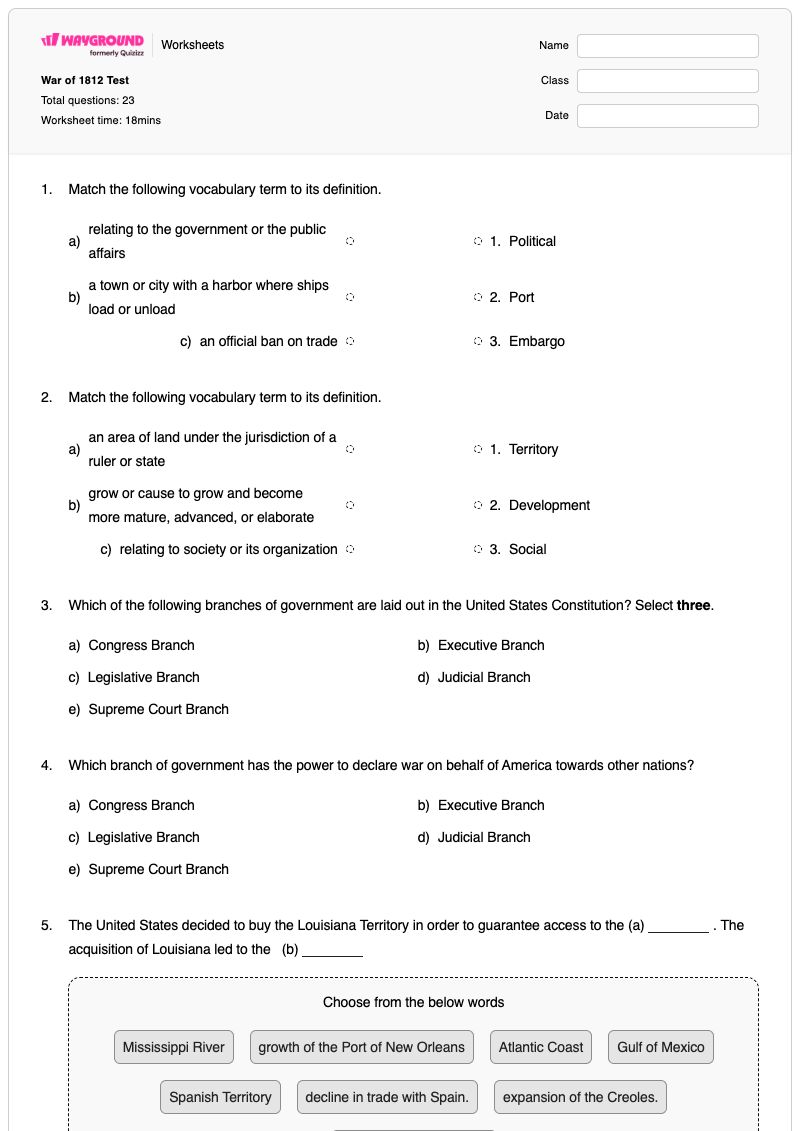
War of 1812 Test is a Grade 7 social studies worksheet that reviews the political, geographic, and historical factors surrounding the War of 1812. Students connect vocabulary terms to definitions, identify the constitutional branches involved in government decisions, examine the Louisiana Territory and Neutral Strip, and interpret how territorial changes affected groups including Creoles, enslaved people, and Native Americans. The worksheet also addresses causes of the war, the Battle of Fort McHenry, the Star-Spangled Banner, and Native American involvement. The 23-item assessment uses matching, multiple-select, multiple-choice, dropdown, and hotspot questions. These varied formats ask students to recall key terms, select all relevant evidence, complete relationships between events and outcomes, and identify a location on a historical map. Designed for Grade 7 social studies review or assessment, this free printable worksheet includes a complete answer key for efficient checking and feedback.

Worksheet settings

Font size

S
M
L
XL
Worksheets

War of 1812 Test

Total questions: 23

Name
Class
Date
1.

Match the following vocabulary term to its definition. 

relating to the government or the public affairs

Political

a town or city with a harbor where ships load or unload 

Port

an official ban on trade

Embargo

2.

Match the following vocabulary term to its definition. 

an area of land under the jurisdiction of a ruler or state

Territory

grow or cause to grow and become more mature, advanced, or elaborate

Development

relating to society or its organization

Social

3.

Which of the following branches of government are laid out in the United States Constitution? Select three.

a)

Congress Branch

b)

Executive Branch

c)

Legislative Branch

d)

Judicial Branch

e)

Supreme Court Branch

4.

Which branch of government has the power to declare war on behalf of America towards other nations?

a)

Congress Branch

b)

Executive Branch

c)

Legislative Branch

d)

Judicial Branch

e)

Supreme Court Branch

5.

The United States decided to buy the Louisiana Territory in order to guarantee access to the​ (a)   . The acquisition of Louisiana led to the ​ ​ (b)  

Choose from the below words
Mississippi River
growth of the Port of New Orleans
Atlantic Coast
Gulf of Mexico
Spanish Territory
decline in trade with Spain.
expansion of the Creoles.
invention of steamboats.
6.

The map shows the Territory of Orleans, part of the Louisiana Territory, from 1804 - 1812.

Select the area that best represents the Neutral Strip between Spanish territory and the territory of the United States.

7.

Why did Spain and the United States establish the Neutral Strip? 

a)

splitting land resources between both countries

b)

making a trade route between them

c)

to form a military alliance against a shared enemy

d)

settling border disagreements and keeping peace

8.

Select the two correct statements that describe the process of Louisiana becoming a state.

a)

The state's population grew

b)

The Neutral Strip was annexed by the Spanish

c)

The state created its first constitution

d)

The steamboat boosted river trade

e)

The port was blockaded by the Germans

9.

How did the United States owning the Louisiana Territory impact the Creoles?

a)

Creoles started the West Florida Republic.

b)

Creoles had less say in politics.

c)

Creoles rebelled against the government.

d)

Creoles were kicked out of the state.

10.

How did the United States owning the Louisiana Territory impact the enslaved people?

a)

Enslaved people tried to set themselves free.

b)

Enslaved people created the Neutral Strip.

c)

Enslaved people ran away to Haiti.

d)

Enslaved people asked for more rights.

11.

What were the reasons that led to the United States to declare war on Great Britain in 1812? Choose the two correct answers.

a)

Britain attacked the United States using airplanes

b)

Britain took land on the other side of the Mississippi River

c)

Britain forced American sailors to join its navy

d)

Britain messed with the United States buying Louisiana

e)

Britain broke the United States' rule of staying neutral

12.

What problem with Native Americans contributed to the outbreak of the War of 1812?

a)

Native Nations attacked Americans because the British supported them.

b)

Native Nations battled each other to trade with the United States.

c)

Native Nations moved to U.S. west of the Mississippi River.

d)

Native Nations formed trade relationships with the Spanish and Germans.

13.

What resulted from the Battle of Fort McHenry?

a)

A new American flag was made because of the battle.

b)

The battle didn't make people think the war should go on

c)

The battle inspired the creation of the Star-Spangled Banner.

d)

The battle led the British to give up fighting in the War of 1812.

14.

How did the Star Spangled Banner boost American patriotism among the citizens?

a)

It was a celebration over the U.S. expansion of British Canada in the northeast. 

b)

The Federalists party disappeared because they wouldn't sing the song

c)


The Loyalists from the Revolution saw the poem as their oath to Great Britain

d)

The poem showed that America was strong and beat the British again

15.

What part did Native Americans play in the War of 1812?

a)

Native Americans fought each other

b)

Native Americans sold all their land to the white settlers

c)

Native Americans wanted better connections to the United States

d)

Native Americans joined together against the United States

16.

What was the effect of the War of 1812 on Native Americans? Choose the two correct answers.

a)

Britain let Native Americans have land in Canada

b)

The Creek Confederacy beat Andrew Jackson at the Battle of New Orelans

c)

Tecumseh, an important Native American leader, died in the war

d)

Native Americans supported the United States against the British

e)

The United States made Native Americans become civilized and give up more land.

17.

Select the four correct statements that most effectively describe the importance of the Battle of New Orleans to the United States.​ ​ ​ ​ ​

a)

confirmed Louisiana's importance to the U.S.

b)
ensured control of the Mississippi River.
c)
showed the power of Democratic-Republican ideals
d)
was the last significant fight in the War of 1812.
e)
boosted Andrew Jackson's reputation.
18.

Select the three consequences of the War of 1812 into the box.​ ​ ​

a)
Britain couldn't protect Canada from more attacks.
b)
Westerners didn't like Democratic-Republican ideas
c)
Federalist Party ended - opposed the war.
d)
Native Americans lost land to the United States.
e)

The United States became a big global power.

19.

What role did Jean Laffite play in the Battle of New Orleans victory?

a)

Andrew Jackson relied on Laffite to smuggle goods to his troops, avoiding British interference.

b)

Laffite showed the British swamps, giving them an advantage over the Americans.

c)

Knowing the bayous, Laffite prevented the British from a backdoor entrance to New Orleans.

d)

Hired by Jackson, Laffite served as an American spy, providing intel to thwart the British attack.

20.

How did the idea of American patriotism contribute to the Era of Good Feelings?

a)
  • America experienced political unity and stability.

b)
  • Economic challenges united citizens for recovery.

c)
  • Citizen pride drove colonization in Europe.

d)
  • Patriotism eased relations with Native Americans.

21.

What is the purpose of the Monroe Doctrine?

a)
  1. Encouraging European states to join the Union.

b)
  1. Justifying military action against Barbary pirates near the United States.

c)
  1. Opposing European colonization in the Western Hemisphere.

d)
  1. Supporting Spanish colonization of Mexico.

22.


Which statements best describe the influence of George Washington on the Monroe Doctrine? Choose two.

a)

aimed for unity among American citizens.

b)

warned about dangers from political parties.

c)

continued Washington's precedent of foreign neutrality.

d)

It demonstrated the president's responsibility as the military's commander in chief.

e)

Like Washington's Farewell Address, it avoided forming permanent foreign alliances.

23.

Select the best answer from each list to complete the sentences about the causes and effects of the American System.

Following the War of 1812, United States Senator Henry Clay introduced a series of reforms called “The American System.” The system was meant to encourage the nation's  ​ (a)   . The system was a major point of ​ (b)   for the different regions of the United States.

Choose from the below words
economic independence
division
shipping capacity
trade relationships
benefit
unity
Answer Key

War of 1812 Test

Total questions: 23

1.

relating to the government or the public affairs

 - 

Political

, 

a town or city with a harbor where ships load or unload 

 - 

Port

, 

an official ban on trade

 - 

Embargo

2.

an area of land under the jurisdiction of a ruler or state

 - 

Territory

, 

grow or cause to grow and become more mature, advanced, or elaborate

 - 

Development

, 

relating to society or its organization

 - 

Social

3.
b)

Executive Branch

, c)

Legislative Branch

, d)

Judicial Branch

4.
c)

Legislative Branch

5.
Mississippi River, growth of the Port of New Orleans
6.
7.
d)

settling border disagreements and keeping peace

8.
a)

The state's population grew

, c)

The state created its first constitution

9.
b)

Creoles had less say in politics.

10.
a)

Enslaved people tried to set themselves free.

11.
c)

Britain forced American sailors to join its navy

, e)

Britain broke the United States' rule of staying neutral

12.
a)

Native Nations attacked Americans because the British supported them.

13.
c)

The battle inspired the creation of the Star-Spangled Banner.

14.
d)

The poem showed that America was strong and beat the British again

15.
d)

Native Americans joined together against the United States

16.
c)

Tecumseh, an important Native American leader, died in the war

, e)

The United States made Native Americans become civilized and give up more land.

17.
a)

confirmed Louisiana's importance to the U.S.

, b) ensured control of the Mississippi River., d) was the last significant fight in the War of 1812., e) boosted Andrew Jackson's reputation.
18.
c) Federalist Party ended - opposed the war., d) Native Americans lost land to the United States., e)

The United States became a big global power.

19.
c)

Knowing the bayous, Laffite prevented the British from a backdoor entrance to New Orleans.

20.
a)
  • America experienced political unity and stability.

21.
c)
  1. Opposing European colonization in the Western Hemisphere.

22.
c)

continued Washington's precedent of foreign neutrality.

, e)

Like Washington's Farewell Address, it avoided forming permanent foreign alliances.

23.
economic independence, division

FAQs

What does the War of 1812 Test worksheet cover?

This Grade 7 social studies worksheet assesses how constitutional government, the Louisiana Territory, the Neutral Strip, and conflicts involving Great Britain and Native Nations shaped the War of 1812. Its 23 items use matching, multiple-select, multiple-choice, dropdown, and hotspot formats to build vocabulary, cause-and-effect reasoning, government-structure knowledge, and historical map-reading skills.

How can I use this worksheet to teach the causes and consequences of the War of 1812?

Use the worksheet after students review the Constitution, the Louisiana Purchase, and the tensions between the United States, Great Britain, Spain, and Native Nations. Have students explain the evidence behind the multiple-select items on impressment, violated neutrality, and British support for Native Nations, then connect those causes to the Battle of Fort McHenry and the Star-Spangled Banner. The Neutral Strip hotspot and related questions provide a focused opportunity to discuss how borders and territorial disputes affected peace.

What mistakes should I watch for when students complete this War of 1812 worksheet?

Watch for students selecting Congress instead of the Legislative Branch when identifying the branch with power to declare war, or choosing only one branch on the multiple-select question about the Constitution. Students may also confuse the Louisiana Territory’s connection to the Mississippi River and New Orleans, misidentify the Neutral Strip on the map, or select unrelated reasons for the 1812 declaration of war. On the historical outcome questions, check that students distinguish the Battle of Fort McHenry’s inspiration for the Star-Spangled Banner from the claim that it ended the war.

How do I assign and grade the War of 1812 Test worksheet?

The War of 1812 Test is available as a printable PDF and as a digital quiz on Wayground, and it includes a complete answer key for its matching, selected-response, dropdown, and hotspot items. For printable submissions, you can scan student work with the Wayground for Teachers app to support faster grading. The PDF option also gives schools a way to reduce screen time when appropriate.

How can I differentiate this War of 1812 worksheet for my students?

Because the worksheet combines vocabulary matching, dense historical questions, dropdown items, and map-based hotspot work, you can adjust font spacing and font size to make the text and answer choices easier to navigate. Wayground’s Advanced Settings also let you apply a dyslexia-friendly font or translate the worksheet into another language, which can support access to the vocabulary and historical explanations.

Where can I find more worksheets like this on Wayground?

Wayground offers a comprehensive collection of free printable worksheets and practice problems across all subjects, with downloadable PDFs and answer keys to help students master essential skills and concepts. Browse more resources at https://wayground.com/en-us/worksheets.