

Wayground
War of 1812 - Printable Social Studies Worksheets year 8 - Wayground

War of 1812

16 questions

8th - 8th Grade

Social Studies

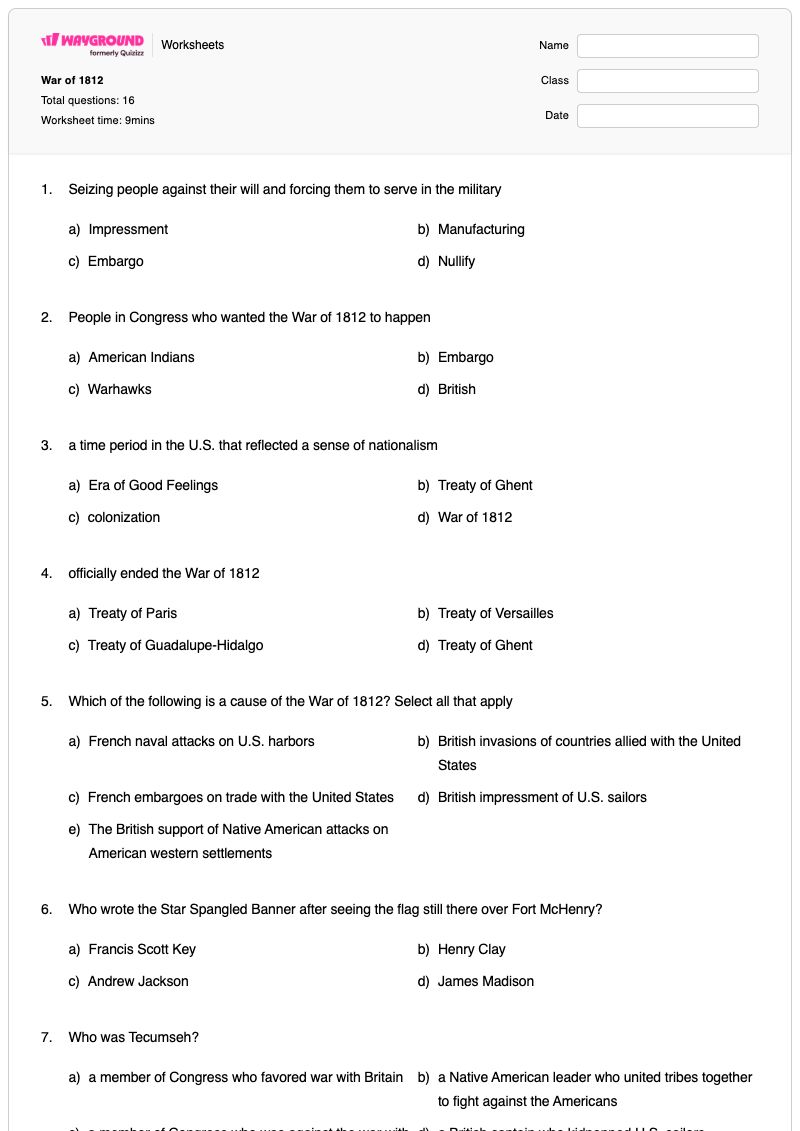
This free printable War of 1812 worksheet helps Grade 8 social studies students review the people, policies, causes, major events, and outcomes connected to the conflict. Across 16 questions—14 multiple choice and 2 multiple select—students identify terms such as impressment, Warhawks, the Embargo Act, and the Non-Intercourse Act; connect figures including Tecumseh, Francis Scott Key, Dolley Madison, and Andrew Jackson to their roles; and recognize events involving Washington, D.C., Fort McHenry, the Great Lakes, and the Battle of New Orleans. The questions also ask students to distinguish the War of 1812’s causes from related policies, identify British alliances and territorial actions, and name the Treaty of Ghent as the agreement that ended the war. This format gives teachers a focused way to check students’ recall of historical vocabulary, people, locations, legislation, and consequences while also testing whether they can select multiple accurate causes or nations. The worksheet includes a complete answer key for efficient review and grading.

Worksheet settings

Font size

S
M
L
XL
Worksheets

War of 1812

Total questions: 16

Name
Class
Date
1.

Seizing people against their will and forcing them to serve in the military

a)

Impressment

b)

Manufacturing

c)

Embargo

d)

Nullify

2.

People in Congress who wanted the War of 1812 to happen

a)

American Indians

b)

Embargo

c)

Warhawks

d)

British

3.

a time period in the U.S. that reflected a sense of nationalism

a)

Era of Good Feelings

b)

Treaty of Ghent

c)

colonization

d)

War of 1812

4.

officially ended the War of 1812

a)

Treaty of Paris

b)

Treaty of Versailles

c)

Treaty of Guadalupe-Hidalgo

d)

Treaty of Ghent

5.

Which of the following is a cause of the War of 1812? Select all that apply

a)

French naval attacks on U.S. harbors

b)

British invasions of countries allied with the United States

c)

French embargoes on trade with the United States

d)

British impressment of U.S. sailors

e)

The British support of Native American attacks on American western settlements

6.

Who wrote the Star Spangled Banner after seeing the flag still there over Fort McHenry?

a)

Francis Scott Key

b)

Henry Clay

c)

Andrew Jackson

d)

James Madison

7.

Who was Tecumseh?

a)

a member of Congress who favored war with Britain

b)

a Native American leader who united tribes together to fight against the Americans

c)

a member of Congress who was against the war with Britain

d)

a British captain who kidnapped U.S. sailors

8.

Who were the British allied with in the War of 1812?

a)

The Creek Native Americans

b)

The Russians

c)

The French

9.

What happened to Washington DC during the War of 1812?

a)

The British burned the city, including the White House and the Capitol

b)

The Americans defended the city and kept the British away

c)

Cherokee and Creek Native Americans protested against their treatment by the US government

d)

The city rapidly expanded as trade with Europe decreased.

10.

Where did the first battles of the War of 1812 take place?

a)

Canada and the Great Lakes

b)

Great Britain

c)

Washington DC

d)

New Orleans

11.

The Embargo Act of 1807 blocked trade with all European countries and hurt ______ the most.

a)

the Americans

b)

the British

c)

the French

d)

the Native Americans

12.

The Non-Intercourse Act stopped trade with which two nations? Select two choices

a)

The British

b)

The French

c)

The Germans

d)

The Native Americans

e)

The Italians

13.

William Henry Harrison negotiated what with the Native Americans?

a)

Turning over land to the United States

b)

Turning over gold to the United States

c)

Agreeing to a lasting peace

d)

Agreeing to pay taxes to the United States

14.

Who is credited with saving a portrait of George Washington and other important papers just hours before the British attacked and burned down Washington DC?

a)

Dolley Madison

b)

Martha Washington

c)

Martha Jefferson

d)

Abigail Adams

15.

In the Battle of New Orleans, there were 291 British casualties. Led by Andrew Jackson, how many American casualties were there?

a)

Around 12

b)

Around 1,200

c)

Around 100

d)

None

16.

What sort of relationship did the US have with Britain after the war?

a)

Friendly- a return to trade

b)

Strained- do not get along

c)

The War ended in a sketchy truce

d)

Enemies to the death

Answer Key

War of 1812

Total questions: 16

1.
a)

Impressment

2.
c)

Warhawks

3.
a)

Era of Good Feelings

4.
d)

Treaty of Ghent

5.
d)

British impressment of U.S. sailors

, e)

The British support of Native American attacks on American western settlements

6.
a)

Francis Scott Key

7.
b)

a Native American leader who united tribes together to fight against the Americans

8.
a)

The Creek Native Americans

9.
a)

The British burned the city, including the White House and the Capitol

10.
a)

Canada and the Great Lakes

11.
a)

the Americans

12.
a)

The British

, b)

The French

13.
a)

Turning over land to the United States

14.
a)

Dolley Madison

15.
a)

Around 12

16.
a)

Friendly- a return to trade

FAQs

What does this War of 1812 worksheet cover, and how does it help students learn?

This Grade 8 social studies worksheet covers the causes, key people, major events, and outcome of the War of 1812 through 14 multiple-choice questions and 2 multiple-select questions. Students practice distinguishing impressment and wartime policies, identifying figures such as Tecumseh and Dolley Madison, connecting events to places such as Washington, D.C., the Great Lakes, and New Orleans, and recognizing the Treaty of Ghent as the agreement that ended the war.

How can I use this worksheet to teach the causes and major events of the War of 1812?

Introduce the worksheet by building a cause-and-event sequence: review British impressment, the Embargo Act, the Non-Intercourse Act, and British support for Native American resistance before students complete the questions. Afterward, discuss why the multiple-select items require students to evaluate every option, then use the items about Washington, D.C., Fort McHenry, and the Battle of New Orleans to connect people and places to the conflict’s major events.

What mistakes should I watch for when students complete this War of 1812 worksheet?

Watch for students confusing impressment with an embargo, or selecting every trade restriction as a direct cause when the worksheet identifies British impressment and British support for Native American attacks. Students may also confuse the Treaty of Ghent with another treaty, mistake Tecumseh or Dolley Madison for a military leader, overlook that the Non-Intercourse Act involved Britain and France, or select the wrong casualty estimate for the Battle of New Orleans.

How do I assign and grade this War of 1812 worksheet?

The worksheet is available as a printable PDF and as a digital quiz on Wayground, and it includes a complete answer key for the 14 multiple-choice and 2 multiple-select questions. For printable submissions, you can grade student work by scanning it with the Wayground for Teachers app.

How can I differentiate this War of 1812 worksheet for my students?

In the worksheet’s Advanced Settings, adjust font spacing or font size to make the historical terms, names, and answer choices easier to read. You can also apply a dyslexia-friendly font or translate the worksheet into another language while keeping the multiple-choice and multiple-select format.

Where can I find more worksheets like this on Wayground?

Wayground offers a comprehensive collection of free printable worksheets and practice problems across all subjects, with downloadable PDFs and answer keys to support essential skills and concepts. Browse more resources at https://wayground.com/en-us/worksheets.