

Wayground
Citizenship in the World Quiz - Printable Social Studies Worksheets year 11 - Wayground

Citizenship in the World Quiz

27 questions

11th - 11th Grade

Social Studies

Citizenship in the World Quiz is a free printable Grade 11 social studies worksheet that builds knowledge of international organizations, global groups, and U.S. citizenship. Students identify the responsibilities of the United Nations, World Trade Organization, International Monetary Fund, and World Health Organization; recognize key facts about the United Nations and groups such as the G7 and Commonwealth of Nations; and distinguish ways people may become U.S. citizens. The 27-item quiz uses 9 multiple-choice questions, 11 multiple-select questions, 4 drag-and-drop tasks, 2 matching items, and 1 classification activity. Students also sort examples of U.S. citizenship rights, duties, and obligations, including voting, obeying laws, paying taxes, and jury trials. This free printable worksheet includes a complete answer key for efficient review, independent practice, or assessment.

Worksheet settings

Font size

S
M
L
XL
Worksheets

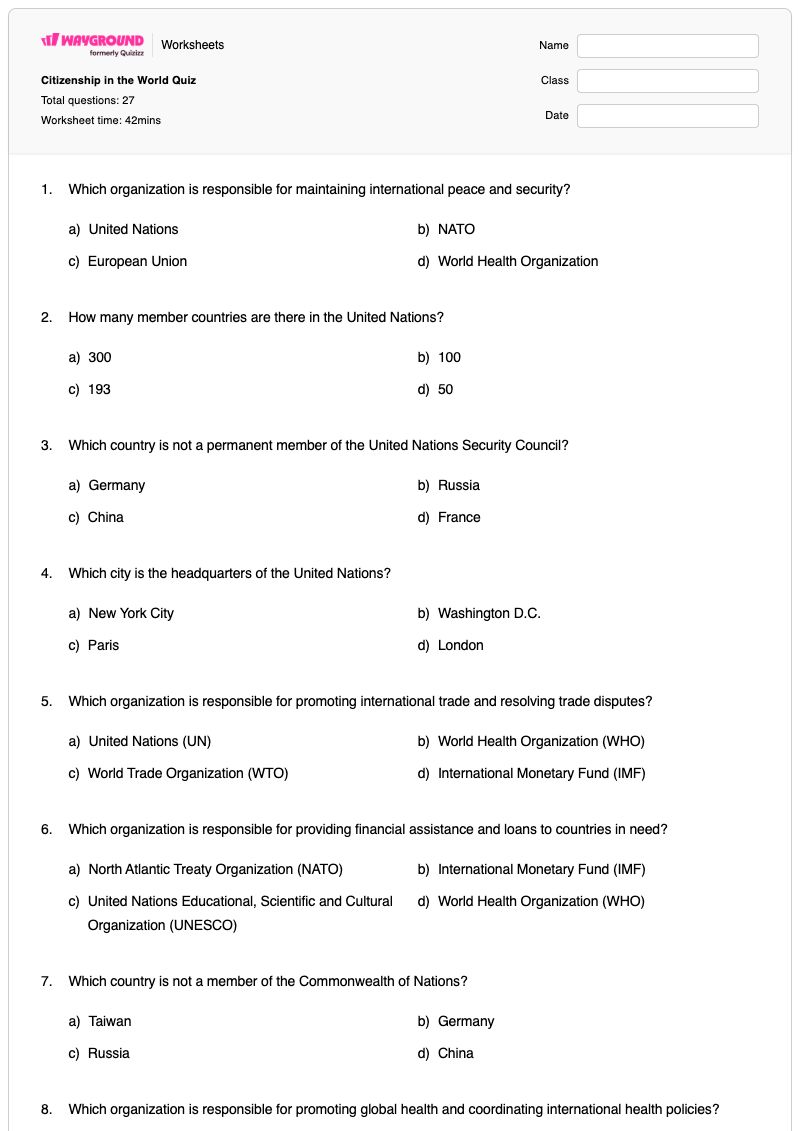
Citizenship in the World Quiz

Total questions: 27

Name
Class
Date
1.

Which organization is responsible for maintaining international peace and security?

a)

United Nations

b)

NATO

c)

European Union

d)

World Health Organization

2.

How many member countries are there in the United Nations?

a)

300

b)

100

c)

193

d)

50

3.

Which country is not a permanent member of the United Nations Security Council?

a)

Germany

b)

Russia

c)

China

d)

France

4.

Which city is the headquarters of the United Nations?

a)

New York City

b)

Washington D.C.

c)

Paris

d)

London

5.

Which organization is responsible for promoting international trade and resolving trade disputes?

a)

United Nations (UN)

b)

World Health Organization (WHO)

c)

World Trade Organization (WTO)

d)

International Monetary Fund (IMF)

6.

Which organization is responsible for providing financial assistance and loans to countries in need?

a)

North Atlantic Treaty Organization (NATO)

b)

International Monetary Fund (IMF)

c)

United Nations Educational, Scientific and Cultural Organization (UNESCO)

d)

World Health Organization (WHO)

7.

Which country is not a member of the Commonwealth of Nations?

a)

Taiwan

b)

Germany

c)

Russia

d)

China

8.

Which organization is responsible for promoting global health and coordinating international health policies?

a)

International Red Cross and Red Crescent Movement

b)

Doctors Without Borders (MSF)

c)

United Nations (UN)

d)

World Health Organization (WHO)

9.

Which country is not a member of the G7 group of advanced economies?

a)

China

b)

Russia

c)

India

d)

Brazil

10.

How does one become a citizen of the United States? Select all that apply.

a)

Being born on US soil.

b)

Serve the US as a spy for the CIA.

c)

Applying for US citizenship and completing a LONG immigration process called naturalization.

d)

As an immigrant, complete a tour of duty in a branch of the US Armed Forces.

11.

How does one become a citizen of the United States? Select all that apply.

a)

Your parents become naturalized citizens while you are under 18 years old.

b)

Pay bribes to the Immigration and Naturalization Office.

c)

As an immigrant, complete a tour of duty in a branch of the US Armed Forces.

d)

Be born to parents who are US Citizens.

12.

Which of these are duties and obligations of a US citizens?

a)

Making yourself aware of federal, state, or local laws.

b)

Following all laws and regulations in good faith.

c)

Paying taxes honestly and in a timely manner.

d)

Making yourself aware of the agendas of your local government organizations.

13.

Which of these are duties and obligations of a US citizens?

a)

Helping fellow citizens at the scene of an accident.

b)

Reporting any witnessed crimes to the authorities.

c)

Fighting in the military and defening your country, if necessary.

d)

Voting in local, state, and federal elections.

14.

Which of these are rights of US citizens?

a)

Right to vote.

b)

Freedom of speech, religion, and expression.

c)

The ability to drive a car.

d)

Right to travel anywhere in the country.

15.

Which of these are rights of US citizens?

a)

Right to a trial by jury.

b)

Right to life, liberty, and the pursuit of happiness.

c)

Right to work in the US.

d)

Right to sing "Happy Birthday" in public.

16.

In the United States and ​ (a)   , citizens are expected to vote and are given the right to free expression.

Choose from the below words
United Kingdom
North Korean
17.

In the United States and ​ (a)   , many citizens believe that peace will be achieved through a strong military.

Choose from the below words
North Korean
Switzerland
18.

Which of these is a characteristic of NATIONAL Law and NOT a characteristic of INTERNATIONAL Law?

a)
  • Handled entirely by a single country without outside input.

b)
  • These laws do not extend outside of a country’s borders.

c)
  • Decided upon by many countries working together.

d)
  • Exists everywhere, even outside of any country’s borders

19.

Which of these is a characteristic of NATIONAL Law and NOT a characteristic of INTERNATIONAL Law?

a)
  • Mainly applies to individuals

b)
  • Based on agreements among countries (treaties)

c)
  • Based on a country’s foundational documents (constitution).

d)
  • Punishments mainly include fines or sanctions

20.

Which are characteristics of BOTH national and international laws?

a)
  • Written laws/agreements that will result in a punishment if violated.

b)
  • Punishments mainly include fines or sanctions

c)
  • Verdicts delivered by a court system.

d)
  • Focused on maintaining peace and finding justice.

21.

Which are properties of a constitutional government?

a)
  • Elected officials must follow the laws of the constitution, and can be removed from office or imprisoned for crimes.

b)
  • People in authority are above the law, and not held responsible for any crimes they might commit.

c)
  • Citizens are free to exercise certain rights.

d)
  • The constitution cannot be changed without following established procedures and receiving the input of citizens.

22.

Which are properties of a non-constitutional government?

a)
  • The leaders are free to create and change laws at will.

b)
  • People in authority are above the law, and not held responsible for any crimes they might commit.

c)
  • Laws cannot be changed without following established procedures and receiving the input of citizens.

d)
  • Court systems may be biased, or might not even exist at all.

23.

Match the types of government with its country.

Federal Republic/ Constitutional Representative Democracy

United States

Totalitarian Dictatorship

North Korea

Socialist Republic

China

Constitutional Monarchy

United Kingdom

Federal Semi-Presidential Republic

Russia

24.

Match the following

Ambassador

Represents interest of a country

Consul

Helps own country's ppl traveling abroad

Bureau of Int. Information Programs

Manages America's reputation abroad

US and Foreign Commerical Service

Supports US businesses around the globe

Agency for International Development

Aids infrastructure in 3rd world nations

25.

A ​ (a)   is an identity document issued by YOUR country.

Choose from the below words
passport
visa
26.

A ​​ (a)   is an identity document issued to you by a foreign country.

Choose from the below words
visa
passport
27.

Organize these options into the right categories

Categorize the following

Business

Employment

Study

Residency

Identity proof

Temporary residence in another country

Access to local aid and protection when traveling

Purposes for a visa
Purposes for a passport
Answer Key

Citizenship in the World Quiz

Total questions: 27

1.
a)

United Nations

2.
c)

193

3.
a)

Germany

4.
a)

New York City

5.
c)

World Trade Organization (WTO)

6.
b)

International Monetary Fund (IMF)

7.
a)

Taiwan

8.
d)

World Health Organization (WHO)

9.
b)

Russia

10.
a)

Being born on US soil.

, c)

Applying for US citizenship and completing a LONG immigration process called naturalization.

11.
a)

Your parents become naturalized citizens while you are under 18 years old.

, d)

Be born to parents who are US Citizens.

12.
a)

Making yourself aware of federal, state, or local laws.

, b)

Following all laws and regulations in good faith.

, c)

Paying taxes honestly and in a timely manner.

13.
b)

Reporting any witnessed crimes to the authorities.

, c)

Fighting in the military and defening your country, if necessary.

, d)

Voting in local, state, and federal elections.

14.
a)

Right to vote.

, b)

Freedom of speech, religion, and expression.

15.
a)

Right to a trial by jury.

, b)

Right to life, liberty, and the pursuit of happiness.

, c)

Right to work in the US.

16.
United Kingdom
17.
North Korean
18.
a)
  • Handled entirely by a single country without outside input.

, b)
  • These laws do not extend outside of a country’s borders.

19.
a)
  • Mainly applies to individuals

, c)
  • Based on a country’s foundational documents (constitution).

20.
a)
  • Written laws/agreements that will result in a punishment if violated.

, c)
  • Verdicts delivered by a court system.

, d)
  • Focused on maintaining peace and finding justice.

21.
a)
  • Elected officials must follow the laws of the constitution, and can be removed from office or imprisoned for crimes.

, c)
  • Citizens are free to exercise certain rights.

, d)
  • The constitution cannot be changed without following established procedures and receiving the input of citizens.

22.
a)
  • The leaders are free to create and change laws at will.

, b)
  • People in authority are above the law, and not held responsible for any crimes they might commit.

, d)
  • Court systems may be biased, or might not even exist at all.

23.

Federal Republic/ Constitutional Representative Democracy

 - 

United States

, 

Totalitarian Dictatorship

 - 

North Korea

, 

Socialist Republic

 - 

China

, 

Constitutional Monarchy

 - 

United Kingdom

, 

Federal Semi-Presidential Republic

 - 

Russia

24.

Ambassador

 - 

Represents interest of a country

, 

Consul

 - 

Helps own country's ppl traveling abroad

, 

Bureau of Int. Information Programs

 - 

Manages America's reputation abroad

, 

US and Foreign Commerical Service

 - 

Supports US businesses around the globe

, 

Agency for International Development

 - 

Aids infrastructure in 3rd world nations

25.
passport
26.
visa
27.
Purposes for a visa

Business

Employment

Study

Residency

Purposes for a passport

Identity proof

Temporary residence in another country

Access to local aid and protection when traveling

FAQs

What does the Citizenship in the World Quiz help students learn?

This Grade 11 social studies worksheet develops students’ ability to identify the roles of major international organizations and distinguish U.S. citizenship pathways, rights, duties, and obligations. Its 27 mixed-format items—including multiple-choice, multiple-select, drag-and-drop, matching, and classification questions—require students to recognize accurate examples and separate them from distractors.

How can I use this worksheet to teach international organizations and U.S. citizenship?

Begin by having students create a reference chart that matches the United Nations, WTO, IMF, and WHO with their functions, then review the worksheet’s questions about the United Nations, G7, Commonwealth of Nations, and Security Council. Next, introduce citizenship pathways and ask students to sort the multiple-select examples into pathways, rights, and duties before completing the quiz. Use the drag-and-drop, matching, and classification items as opportunities for students to explain why each example belongs in its category.

What mistakes should I watch for on this citizenship worksheet?

Students may confuse the international organizations’ roles—for example, selecting the WHO for trade, the WTO for global health, or the IMF for international peace and security. In the multiple-select items, watch for students choosing every plausible-sounding option instead of checking each choice individually, especially when distinguishing citizenship pathways from unsupported options and separating rights such as voting from duties such as paying taxes or following laws. Students may also mix up facts about the G7, Commonwealth of Nations, and permanent Security Council membership.

How do I assign and grade the Citizenship in the World Quiz?

The Citizenship in the World Quiz is available as a printable PDF and as a digital quiz on Wayground, with a complete answer key for all 27 items. Assign the PDF for paper practice or use the digital version for online responses; printable submissions can be graded by scanning student work with the Wayground for Teachers app. The printable option can also support schools that are reducing screen time.

How can I differentiate this worksheet for my students?

Use the worksheet’s Advanced Settings to adjust font spacing or font size so the multiple-select, matching, and classification items are easier to navigate. You can also enable a dyslexia-friendly font or translate the worksheet into another language while students work with the international-organization and U.S. citizenship questions.

Where can I find more worksheets like this on Wayground?

Wayground offers a comprehensive collection of free printable worksheets and practice problems across all subjects, including downloadable PDFs with answer keys to help students master essential skills and concepts. Browse more resources at https://wayground.com/en-us/worksheets.