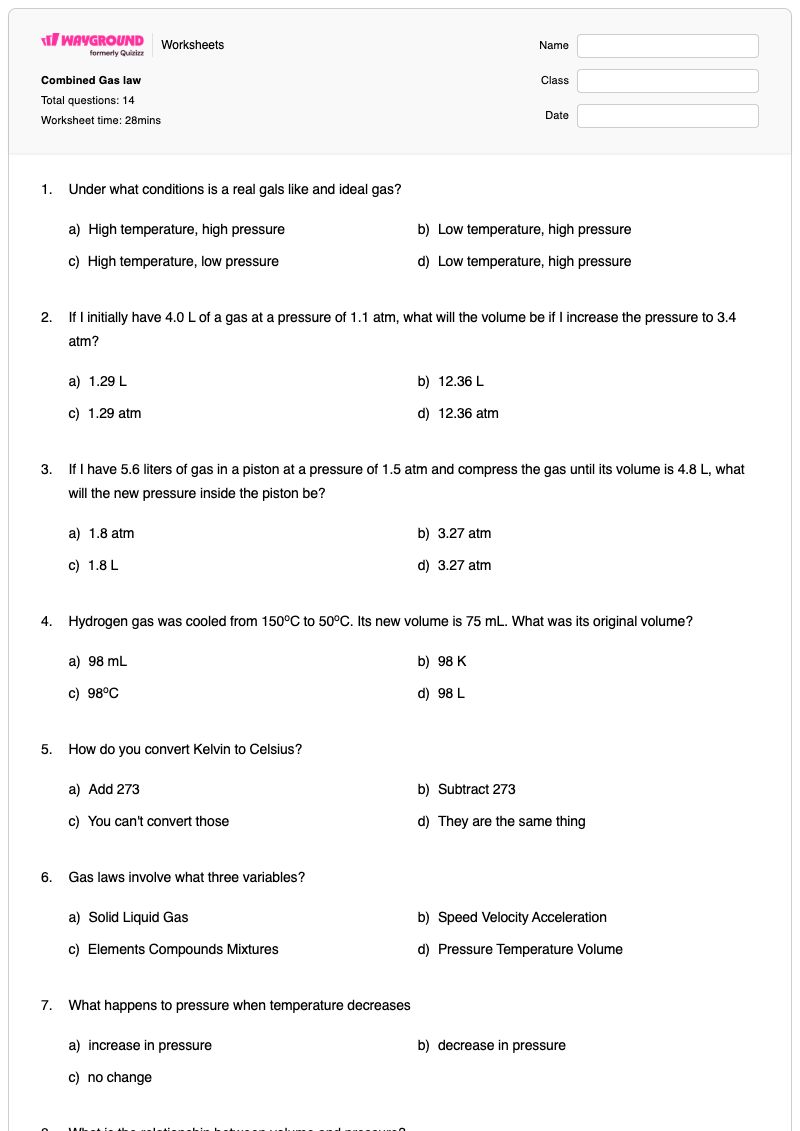
This Grade 10 science worksheet builds foundational understanding of the Combined Gas Law by focusing on the relationships among pressure, temperature, and volume. Students answer 14 multiple-choice questions about ideal-gas conditions, inverse and direct relationships, gas-molecule motion, graph interpretation, Kelvin-to-Celsius conversion, and the law that combines all three variables. Several items also require calculating a changed pressure or volume and selecting the correct unit.
The worksheet is useful for introducing or reviewing gas-law concepts before students complete more extended calculations. Its varied questions help teachers check whether students can distinguish pressure-volume relationships from temperature-pressure relationships, apply proportional reasoning to changing gas conditions, and recognize common gas-law principles, including equal-volume comparisons of gas samples. This free printable worksheet includes a complete answer key for efficient checking and review.
Worksheet settings
Font size
S
M
L
XL
Worksheets
Combined Gas law
Total questions: 14
Name
Class
Date
1.
Under what conditions is a real gals like and ideal gas?
a)
High temperature, high pressure
b)
Low temperature, high pressure
c)
High temperature, low pressure
d)
Low temperature, high pressure
2.
If I initially have 4.0 L of a gas at a pressure of 1.1 atm, what will the volume be if I increase the pressure to 3.4 atm?
a)
1.29 L
b)
12.36 L
c)
1.29 atm
d)
12.36 atm
3.
If I have 5.6 liters of gas in a piston at a pressure of 1.5 atm and compress the gas until its volume is 4.8 L, what will the new pressure inside the piston be?
a)
1.8 atm
b)
3.27 atm
c)
1.8 L
d)
3.27 atm
4.
Hydrogen gas was cooled from 150oC to 50oC. Its new volume is 75 mL. What was its original volume?
a)
98 mL
b)
98 K
c)
98oC
d)
98 L
5.
How do you convert Kelvin to Celsius?
a)
Add 273
b)
Subtract 273
c)
You can't convert those
d)
They are the same thing
6.
Gas laws involve what three variables?
a)
Solid Liquid Gas
b)
Speed Velocity Acceleration
c)
Elements Compounds Mixtures
d)
Pressure Temperature Volume
7.
What happens to pressure when temperature decreases
a)
increase in pressure
b)
decrease in pressure
c)
no change
8.
What is the relationship between volume and pressure?
a)
flipped
b)
direct
c)
inverse
d)
none
9.
what relationship does this graph show?
a)
temperature and pressure- direct
b)
temperature and pressure- inverse
c)
pressure and volume- direct
d)
pressure and volume- inverse
10.
How do gas molecules move?
a)
In an orderly fashion
b)
Constantly and randomly
c)
In straight-line paths
d)
In a circular motion
11.
As pressure increases, temperature increases. Describe the relationship:
a)
Direct Relationship
b)
Inverse Relationship
c)
No Relationship
12.
a)
This is an example of Charles's law
b)
This is an example of Boyle's law
13.
What law combines all 3 factors (pressure, temperature, and volume)
a)
Combined Gas Law
b)
Charle's Law
c)
Boyle's Law
d)
Avagadros Ideal Gas Law
14.
Which rigid cylinder contains the same number of gas molecules as a 2.0 Liter rigid cylinder containing hydrogen gas?
a)
1.0 L of Oxygen gas
b)
2.0 L of methane gas
c)
1.5 L of ammonia gas
d)
4.0 L of Helium gas
Answer Key
Combined Gas law
Total questions: 14
1.
c)
High temperature, low pressure
2.
a)
1.29 L
3.
a)
1.8 atm
4.
a)
98 mL
5.
b)
Subtract 273
6.
d) Pressure Temperature Volume
7.
b)
decrease in pressure
8.
c)
inverse
9.
d)
pressure and volume- inverse
10.
c) In straight-line paths
11.
a)
Direct Relationship
12.
a) This is an example of Charles's law
13.
a) Combined Gas Law
14.
b)
2.0 L of methane gas
140 %
Browse by subjects
Browse by grades
Browse by format
FAQs
What does this Combined Gas Law worksheet cover?
This Grade 10 science worksheet uses 14 multiple-choice questions to assess how pressure, temperature, and volume relate in gases. Students identify direct and inverse relationships, interpret a pressure-volume graph, convert Kelvin to Celsius, recognize ideal-gas conditions, and calculate changed pressure or volume in gas-law scenarios. It also checks understanding of molecular motion and comparisons between gas samples in rigid cylinders.
How can I use this worksheet to teach the Combined Gas Law?
Introduce the three variables—pressure, temperature, and volume—before assigning the multiple-choice items. Have students explain whether each relationship is direct or inverse, then model how to substitute values and track units in the pressure-volume and temperature-volume calculations. Use the graph question and the ideal-gas conditions question as discussion prompts before students complete the remaining items independently.
What mistakes should I watch for when students complete this gas-law worksheet?
Watch for students choosing a pressure or temperature unit when the calculation asks for volume, or selecting a numerical distractor with the wrong unit. Students may also reverse the inverse pressure-volume relationship, treat decreasing temperature as increasing pressure, or add 273 instead of subtracting 273 when converting Kelvin to Celsius. Check that they distinguish the direct pressure-temperature relationship from the inverse pressure-volume relationship shown in the graph item.
How do I assign and grade this Combined Gas Law worksheet?
The worksheet is available as a printable PDF and as a digital quiz on Wayground, so you can assign the 14 multiple-choice questions in the format that fits your lesson. It includes a complete answer key for checking calculations, units, relationship questions, and conceptual responses. Printable submissions can also be graded by scanning student work with the Wayground for Teachers app.
How can I differentiate this gas-law worksheet for my students?
In the worksheet’s Advanced Settings, adjust font spacing or font size to make the calculation items, units, and answer choices easier to read. You can also enable a dyslexia-friendly font or translate the worksheet into another language when that better supports access to the gas-law vocabulary and questions.
Where can I find more worksheets like this on Wayground?
Wayground offers a broad collection of free printable worksheets and practice problems across subjects, with downloadable PDFs and answer keys to help students master essential skills and concepts. Browse more resources at https://wayground.com/en-us/worksheets.


 Worksheets
