
Wayground
Global Connections and Conflict - Printable Social studies Worksheets year 7 - Wayground

Global Connections and Conflict

Brielle MS]

Created by Brielle MS]

10 questions

7th Grade

Social studies

Updated May 2025

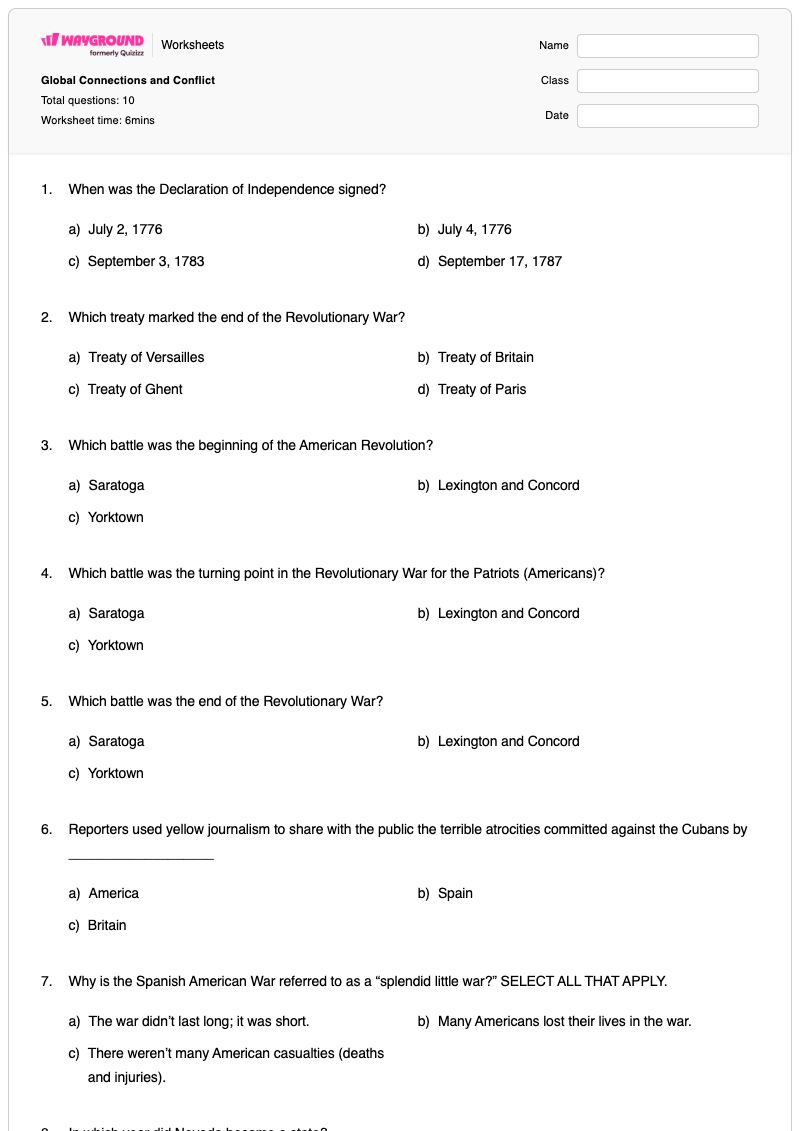
Global Connections and Conflict is a free printable Grade 7 social studies worksheet that reviews key events, dates, and ideas in U.S. history. Students identify the date associated with the Declaration of Independence, the Treaty of Paris, the battles of Lexington and Concord, Saratoga, and Yorktown, and Nevada’s statehood in 1864. They also connect yellow journalism to the Spanish-American War and define imperialism. The worksheet includes eight multiple-choice questions and two multiple-select questions. The selected-response items ask students to distinguish reasons for U.S. expansionism and explain why the Spanish-American War was called a “splendid little war,” requiring attention to all correct choices rather than one answer. This free printable worksheet includes a complete answer key, making it useful for Grade 7 review, independent practice, or a short social studies assessment.

Worksheet settings

Font size

S
M
L
XL
WaygroundWorksheets

Global Connections and Conflict

Total questions: 10

Name
Class
Date
1.

When was the Declaration of Independence signed?

a)

July 2, 1776

b)

July 4, 1776

c)

September 3, 1783

d)

September 17, 1787

2.

Which treaty marked the end of the Revolutionary War?

a)

Treaty of Versailles

b)

Treaty of Britain

c)

Treaty of Ghent

d)

Treaty of Paris

3.

Which battle was the beginning of the American Revolution?

a)

Saratoga

b)

Lexington and Concord

c)

Yorktown

4.

Which battle was the turning point in the Revolutionary War for the Patriots (Americans)?

a)

Saratoga

b)

Lexington and Concord

c)

Yorktown

5.

Which battle was the end of the Revolutionary War?

a)

Saratoga

b)

Lexington and Concord

c)

Yorktown

6.

Reporters used yellow journalism to share with the public the terrible atrocities committed against the Cubans by ___________________

a)

America

b)

Spain

c)

Britain

7.

Why is the Spanish American War referred to as a “splendid little war?” SELECT ALL THAT APPLY.

a)

The war didn’t last long; it was short.

b)

Many Americans lost their lives in the war.

c)

There weren’t many American casualties (deaths and injuries).

8.

In which year did Nevada become a state?

a)

1861

b)

1864

c)

1865

d)

1867

9.

Which of the following are reasons for U.S. expansionism? SELECT ALL THAT APPLY.

a)

Due to Social Darwinism, the U.S. felt it had a moral duty to uplift “backwards people.”

b)

The U.S. wanted a powerful navy to defend the country.

c)

The U.S. wanted to compete with Europe for power and natural resources.

d)

The U.S. had the smallest world economy during the late 1800s.

10.

Which of the following terms is best described as “the policy of extending the rule or authority of one nation over others by territorial acquisition or through economic or political dominance?”

a)

Nationalism

b)

Militarism

c)

Imperialism

d)

Social Darwinism

WaygroundAnswer Key

Global Connections and Conflict

Total questions: 10

1.
b)

July 4, 1776

2.
d)

Treaty of Paris

3.
b)

Lexington and Concord

4.
a)

Saratoga

5.
c)

Yorktown

6.
b)

Spain

7.
c)

There weren’t many American casualties (deaths and injuries).

, a)

The war didn’t last long; it was short.

8.
b)

1864

9.
c)

The U.S. wanted to compete with Europe for power and natural resources.

, b)

The U.S. wanted a powerful navy to defend the country.

, a)

Due to Social Darwinism, the U.S. felt it had a moral duty to uplift “backwards people.”

10.
c)

Imperialism

FAQs

What does the Global Connections and Conflict worksheet cover?

This Grade 7 social studies worksheet uses eight multiple-choice and two multiple-select questions to assess key events, dates, and concepts related to the American Revolution, the Spanish-American War, Nevada statehood, and U.S. expansionism. Students identify Revolutionary War milestones, recognize reasons for expansionism, interpret the term imperialism, and select all valid explanations for the phrase “splendid little war.”

How can I use this worksheet to teach U.S. conflict and expansionism?

Use the worksheet after students have reviewed a timeline of the American Revolution, including Lexington and Concord, Saratoga, Yorktown, and the Treaty of Paris. Then discuss how yellow journalism, the Spanish-American War, Social Darwinism, naval power, and competition with Europe relate to expansionism before having students complete the multiple-select items and justify each selected answer.

What mistakes should I watch for when students complete this worksheet?

Students may confuse the Revolutionary War sequence by selecting Saratoga as the beginning or Yorktown as the turning point instead of matching each battle to its role. They may also choose only one response on the “splendid little war” and expansionism questions, overlook that these are multiple-select items, or confuse imperialism with nationalism, militarism, or Social Darwinism.

How do I assign and grade this Global Connections and Conflict worksheet?

You can assign it as a printable PDF or as a digital quiz on Wayground. The worksheet includes a complete answer key, and printable submissions can be graded by scanning student work with the Wayground for Teachers app. The printable format also supports classrooms that are reducing screen time.

How can I differentiate this worksheet for my students?

In the worksheet’s Advanced Settings, adjust font spacing or choose a larger font size to make the historical dates, battle names, and multiple-select options easier to track. You can also apply a dyslexia-friendly font or translate the worksheet into another language while preserving its selected-response format.

Where can I find more worksheets like this on Wayground?

Wayground offers a broad collection of free printable worksheets and practice problems across subjects, with downloadable PDFs and answer keys to help students build essential skills and concepts. Browse more resources at https://wayground.com/en-us/worksheets.
