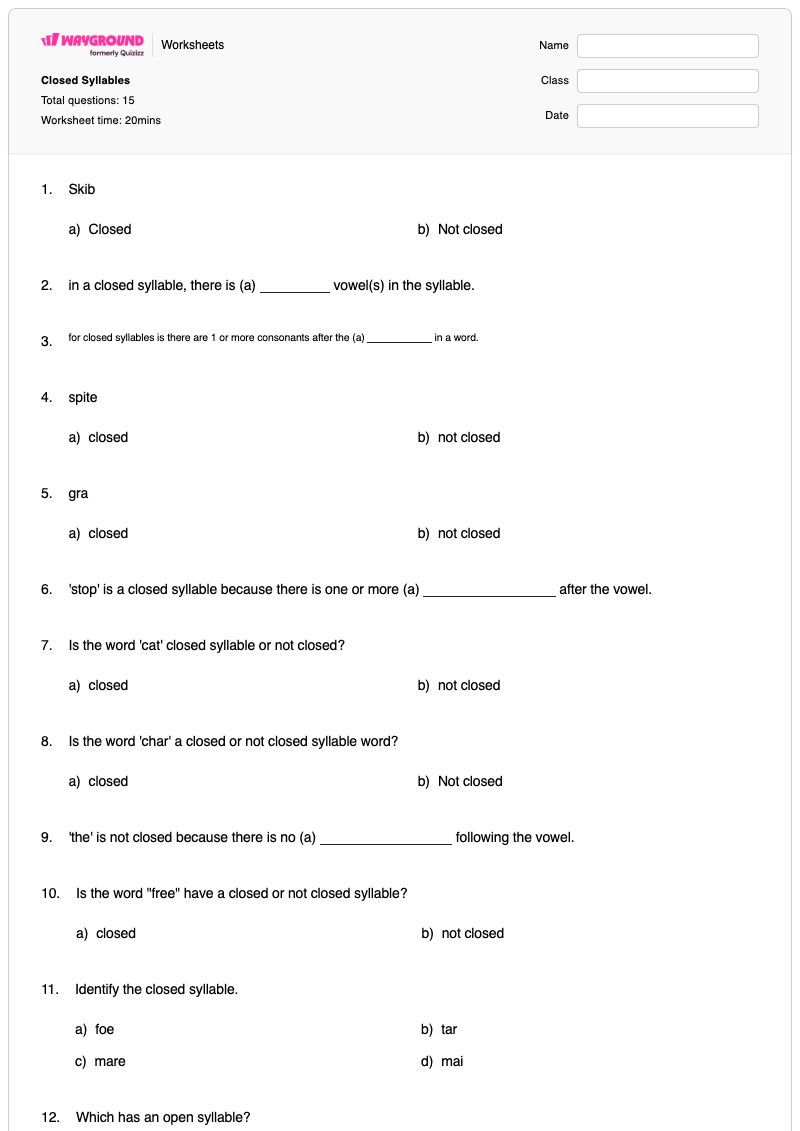
This Grade 3 English worksheet helps students identify and explain closed syllables. Students apply the rule that a closed syllable has one vowel followed by one or more consonants, then distinguish closed syllables from open or not-closed examples such as “cat,” “stop,” “spite,” “free,” and “the.”
The 15-item practice set includes 10 multiple-choice questions, four fill-in-the-blank items, and one open-ended response. Students classify syllables and words, complete statements about the role of vowels and consonants, explain why “frapp” is closed, and state the two rules for closed syllables. This free printable worksheet is designed for Grade 3 English instruction, independent practice, or a quick skills check, and it includes a complete answer key.
Worksheet settings
Font size
S
M
L
XL
Worksheets
Closed Syllables
Total questions: 15
Name
Class
Date
1.
Skib
a)
Closed
b)
Not closed
2.
in a closed syllable, there is (a) vowel(s) in the syllable.
3.
for closed syllables is there are 1 or more consonants after the (a) in a word.
4.
spite
a)
closed
b)
not closed
5.
gra
a)
closed
b)
not closed
6.
'stop' is a closed syllable because there is one or more (a) after the vowel.
7.
Is the word 'cat' closed syllable or not closed?
a)
closed
b)
not closed
8.
Is the word 'char' a closed or not closed syllable word?
a)
closed
b)
Not closed
9.
'the' is not closed because there is no (a) following the vowel.
10.
Is the word "free" have a closed or not closed syllable?
a)
closed
b)
not closed
11.
Identify the closed syllable.
a)
foe
b)
tar
c)
mare
d)
mai
12.
Which has an open syllable?
a)
paf
b)
gat
c)
pham
d)
tare
13.
John is learning about syllables in his English class. His teacher gave him the word "frapp" and asked him why it is considered a closed syllable. Can you help John?
a)
It's closed because there are two vowels.
b)
It's an open syllable
c)
Its closed because there are no consonants
d)
It has two consonants after the vowel.
14.
Why is Miss Graff so cool?
a)
She was just born like that fr
b)
She has the prettiest eyes
c)
d)
She's not even that cool.
(wrong answer)
15.
What are the two rules for closed syllables?
4 lines
Answer Key
Closed Syllables
Total questions: 15
1.
a)
Closed
2.
one
3.
vowel
4.
b)
not closed
5.
b)
not closed
6.
consonant
7.
a)
closed
8.
a)
closed
9.
consonant
10.
b)
not closed
11.
b)
tar
12.
d)
tare
13.
d)
It has two consonants after the vowel.
14.
c)
15.
n/a
140 %
Browse by subjects
Browse by grades
Browse by format
FAQs
What does this closed syllables worksheet help Grade 3 students learn?
This worksheet teaches students to identify closed syllables by applying the rule that one vowel is followed by one or more consonants. Its multiple-choice items ask students to classify examples such as “cat,” “stop,” “spite,” and “free,” while the fill-in-the-blank and open-ended questions require them to state and explain the rules in their own words.
How can I use this worksheet to teach closed syllables?
First, model the worksheet’s rule with examples such as “cat,” “stop,” and “frapp,” pointing out the consonant or consonants after the vowel. Contrast them with the worksheet’s not-closed or open examples, including “the,” “free,” “gra,” and “tare,” and ask students to explain what changes. Then use the multiple-choice items for guided practice, the fill-in-the-blank statements to reinforce vocabulary, and the final open-ended response as a check for rule recall.
What mistakes should I watch for when students complete this closed syllables worksheet?
Watch for students who identify a syllable by its overall word length instead of checking whether a vowel is followed by a consonant. Students may also reverse the roles of vowels and consonants in the fill-in-the-blank items, classify examples such as “the” or “free” as closed, or forget to include both rules in the final open-ended response. The “frapp” question is useful for checking whether students recognize that two consonants can follow the vowel.
How do I assign and grade this closed syllables worksheet?
Wayground provides this closed syllables worksheet as a printable PDF and as a digital quiz, so you can assign the format that fits your lesson. It includes a complete answer key for the multiple-choice and fill-in-the-blank items, while the open-ended response can be checked for both closed-syllable rules. For printable submissions, you can scan student work with the Wayground for Teachers app to support grading.
How can I differentiate this closed syllables worksheet for my students?
Use the worksheet’s Advanced Settings to adjust font spacing and font size so the multiple-choice options and fill-in-the-blank statements are easier to follow. You can also apply a dyslexia-friendly font or translate the worksheet into another language when that supports access to the closed-syllable directions and examples.
Where can I find more worksheets like this on Wayground?
Wayground offers a broad collection of free printable worksheets and practice problems across subjects, with downloadable PDFs and answer keys to help students build essential skills and concepts. Browse more resources at https://wayground.com/en-us/worksheets.

 Worksheets