

Wayground
Geometry LinkIt! Practice - Printable Math Worksheets year 9 - Wayground

Geometry LinkIt! Practice

Erin Blarr

Created by Erin Blarr

10 questions

9th Grade

Math

Updated Aug 2026

Geometry LinkIt! Practice is a free printable Grade 9 mathematics worksheet that builds applied geometry reasoning through 10 varied digital and paper-friendly questions. Students complete midpoint-based triangle proofs, calculate an altitude from an angle of elevation, identify sequences of transformations, determine dilation scale factors and centers, and solve for missing lengths. The worksheet also asks students to calculate a triangle’s perimeter from coordinates, recognize when triangles can be mapped through transformations, and select valid congruence criteria such as ASA, SAS, or SSS. Its drag-and-drop, fill-in-the-blank, multiple-select, and diagram-based proof items require students to connect visual models, coordinate rules, measurements, and formal justifications. It includes a complete answer key for checking student work and is suitable for guided practice, independent review, or assessment preparation.

Worksheet settings

Font size

S
M
L
XL
WaygroundWorksheets

Geometry LinkIt! Practice

Total questions: 10

Name
Class
Date
1.

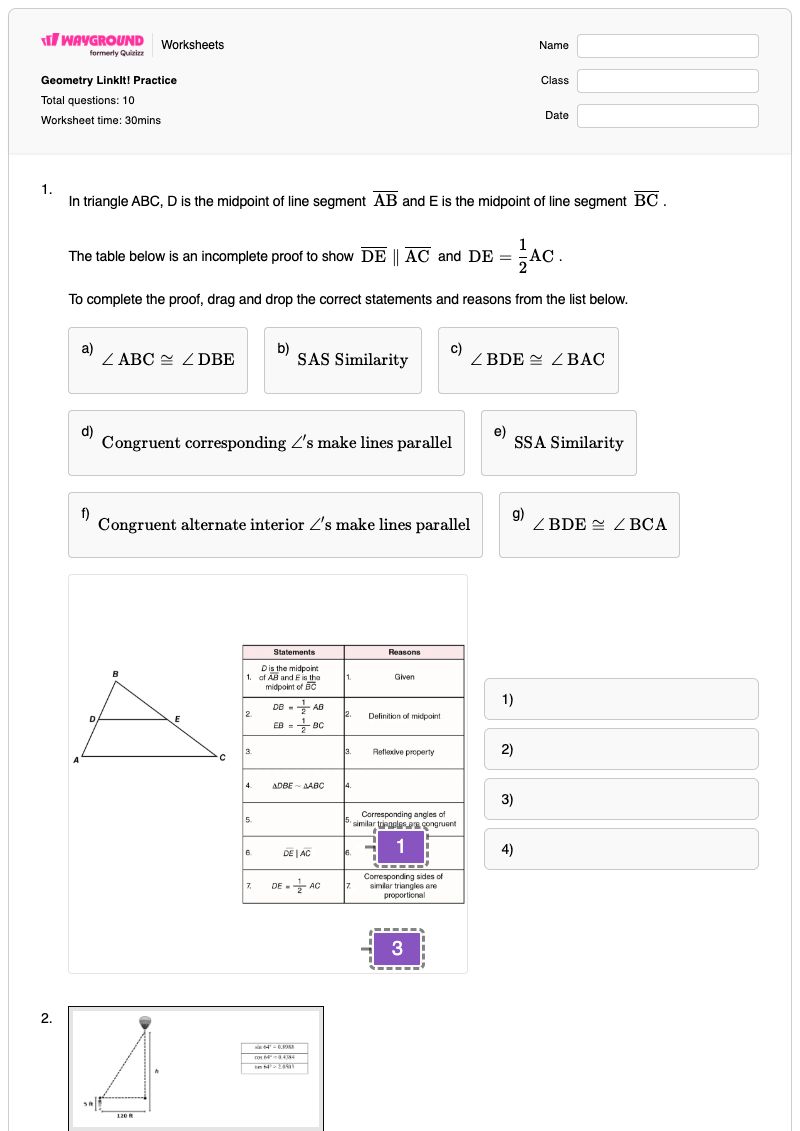
In triangle ABC, D is the midpoint of line segment  AB‾\overline{AB} and E is the midpoint of line segment  BC‾\overline{BC} .

The table below is an incomplete proof to show  DE‾∥AC‾\overline{DE}\parallel\overline{AC}  and  DE=12ACDE=\frac{1}{2}AC .

To complete the proof, drag and drop the correct statements and reasons from the list below.

2.
A man observes a balloon at a 64° angle of elevation. He knows the balloon is hovering directly above a point on the ground,…

A man observes a balloon at a 64° angle of elevation. He knows the balloon is hovering directly above a point on the ground, 120 feet to the east, as shown in the figure below.

If the man is 5 feet tall, what is h, the altitude of the balloon, to the nearest whole foot?
Use the trigonometric ratios provided and enter your answer in the box.

(a)  

3.
Drag the transformations used into the boxes to show the sequence that generated A′B′C′ from ABC. Transformation used: Step…

Drag the transformations used into the boxes to show the sequence that generated A′B′C′ from ABC.


Transformation used:

Step 1:​ (a)  

Step 2:​ (b)  

Choose from the below words
Reflection across the y-axis
Translation 2 units right and 1 unit down
Reflection across the x-axis
Translation 2 units left and 1 unit up
Counterclockwise rotation by 90° about the origin
4.

The table shows an incomplete proof that ∠ 1≅∠ 2\angle\ 1\cong\angle\ 2 . Drag the correct step and reason to complete the proof.

5.
Drag and drop the numbers into each of the boxes to complete the sentence. The scale factor of the dilation is , and the…

Drag and drop the numbers into each of the boxes to complete the sentence.

The scale factor of the dilation is (a)   , and the coordinates of the center of the dilation are (​ (b)   , ​ (c)   ).

Choose from the below words
2
5
4
1
3
6.
Enter the number in the box. PR = cm

Enter the number in the box.
PR = (a)   cm

7.
Click on the triangles that can be mapped onto by a sequence of translations, rotations, reflections, or dilations. Select…

Click on the triangles that can be mapped onto  ΔABC\Delta ABC  by a sequence of translations, rotations, reflections, or dilations. Select all that apply.

a)
Click on the triangles that can be mapped onto by a sequence of translations, rotations, reflections, or dilations. Select…

b)
Click on the triangles that can be mapped onto by a sequence of translations, rotations, reflections, or dilations. Select…

c)
Click on the triangles that can be mapped onto by a sequence of translations, rotations, reflections, or dilations. Select…

d)
Click on the triangles that can be mapped onto by a sequence of translations, rotations, reflections, or dilations. Select…

e)
Click on the triangles that can be mapped onto by a sequence of translations, rotations, reflections, or dilations. Select…

8.

The coordinates of triangle PQRPQR plotted on a coordinate plane are P(−6,9)P\left(-6,9\right) , Q(6,4)Q\left(6,4\right) , and R(2,1)R\left(2,1\right) .

Enter a number in the box to complete the sentence.

The perimeter of the triangle is (a)   units. Round your answer to the nearest tenth.

9.

Decide whether each pair of triangles must be congruent. Drag the correct congruency criteria into the boxes, or if congruence cannot be determined drag "None". 

10.
Drag and drop the numbers below to complete the answer. ​ ​ /​

Drag and drop the numbers below to complete the answer.

tan⁡A=\tan A= ​ ​ (a)   /​ (b)  

Choose from the below words
15
8
17
WaygroundAnswer Key

Geometry LinkIt! Practice

Total questions: 10

1.
2.
251
3.
Reflection across the y-axis, Translation 2 units right and 1 unit down
4.
5.
2, 5, 4
6.
10
7.
a)

, b)

, e)

8.
29.3
9.
10.
15, 8

FAQs

What does the Geometry LinkIt! Practice worksheet cover?

This Grade 9 geometry worksheet uses 10 diagram-based, drag-and-drop, fill-in-the-blank, and multiple-select items to assess connected skills. Students complete triangle proof statements and reasons, calculate an altitude using an angle of elevation, identify transformation sequences, determine dilation information, evaluate congruence criteria, and find lengths or perimeter from coordinate and geometric information. Completing the mixed-format items helps students choose appropriate geometric reasoning rather than applying one procedure repeatedly.

How can I use this worksheet to teach these geometry skills?

Use the incomplete proof tables first to model how a geometric statement must be paired with a valid reason, then have students explain why each selected step follows. Next, review the order of transformations and the meaning of a dilation’s scale factor and center before students attempt the drag-and-drop items. For the angle-of-elevation and coordinate questions, ask students to identify the known measurements, choose the relevant relationship, preserve units, and check rounding before completing the answer box.

What mistakes should I watch for when students complete this geometry worksheet?

In the proof items, students may drag a true statement with the wrong reason or skip the role of the midpoint information. They may also reverse the order of the two transformations, confuse a dilation’s scale factor with its center coordinates, or select a congruence criterion when the given information is insufficient and “None” is required. For the angle-of-elevation and coordinate items, watch for forgetting the observer’s 5-foot height, mishandling units, or rounding the final value incorrectly.

How do I assign and grade this Geometry LinkIt! Practice worksheet?

On Wayground, assign it as a printable PDF or as a digital quiz. The worksheet includes a complete answer key, and printable submissions can be graded by scanning student work with the Wayground for Teachers app. The printable format can also support classrooms that are reducing screen time while preserving the same geometry practice.

How can I differentiate this geometry worksheet for my students?

In the worksheet’s Advanced Settings, adjust font spacing or choose a larger font size to make the proof prompts, coordinate questions, and drag-and-drop labels easier to read. You can also enable a dyslexia-friendly font or translate the written directions into another language while keeping the geometry diagrams and mathematical relationships available for students to interpret.

Where can I find more worksheets like this on Wayground?

Wayground offers a comprehensive collection of free printable worksheets and practice problems across all subjects, with downloadable PDFs and answer keys to support mastery of essential skills and concepts. Browse more resources at https://wayground.com/en-us/worksheets.