

Wayground
AKS 40a Partitioning of Africa - Printable Social Studies Worksheets year 7 - Wayground

AKS 40a Partitioning of Africa

10 questions

7th - 7th Grade

Social Studies

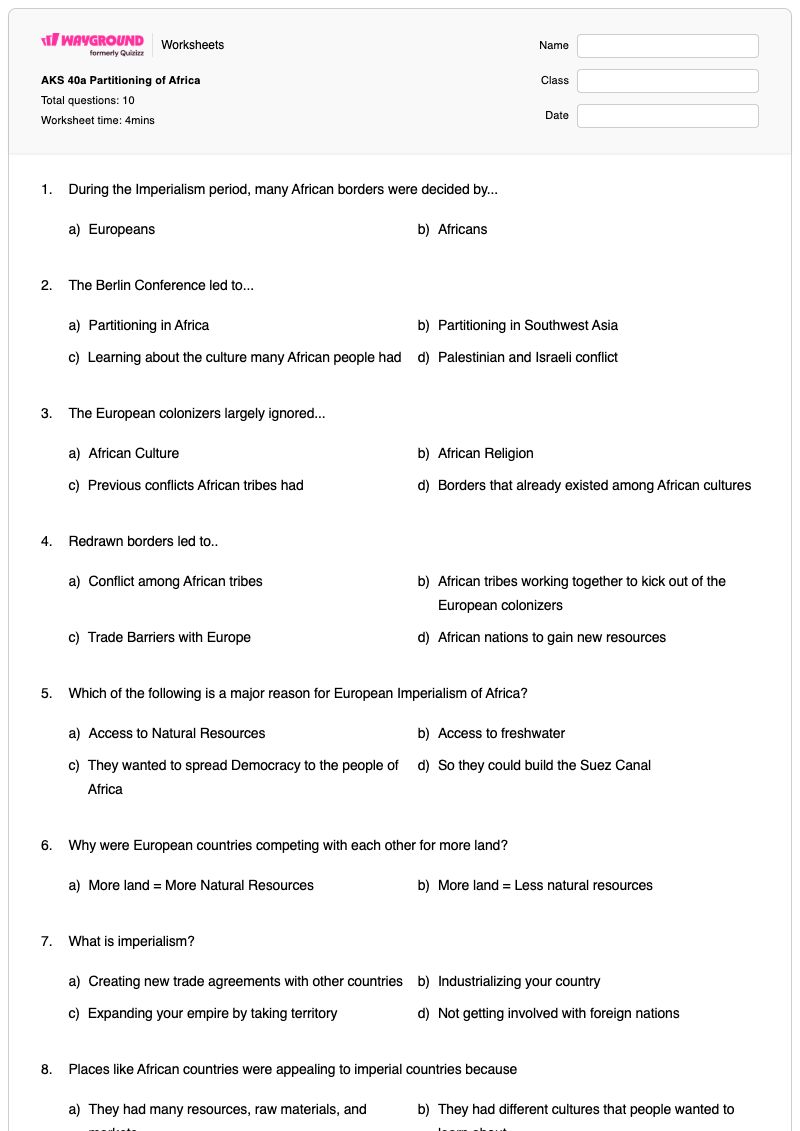
This Grade 7 Social Studies worksheet examines how European imperialism led to the partitioning and colonization of Africa. Students complete nine multiple-choice questions and one multiple-select question covering the Berlin Conference, European control of African borders, the economic motives behind imperialism, the definition of imperialism, and the effects of redrawn borders on African communities. The questions help students connect European competition for land, natural resources, raw materials, and markets with the Scramble for Africa. They also identify how colonizers disregarded African cultures, religions, existing borders, and tribal conflicts, contributing to conflict and resistance. This free printable worksheet with an answer key is suitable for Grade 7 social studies review, guided practice, or a quick check of understanding after instruction on African imperialism.

Worksheet settings

Font size

S
M
L
XL
Worksheets

AKS 40a Partitioning of Africa

Total questions: 10

Name
Class
Date
1.

During the Imperialism period, many African borders were decided by...

a)

Europeans

b)

Africans

2.

The Berlin Conference led to...

a)

Partitioning in Africa

b)

Partitioning in Southwest Asia

c)

Learning about the culture many African people had

d)

Palestinian and Israeli conflict

3.

The European colonizers largely ignored...

a)

African Culture

b)

African Religion

c)

Previous conflicts African tribes had

d)

Borders that already existed among African cultures

4.

Redrawn borders led to..

a)

Conflict among African tribes

b)

African tribes working together to kick out of the European colonizers

c)

Trade Barriers with Europe

d)

African nations to gain new resources

5.

Which of the following is a major reason for European Imperialism of Africa?

a)

Access to Natural Resources

b)

Access to freshwater

c)

They wanted to spread Democracy to the people of Africa

d)

So they could build the Suez Canal

6.

Why were European countries competing with each other for more land?

a)

More land = More Natural Resources

b)

More land = Less natural resources

7.

What is imperialism?

a)

Creating new trade agreements with other countries

b)

Industrializing your country

c)

Expanding your empire by taking territory

d)

Not getting involved with foreign nations

8.

Places like African countries were appealing to imperial countries because

a)

They had many resources, raw materials, and markets

b)

They had different cultures that people wanted to learn about

c)

They had extremely powerful militaries

d)

They had alliances together against European countries

9.

Due to the Scramble for Africa, most of Africa was

a)

Divided into spheres of influence

b)

Colonized by Europeans

c)

Independent of foreign rule

d)

At war with each other

10.

Which of the following was true about the way natives reacted to imperialism?

a)

Natives welcomed foreigners as superiors

b)

Natives were happy to form new alliances with the Europeans

c)

Natives often felt disrespected and wanted to fight back

d)

Natives attempted to invade the homelands of the foreigners

Answer Key

AKS 40a Partitioning of Africa

Total questions: 10

1.
a)

Europeans

2.
a)

Partitioning in Africa

3.
a)

African Culture

, b)

African Religion

, c)

Previous conflicts African tribes had

, d)

Borders that already existed among African cultures

4.
a)

Conflict among African tribes

5.
a)

Access to Natural Resources

6.
a)

More land = More Natural Resources

7.
c)

Expanding your empire by taking territory

8.
a)

They had many resources, raw materials, and markets

9.
b)

Colonized by Europeans

10.
c)

Natives often felt disrespected and wanted to fight back

FAQs

What does the Partitioning of Africa worksheet cover?

This Grade 7 worksheet uses nine multiple-choice questions and one multiple-select question to assess how European imperialism partitioned and colonized Africa. Students identify the Berlin Conference, explain European motives such as access to natural resources and markets, define imperialism, and connect redrawn borders with conflict and African resistance.

How can I use this worksheet to teach the partitioning of Africa?

Use the questions in sequence: begin with the definition and economic motives of imperialism, then introduce the Berlin Conference and the European control of African borders. After students complete the items, discuss why ignoring African cultures, religions, existing borders, and previous conflicts created lasting tension, and ask students to justify their answers to the multiple-select question.

What mistakes should I watch for when students complete this worksheet?

Students may confuse the Berlin Conference with a general study of African culture or with events in Southwest Asia, or mistake imperialism for industrialization or a trade agreement. On the multiple-select item, watch for students who select only one way European colonizers ignored African societies instead of recognizing all four correct factors; they may also confuse the cause of redrawn borders with the resulting conflict among African tribes.

How do I assign and grade this Partitioning of Africa worksheet?

On Wayground, assign it as a printable PDF or as a digital quiz, and use the complete answer key to check the nine multiple-choice and one multiple-select responses. Printable submissions can also be graded by scanning student work with the Wayground for Teachers app.

How can I differentiate this worksheet for my students?

In the worksheet's Advanced Settings, adjust font spacing or choose a larger font size to make the multiple-choice and multiple-select items easier to read. You can also enable a dyslexia-friendly font or translate the worksheet into another language while keeping the questions about imperialism, the Berlin Conference, and the partitioning of Africa intact.

Where can I find more worksheets like this on Wayground?

Wayground offers a comprehensive collection of free printable worksheets and practice problems across subjects, with downloadable PDFs and answer keys to help students master essential skills and concepts. Browse more resources at https://wayground.com/en-us/worksheets.