

Wayground
Test Unit 5 Moles - Printable Science Worksheets year 9 - Wayground

Test Unit 5 Moles

20 questions

9th - 9th Grade

Science

Test Unit 5 Moles is a Grade 9 science worksheet that checks students’ understanding of the mole as a counting unit and their ability to connect moles with mass, particles, and gas volume. Across 20 items—13 multiple-choice, 2 multiple-select, 1 ordering task, and 4 dropdown questions—students identify molar mass, mole notation, Avogadro’s number, and representative particles; interpret chemical formulas such as C₂H₆ and SF₆; and recognize quantities equivalent to one mole. The worksheet also provides practice selecting conversion factors and completing mole calculations, including molar mass for CuSO₄·5H₂O, grams-to-moles, moles-to-mass, particles-to-moles, and gas-volume conversions. Its ordering item reinforces the dimensional-analysis sequence for converting grams of O₂ to liters, including units and substance labels in the final answer. Designed for Grade 9 science review or assessment, this free printable worksheet includes a complete answer key for efficient checking.

Worksheet settings

Font size

S
M
L
XL
Worksheets

Test Unit 5 Moles

Total questions: 20

Name
Class
Date
1.

The mass of 1 mole for an element or compound can be found on the periodic table. This mass is known as...

a)

molality

b)

molar mass

c)

formal mass

d)

molarity

2.

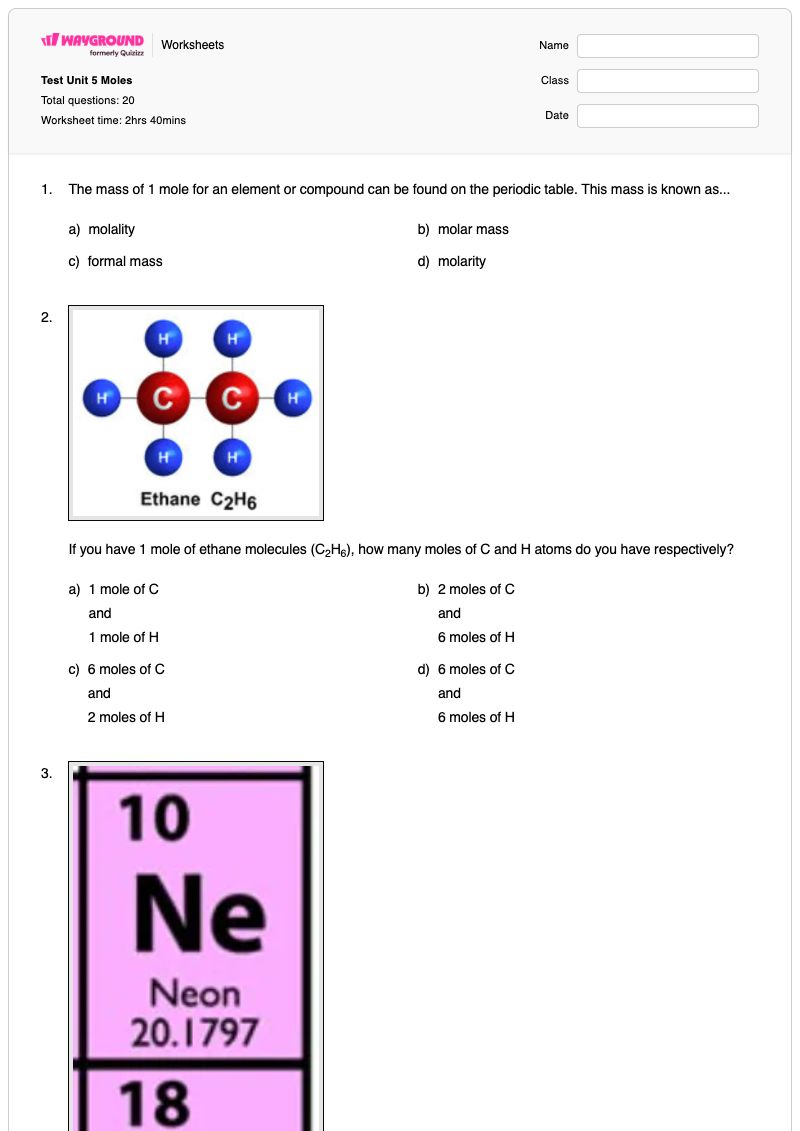
If you have 1 mole of ethane molecules (C2H6), how many moles of C and H atoms do you have respectively?

a)

1 mole of C

and

1 mole of H

b)

2 moles of C

and

6 moles of H

c)

6 moles of C

and

2 moles of H

d)

6 moles of C

and

6 moles of H

3.

Identify the sample with the most moles:

20.18 g of neon

or

39.95 g of argon

a)

20.18 g of neon

b)

39.95 g of argon

c)

They are both equal to 1 mole

4.

Identify the number of moles in 6.02 x 10²³ molecules of H2O.

a)

1 mole

b)

2 moles

c)

6.02 moles

d)

6.02 x 10²³ moles

5.

Identify the type of Representative Particle.

One mole of sulfur hexafluoride (SF6) contains 6.02 x 10²³ _____.

a)

atoms

b)

formula units

c)

ions

d)

molecules

6.

Identify the conversion factor (ratio) needed to calculate the following:

Calculate the number of molecules in 4 moles of glucose, C6H12O6.

a)
b)
c)
d)

7.

SELECT ALL CORRECT ANSWERS - The mole can be used to measure:

a)

The amount of volume for a gas at STP.

b)

The amount of molecules in a covalent substance

c)

The amount of mass for a compound.

d)

The amount of pressure an object applies.

8.

Identify the conversion factor (ratio) needed to calculate the following:

Calculate the number of moles in 7.0x1044 formula units of (NH4)3PO4.

a)
b)
c)
d)
9.

Identify the abbreviation for mole.

a)

M

b)

m

c)

mol

d)

ml

10.

Identify the unit of measurement for Avogadro's number.

a)

meters

b)

particles

c)

grams

d)

liters

11.

SELECT ALL THAT APPLY:

Which of the following is equivalent to 1 mole?

a)

1 mole of Scandium

b)

72.61 grams of Germanium

c)

6.02x1026

formula units of LiBr

d)

6.02x10²³ molecules of CO2

12.

Calculate the molar mass of copper(II)sulfate pentahydrate:

CuSO4 ⋅ 5H2O

a)

90.10 g

b)

14,381.76 g

c)

159.62 g

d)

249.72 g

13.

Calculate the moles magnesium in a 91.0 gram sample.

a)

8.4 mol Mg

b)

21 mol Mg

c)

2.5 mol Mg

d)

3.6 mol Mg

14.

Calculate the mass, in grams, of a gas sample containing 52.0 L of nitrogen (N2).

a)

41.57 g N2

b)

52.0 g N2

c)

41.57 L N2

d)

65.05 g N2

15.

Reorder the following instructions on how to complete the given mole conversion:

Convert 2.5 grams of oxygen gas (O2) to liters.

a)

Write the value that is given as the first ratio, in grams.

b)

Write the ratio to convert the given mass value, to moles.

c)

Write the ratio to convert the given mole value, to liters.

d)

Multiply all top ratio values together, then multiply all the bottom ratio values together, then divide the top value by the bottom value.

e)

Give an answer with the appropriate units, in liters, and substance, O2.

1)
2)
3)
4)
5)
16.

Identify the type of Representative Particle.

One mole of calcium carbonate (CaCO3) contains 6.02 x 10²³ _____.

a)

atoms

b)

formula units

c)

ions

d)

molecules

17.

Identify the following as ionic, covalent or metallic:

FeCl3

​ (a)  

Choose from the below words
Ionic
Covalent
metallic
18.

Identify the following as ionic, covalent or metallic:

NaNO3

​ (a)  

Choose from the below words
Ionic
Covalent
metallic
19.

Identify the following as ionic, covalent or metallic:

C6H12O6

​ (a)  

Choose from the below words
Covalent
Metallic
Ionic
20.

Identify the following as ionic, covalent or metallic:

H2S

​ (a)  

Choose from the below words
Covalent
Metallic
Ionic
Answer Key

Test Unit 5 Moles

Total questions: 20

1.
b)

molar mass

2.
b)

2 moles of C

and

6 moles of H

3.
c)

They are both equal to 1 mole

4.
a)

1 mole

5.
d)

molecules

6.
b)
7.
a)

The amount of volume for a gas at STP.

, b)

The amount of molecules in a covalent substance

, c)

The amount of mass for a compound.

8.
a)
9.
c)

mol

10.
b)

particles

11.
a)

1 mole of Scandium

, b)

72.61 grams of Germanium

, d)

6.02x10²³ molecules of CO2

12.
d)

249.72 g

13.
d)

3.6 mol Mg

14.
d)

65.05 g N2

15.
a, b, c, d, e
16.
b)

formula units

17.
Ionic
18.
Ionic
19.
Covalent
20.
Covalent

FAQs

What does the Test Unit 5 Moles worksheet cover?

This Grade 9 science worksheet covers mole relationships, including molar mass, Avogadro’s number, representative particles, chemical-formula subscripts, and conversions among mass, moles, particles, and gas volume. Its 20 questions use multiple-choice, multiple-select, dropdown, and ordering formats to have students identify conversion factors, calculate quantities such as the molar mass of CuSO₄·5H₂O, and sequence the steps for converting grams of O₂ to liters.

How can I use this worksheet to teach mole conversions?

Introduce the worksheet by reviewing the mole as 6.02 × 10²³ particles and modeling how a chemical formula determines the number of atoms in one mole of a compound, such as the 2 carbon and 6 hydrogen atoms in C₂H₆. Then have students use the conversion-factor items and the ordered O₂ grams-to-liters task to explain each dimensional-analysis step, including why units cancel and why the final answer must include liters and O₂. Use the mass, particle, and gas-volume calculation questions for guided practice before assigning the full worksheet independently.

What mistakes should I watch for on the Test Unit 5 Moles worksheet?

Watch for students confusing subscripts with the number of moles in a sample—for example, reading C₂H₆ as one mole each of carbon and hydrogen instead of 2 moles of carbon and 6 moles of hydrogen. Students may also use the wrong representative-particle term, misread 6.02 × 10²³ as a number of moles rather than particles, or select an incorrect power of ten in a conversion factor. In calculation and ordering items, check that they use molar mass for mass conversions, account for all parts of CuSO₄·5H₂O, cancel units in the correct sequence, and report the requested unit and substance.

How do I assign and grade this mole worksheet?

You can assign Test Unit 5 Moles as a printable PDF or as a digital quiz on Wayground. The worksheet includes a complete answer key, and printable submissions can be graded by scanning student work with the Wayground for Teachers app. The PDF option also supports classrooms that are reducing screen time while students practise mole calculations.

How can I differentiate this mole worksheet for my students?

Use the worksheet’s Advanced Settings to adjust font spacing and font size around the chemical formulas, conversion-factor choices, and multi-step calculation prompts. You can also enable a dyslexia-friendly font or translate the worksheet into another language when that helps students access the mole-conversion directions and answer choices. These file-level options can make the 20-item mixed-format worksheet easier to read without changing its chemistry content.

Where can I find more free worksheets like this on Wayground?

Wayground offers a broad collection of free printable worksheets and practice problems across subjects, with downloadable PDFs and answer keys to help students master essential skills and concepts. Browse more resources at https://wayground.com/en-us/worksheets.