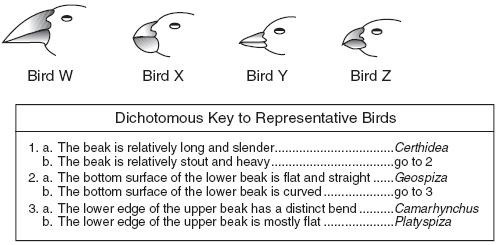
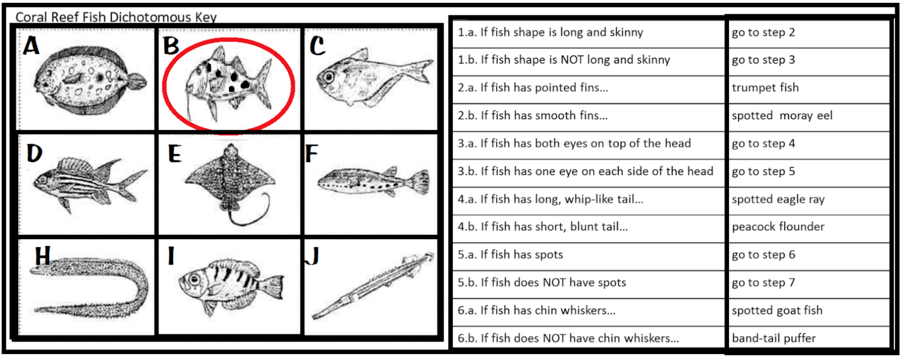
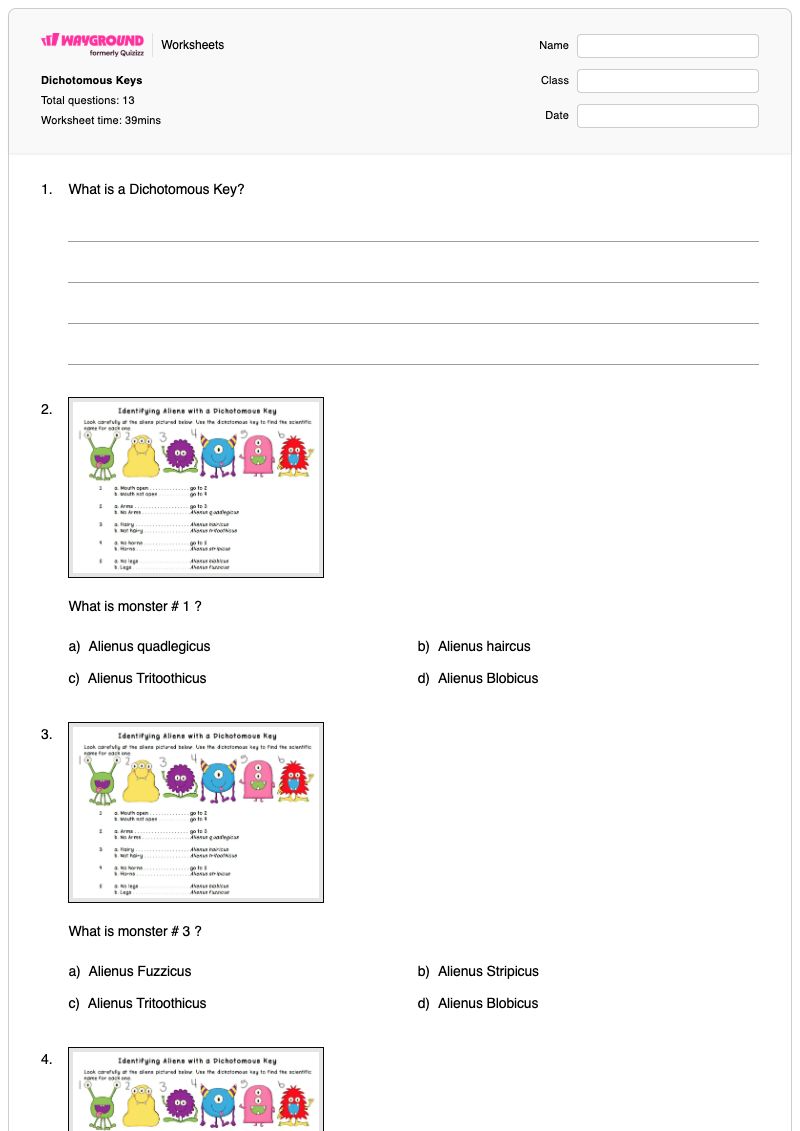
This Grade 5 science worksheet introduces students to dichotomous keys, a tool for identifying organisms by comparing physical features through a sequence of two-choice decisions. Students begin with an open-ended definition question, then apply the key to identify six fictional monsters, two birds, and two circled fish, including trumpet fish and spotted goat fish. Additional multiple-choice items reinforce that identification starts at step 1 and relies on physical features rather than unrelated traits.
Designed for elementary science instruction, this free printable worksheet gives students repeated practice moving from observable characteristics to an organism name. The 13-question set—one open-ended response and 12 multiple-choice questions—supports guided practice, independent review, or a quick check for understanding after students learn how dichotomous keys work. A complete answer key is included so teachers can review the definition response and efficiently check the identification items.
Worksheet settings
Font size
S
M
L
XL
Worksheets
Dichotomous Keys
Total questions: 13
Name
Class
Date
1.
What is a Dichotomous Key?
4 lines
2.
What is monster # 1 ?
a)
Alienus quadlegicus
b)
Alienus haircus
c)
Alienus Tritoothicus
d)
Alienus Blobicus
3.
What is monster # 3 ?
a)
Alienus Fuzzicus
b)
Alienus Stripicus
c)
Alienus Tritoothicus
d)
Alienus Blobicus
4.
What is monster # 4 ?
a)
Alienus Fuzzicus
b)
Alienus Stripicus
c)
Alienus Quadlegicus
d)
Alienus Blobicus
5.
What is monster # 2 ?
a)
Alienus Fuzzicus
b)
Alienus Stripicus
c)
Alienus Tritoothicus
d)
Alienus Blobicus
6.
What is monster # 5 ?
a)
Alienus Fuzzicus
b)
Alienus Tritoothicus
c)
Alienus Hairicus
d)
Alienus Blobicus
7.
What is monster # 6 ?
a)
Alienus Stripicus
b)
Alienus Tritoothicus
c)
Alienus Hairicus
d)
Alienus Quadlegicus
8.
What is the name of bird W?
a)
Certhidea
b)
Geospiza
c)
Camarhynchus
d)
Platyspiza
9.
What is the name of bird Z?
a)
Certhidea
b)
Geospiza
c)
Camarhynchus
d)
Platyspiza
10.
Using this dichotomous key, identify the name of the circled Fish, J.
a)
peacock flounder
b)
band-tail puffer
c)
trumpet fish
d)
spotted goat fish
11.
Using this dichotomous key, identity the name of the circled fish.
a)
band-tail puffer
b)
spotted goat fish
c)
peacock flounder
d)
trumpet fish
12.
When using a dichotomous key to identify organisms, what do we look at?
a)
physical features
b)
weather patterns
c)
environment
d)
diet
13.
What step do we always start with when using dichotomous keys?
a)
1
b)
2
c)
3
d)
4
Answer Key
Dichotomous Keys
Total questions: 13
1.
n/a
2.
a)
Alienus quadlegicus
3.
a)
Alienus Fuzzicus
4.
b)
Alienus Stripicus
5.
d)
Alienus Blobicus
6.
b)
Alienus Tritoothicus
7.
c)
Alienus Hairicus
8.
b) Geospiza
9.
c) Camarhynchus
10.
c) trumpet fish
11.
b) spotted goat fish
12.
a) physical features
13.
a) 1
140 %
Browse by subjects
Browse by grades
Browse by format
FAQs
What does the Dichotomous Keys worksheet cover?
This Grade 5 science worksheet teaches students to use dichotomous keys to identify organisms by comparing physical features and following the key from step 1. One open-ended question checks the meaning of a dichotomous key, while 12 multiple-choice items ask students to identify fictional monsters, birds, and circled fish such as the trumpet fish and spotted goat fish.
How can I use this worksheet to teach students to use dichotomous keys?
Introduce the worksheet by modeling how to begin at step 1 and choose between observable physical features before revealing an organism’s name. Then have students trace the key for one monster, bird, or fish aloud, explaining each choice, before they complete the remaining identification questions independently. Use the final questions to discuss why physical features—not diet, environment, or weather patterns—guide identification.
What mistakes should I watch for when students complete this dichotomous keys worksheet?
Watch for students who start at a later step, choose an answer from the organism names without following the key, or use an unrelated characteristic such as diet or environment. Students may also confuse similar-looking answer choices among the six monsters or select a familiar bird or fish name without checking each physical-feature choice. Ask them to point to the feature that supports every identification.
How do I assign and grade this Dichotomous Keys worksheet?
The worksheet is available as a printable PDF and as a digital quiz on Wayground, and it includes a complete answer key for the open-ended definition item and the 12 multiple-choice questions. For printable submissions, scan student work with the Wayground for Teachers app to help grade responses efficiently. The printable format can also support schools that are reducing screen time.
How can I differentiate this dichotomous keys worksheet for my students?
Use the worksheet’s Advanced Settings to adjust font spacing or font size so the monster, bird, and fish identification items are easier to read and navigate. You can also apply a dyslexia-friendly font or translate the worksheet into another language while keeping the same dichotomous-key practice.
Where can I find more worksheets like this on Wayground?
Wayground offers a comprehensive collection of free printable worksheets and practice problems across subjects, with downloadable PDFs and answer keys to help students master essential skills and concepts. Browse more resources at https://wayground.com/en-us/worksheets.

 Worksheets