Dichotomous Key Practice is a free printable Grade 7 science worksheet that develops students’ ability to use branching identification tools. Across nine multiple-choice questions, students determine the starting step in a dichotomous key, select relevant physical features, follow paired choices to classify organisms, and interpret illustrations and comparison tables.
The worksheet applies these skills to organisms and structures including arachnids, insects, fiddler crabs, and sharks. Students also distinguish traits that can separate organisms, trace an arachnid identification pathway, and read labeled images to identify features such as wings. It is useful for guided practice, independent review, or a quick formative assessment after introducing classification and dichotomous keys. The worksheet is available as a free printable PDF and includes a complete answer key.
Worksheet settings
Font size
S
M
L
XL
Worksheets
Dichotomous Key Practice
Total questions: 9
Name
Class
Date
1.
What step do we always start with when using dichotomous keys?
a)
1
b)
2
c)
3
d)
4
2.
When using a dichotomous key to identify organisms, what do we look at?
a)
physical features
b)
weather patterns
c)
environment
d)
diet
3.
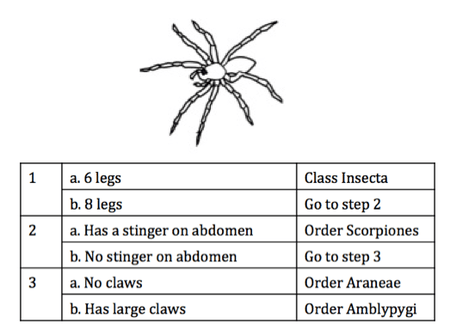
An illustration and a dichotomous key are given. What is the correct classification for this organism?
a)
Class Insecta
b)
Order Amblygygi
c)
Order Araneae
d)
Order Scorpiones
4.
A table of arachnid and insect characteristics is shown. Which characteristic could be used to distinguish between arachnids and insects?
a)
Jointed legs
b)
Body segments
c)
Presence of eyes
d)
Presence of antennae
5.
Which of the following is an accurate description of the fiddler crab?
a)
3 Paris of walking legs on both sides
b)
Two propodus
c)
3 Chelipeds
d)
A pair of eyes
6.
A student discovers an arachnid with a segmented abdomen, long legs, and a tail with no stinger.
The student uses the dichotomous key below to identify it.
1. a) Abdomen segmented.............go to 2
b) Abdomen not segmented ......go to 4
2. a) Abdomen with tail....................go to 3
b) Abdomen without tail...............go to 5
3. a) Tail with stinger..........................Scorpion
b) Tail without stinger.....................Whip scorpion
4. a) Legs longer than body.............Daddy Long Legs
b) Legs not longer than body……….Wind scorpion
5. a) Covered with spines .......................Mite
b) Few spines.....................................Tick
a)
Whip Scorpion
b)
Daddy Long Legs
c)
Mite
d)
Tick
7.
Which letter in the picture has two pairs of wings?
a)
M
b)
K
c)
F
d)
L
8.
Which of the paired statements could be used to tell the difference between the two insects using a dichotomous key?
a)
Has 6 legs
Has 8 legs
b)
Large hind legs
Small hind legs
c)
2 pairs of spots on wing cover
3 pairs of spots on wing cover
d)
Antennae absent
Antennae present
9.
Which shark is the picture of?
a)
Cow Shark
b)
Great White Shark
c)
Hammerhead Shark
d)
Saw Shark
Answer Key
Dichotomous Key Practice
Total questions: 9
1.
a) 1
2.
a) physical features
3.
c) Order Araneae
4.
d) Presence of antennae
5.
d)
A pair of eyes
6.
a)
Whip Scorpion
7.
b)
K
8.
c)
2 pairs of spots on wing cover
3 pairs of spots on wing cover
9.
b)
Great White Shark
140 %
Browse by subjects
Browse by grades
Browse by format
FAQs
What does the Dichotomous Key Practice worksheet cover?
This Grade 7 science worksheet uses nine multiple-choice questions to practice identifying organisms with dichotomous keys. Students select the correct starting step, focus on physical features, follow paired branches to classify an arachnid, and use illustrations and tables to compare traits such as antennae, wings, and body structures.
How can I use this worksheet to teach students to use a dichotomous key?
Introduce the idea that each decision in a dichotomous key uses one of two contrasting physical descriptions, then model how to follow the branches without skipping a step. Use the arachnid identification question to think aloud: have students track segmented abdomen, tail, and stinger choices before selecting the organism. Afterward, discuss which paired characteristics in the insect questions would produce clear, observable branches.
What mistakes should I watch for when students complete this dichotomous key worksheet?
Students may begin at the wrong numbered step, choose an organism’s environment or diet instead of an observable physical feature, or jump to a later branch without resolving the earlier choice. In the arachnid item, check that they distinguish a tail with a stinger from a tail without a stinger. Students may also select a trait that is shared by both organisms rather than a paired characteristic that actually separates the two insects.
How do I assign and grade the Dichotomous Key Practice worksheet?
Assign it as a printable PDF or as a digital quiz on Wayground; both versions contain the same nine multiple-choice items about applying dichotomous keys and comparing organism features. The worksheet includes a complete answer key for checking responses. For printable submissions, teachers can scan student work with the Wayground for Teachers app to grade it.
How can I differentiate this dichotomous key worksheet for my students?
In the worksheet’s Advanced Settings, adjust font spacing or choose a larger font size to make the numbered key, answer choices, and labeled illustrations easier to read. You can also apply a dyslexia-friendly font or translate the worksheet into another language while keeping the multiple-choice format focused on identifying organisms from physical features.
Where can I find more worksheets like this on Wayground?
Wayground offers a broad collection of free printable worksheets and practice problems across subjects, with downloadable PDFs and answer keys to support essential skills and concepts. Browse more resources at https://wayground.com/en-us/worksheets.

 Worksheets