

Wayground
Distance/Displacement (Physics) - Printable Physics Worksheets - Wayground

Distance/Displacement (Physics)

20 questions

9th - 12th Grade

Physics

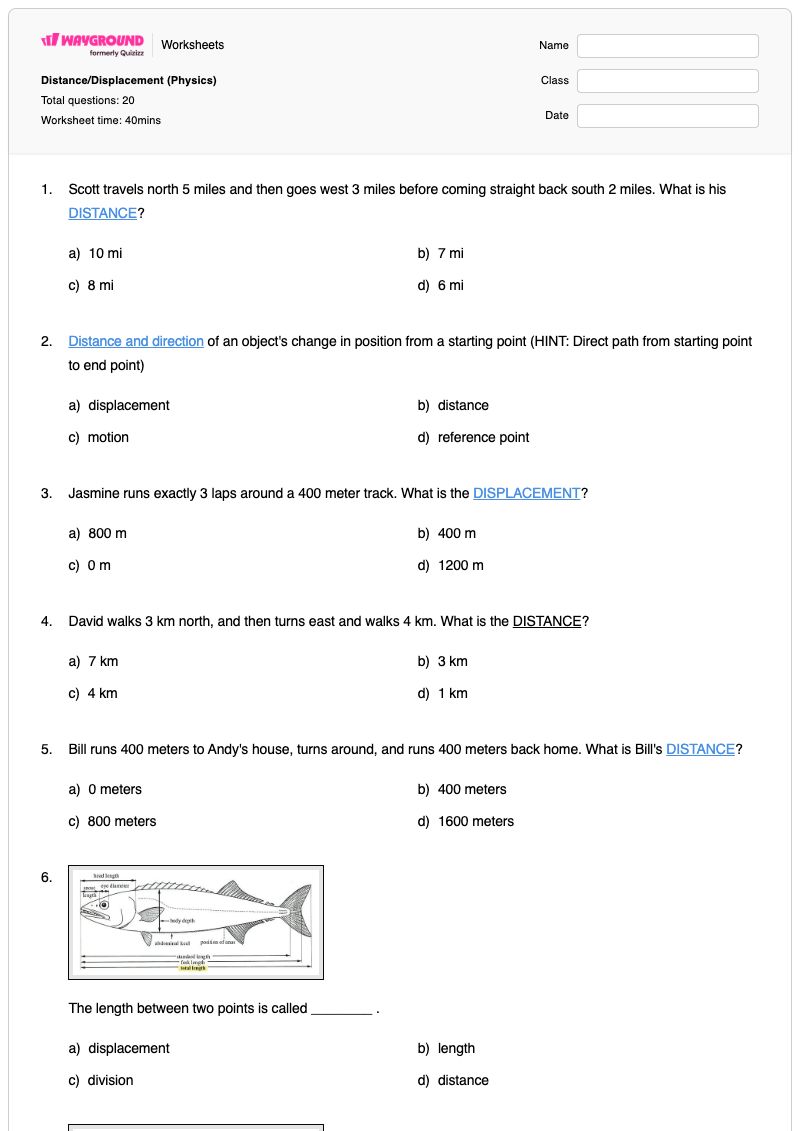
This free printable Distance/Displacement (Physics) worksheet helps students in Grades 9–12 distinguish between distance and displacement in motion scenarios. Across 20 questions—19 multiple-choice items and one multiple-select item—students identify definitions, calculate total distance along a path, determine displacement after round trips, and interpret displacement as a vector with magnitude and direction. Students also decide whether to add or subtract displacements in the same or opposite directions and when to use the Pythagorean theorem for perpendicular displacements. Examples involving tracks, routes, maps, and everyday movement give students practice connecting calculations to an object's starting and ending positions. The worksheet is suitable for physics instruction, guided practice, review, or independent assessment. It is available as a free printable worksheet with an answer key.

Worksheet settings

Font size

S
M
L
XL
Worksheets

Distance/Displacement (Physics)

Total questions: 20

Name
Class
Date
1.

Scott travels north 5 miles and then goes west 3 miles before coming straight back south 2 miles. What is his DISTANCE?

a)

10 mi

b)

7 mi

c)

8 mi

d)

6 mi

2.

Distance and direction of an object's change in position from a starting point (HINT: Direct path from starting point to end point)

a)

displacement

b)

distance

c)

motion

d)

reference point

3.

Jasmine runs exactly 3 laps around a 400 meter track. What is the DISPLACEMENT?

a)

800 m

b)

400 m

c)

0 m

d)

1200 m

4.

David walks 3 km north, and then turns east and walks 4 km. What is the DISTANCE?

a)

7 km

b)

3 km

c)

4 km

d)

1 km

5.

Bill runs 400 meters to Andy's house, turns around, and runs 400 meters back home. What is Bill's DISTANCE?

a)

0 meters

b)

400 meters

c)

800 meters

d)

1600 meters

6.
The length between two points is called ________ .
a)
displacement
b)
length
c)
division
d)
distance
7.

Find the DISTANCE Sara walks from A to B, B to C then C to D? (HINT: She does not complete the entire square!)

a)

11m

b)

3m

c)

5m

d)

16m

8.
After completing one trip on a roller coaster, the roller coaster's ________ is zero.
a)
displacement
b)
reference point
c)
length
d)
distance
9.

You should ___ when displacements are in the same direction

a)

add

b)

subtract

c)

do Pythagorean's Theorem (a2 + b2 = c2)

10.

You should ___ when displacements are in opposite directions

a)

add

b)

subtract

c)

do Pythagorean's Theorem (a2 + b2 = c2)

11.

You should ___ when displacements make a right angle

a)

add

b)

subtract

c)

do Pythagorean's Theorem (a2 + b2 = c2)

12.

What does magnitude mean?

a)

amount

b)

vector

c)

frame of reference

d)

motion

13.

Displacement is a vector because it has:

a)

magnitude

b)

direction

c)

motion

d)

frame of reference

14.
Ivan walks 10 meters west to the water fountain, then runs 2 meters east to his class to avoid a lockout. His displacement would be:
a)
8 meters
b)
8 meters, east
c)
8 meters, west
d)
12 meters
15.
During a game of dodgeball, Marina runs 2.45 meters forward to grab a dodgeball, then runs 1.25 meters backward to avoid a opponent's dodgeball. Her displacement would be:
a)
3.7 meters backwards
b)
1.2 meters backwards
c)
3.7 meters forwards
d)
1.2 meters forwards
16.
Ronaldo runs across a soccer field, moving 10 meters north, then 8 meters west. His displacement would be:
a)
10.2 m, NW
b)
12.8 m, NW
c)
15.4 m, NW
d)
18.0 m, NW
17.

David walks 7 km north, and then turns east and walks 5 km. What is the displacement?

a)

8.6 km NE

b)

74 km NE

c)

5 km NE

d)

12 km NE

18.
A person walks 50 meters directly north, stops, and then travels 32 meters directly south.  What is their displacement?
a)
82 meters
b)
18 meters
c)
28 meters
19.

Find Sara's DISPLACEMENT if she walks from A to B, B to C then C to D?

a)

5m E

b)

11m

c)

5m W

d)

0m

20.

Ivan walks 10 meters west to the water fountain, then runs 12 meters south to his class to avoid a lockout. His displacement would be:

a)

2 meters

b)

244 meters, SW

c)

15.6 meters, SW

d)

22 meters

Answer Key

Distance/Displacement (Physics)

Total questions: 20

1.
a)

10 mi

2.
a)

displacement

3.
c)

0 m

4.
a)

7 km

5.
c)

800 meters

6.
d) distance
7.
a)

11m

8.
a) displacement
9.
a)

add

10.
b)

subtract

11.
c)

do Pythagorean's Theorem (a2 + b2 = c2)

12.
a)

amount

13.
a)

magnitude

, b)

direction

14.
c) 8 meters, west
15.
d) 1.2 meters forwards
16.
b) 12.8 m, NW
17.
a)

8.6 km NE

18.
b) 18 meters
19.
a)

5m E

20.
c)

15.6 meters, SW

FAQs

What does this distance and displacement worksheet cover?

This Grade 9–12 physics worksheet uses 19 multiple-choice questions and one multiple-select question to practice distinguishing total distance traveled from displacement between a starting and ending position. Students calculate path length, determine direction and magnitude for opposite-direction motion, recognize zero displacement after a complete trip, and choose when to add, subtract, or use the Pythagorean theorem.

How can I use this worksheet to teach distance and displacement?

Introduce distance as the total path traveled and displacement as the direct change in position, then model one route problem and one round-trip example from the worksheet. Have students mark the starting and ending points before solving, and discuss why a completed lap can produce nonzero distance but zero displacement. Finish with the vector questions to connect direction and magnitude to the numerical answers.

What mistakes should I watch for when students complete this distance and displacement worksheet?

Students may report total distance when a question asks for displacement, especially in the track and return-trip scenarios. Watch for missed direction in opposite-direction problems, incorrect addition when motion reverses, and failure to identify displacement as a vector with both magnitude and direction. Students may also add perpendicular displacements directly instead of recognizing when the Pythagorean theorem applies.

How do I assign and grade this distance and displacement worksheet?

This worksheet is available as a printable PDF and as a digital quiz on Wayground, with a complete answer key included. Assign the PDF for handwritten practice or share the digital version for online responses; printable submissions can be graded by scanning student work with the Wayground for Teachers app.

How can I differentiate this distance and displacement worksheet for my students?

Use the worksheet’s Advanced Settings to adjust font spacing and font size so the route calculations, directional answer choices, and vector questions are easier to read. You can also enable a dyslexia-friendly font or translate the worksheet into another language when those options support access to the physics vocabulary and scenarios.

Where can I find more worksheets like this on Wayground?

Wayground offers a broad collection of free printable worksheets and practice problems across subjects, with downloadable PDFs and answer keys to help students master essential skills and concepts. Browse more resources at https://wayground.com/en-us/worksheets.