

Wayground
Topic 8.1 - Key Features of Quadratic Functions - Printable Math Worksheets year 12 - Wayground

Topic 8.1 - Key Features of Quadratic Functions

William Polascak

Created by William Polascak

20 questions

9th - 12th Grade

Math

Updated Oct 2026

This Grade 9–12 mathematics worksheet develops students’ ability to identify and interpret key features of quadratic functions. Across 20 items, students recognize quadratic form and terminology, match coefficients to variable terms, find vertices as ordered pairs, identify the axis of symmetry, and determine domain and range. They also analyze the direction a parabola opens, distinguish maximums from minimums, and identify x-intercepts, y-intercepts, and other graph features. The mixed-format practice includes dropdown, matching, fill-in-the-blank, drag-and-drop, multiple-choice, multiple-select, and graphing questions. Several items require students to evaluate whether statements about a quadratic graph are true or false, helping them connect equations, coordinates, and visual features rather than recall isolated definitions. Designed for Grades 9–12 mathematics instruction, this free printable worksheet includes a complete answer key for independent practice, review, homework, or formative assessment.

Worksheet settings

Font size

S
M
L
XL
WaygroundWorksheets

Topic 8.1 - Key Features of Quadratic Functions

Total questions: 20

Name
Class
Date
1.

A quadratic function is in the form of ​ (a)  

Choose from the below words

f(x)=ax2+bx+cf\left(x\right)=ax^2+bx+c  

f(x)=mx+bf\left(x\right)=mx+b  

f(x)=a(b)xf\left(x\right)=a\left(b\right)^x  

f(x)=∣x∣f\left(x\right)=\left|x\right|  

2.

Match the following term with the best definition.

parabola

The shape of a quadratic function

Axis of symmetry equation

x=−b2ax=\frac{-b}{2a}

vertex

The highest or lowest point

axis of symmetry

The line of reflection of a quadratic function

Quadratic Function Equation

Ax2+Bx+CAx^2+Bx+C

3.

Match the following coefficient with its term letter for the following quadratic

2x2−4x+32x^2-4x+3

2

A

-4

B

3

C

4.
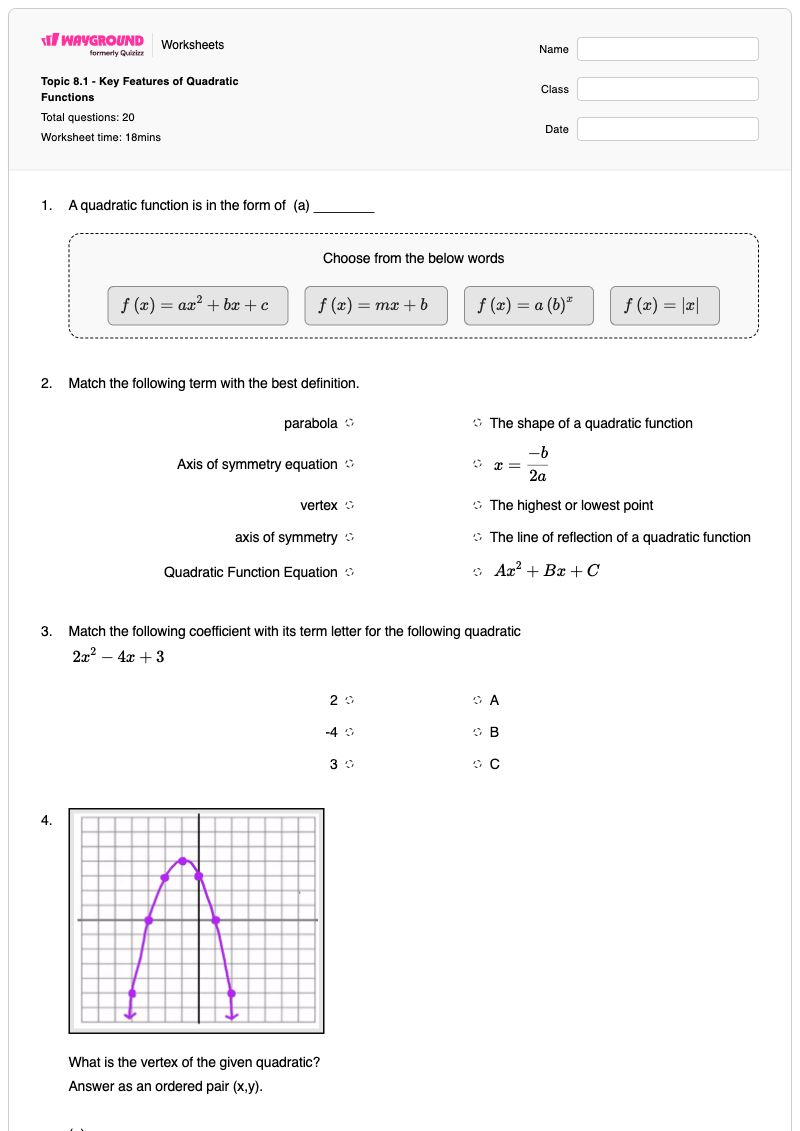
What is the vertex of the given quadratic? Answer as an ordered pair (x,y).

What is the vertex of the given quadratic?

Answer as an ordered pair (x,y).

(a)  

5.
Which best describes the axis of symmetry? ​ ​

Which best describes the axis of symmetry?

​ ​ (a)  

Choose from the below words
x = -1
y = 4
y = -1
y = -3
x = -3
x = 1
y = 1
6.
What is the RANGE of the graph?

What is the RANGE of the graph?

a)

y > -3

b)

y < -3

c)

All Real Numbers

d)

x > -3

e)

x < -3

7.

What does a NEGATIVE leading coefficient represent in a quadratic? Select all answers.

a)

It has a minimum

b)

It has a maximum

c)

It opens UPWARDS

d)

It opens DOWNWARDS

e)

The axis of symmetry is on a negative number

8.
What is the equation of the axis of symmetry?

What is the equation of the axis of symmetry?

a)

y = 0

b)

x = 0

c)

x = 3

d)

x = -3

9.
Which of the statements about the graph is FALSE?

Which of the statements about the graph is FALSE?

a)

The vertex is a maximum

b)

There are two zeros at x = -3 and x = 3

c)

The y-intercept is (0, 18)

d)

The range is y ≥ 18

10.
What is the significance of the ordered pair (0, -2) to the graph?

What is the significance of the ordered pair (0, -2) to the graph?

a)

It is the vertex

b)

It is an x-intercept

c)

It is the y-intercept

d)

It is the axis of symmetry

11.
What is the significance of the ordered pair (2, -4) to the graph?

What is the significance of the ordered pair (2, -4) to the graph?

a)

It is the vertex

b)

It is an x-intercept

c)

It is the y-intercept

d)

It is the axis of symmetry

12.
Which statement about the graph is FALSE?

Which statement about the graph is FALSE?

a)

The vertex is (-3, 18)

b)

The vertex is a maximum

c)

The y-intercept is y = 0

d)

The axis of symmetry is y = -3

13.
Which statement about the graph is FALSE?

Which statement about the graph is FALSE?

a)

The vertex is also a zero of the function

b)

The y-intercept is (0, -2)

c)

The axis of symmetry is x = 2

d)

The range is y ≥ 0

14.

Which function has a domain of all real numbers?

a)
Which function has a domain of all real numbers?
b)
Which function has a domain of all real numbers?
c)
Which function has a domain of all real numbers?
d)

All of the above

15.

Which of the following represents a quadratic equation?

a)

y=3x−4y=3x-4

b)

y=x2−4y=x^2-4

c)

y=2x3−4x2+2y=2x^3-4x^2+2

d)

y=12(3)xy=\frac{1}{2}\left(3\right)^x

16.

What is the axis of symmetry for the following equation?

Remember to use −b2a\frac{-b}{2a} to find the axis of symmetry.

y=x2−6x+1y=x^2-6x+1

x = ?

(a)  

17.
Describe the end behavior of the function.

Describe the end behavior of the function.

a)

as x→−∞, y→−∞as\ x→-∞,\ y\rightarrow-∞  
as x→∞, y→∞as\ x→∞,\ y\rightarrow∞  

b)

as x→−∞, y→∞as\ x→-∞,\ y\rightarrow∞  
as x→∞, y→−∞as\ x→∞,\ y\rightarrow-∞  

c)

as x →−∞, y →0as\ x\ →-∞,\ y\ \rightarrow0  
as x →∞, y →∞as\ x\ →∞,\ y\ \rightarrow∞  

d)

as x→−∞, y→∞as\ x→-∞,\ y\rightarrow∞  
as x→∞, y→∞as\ x→∞,\ y\rightarrow∞  

18.
Describe the end behavior of the function.

Describe the end behavior of the function.

a)

as x→−∞, y→−∞as\ x→-∞,\ y\rightarrow-∞  
as x→∞, y→−∞as\ x→∞,\ y\rightarrow-∞  

b)

as x→−∞, y→∞as\ x→-∞,\ y\rightarrow∞  
as x→∞, y→−∞as\ x→∞,\ y\rightarrow-∞  

c)

as x →−∞, y →−∞as\ x\ →-∞,\ y\ \rightarrow-\infty  
as x →∞, y →∞as\ x\ →∞,\ y\ \rightarrow∞  

d)

as x→−∞, y→∞as\ x→-∞,\ y\rightarrow∞  
as x→∞, y→∞as\ x→∞,\ y\rightarrow∞  

19.
The graph of quadratic function f is shown on the grid. Vertex: y-intercept: Axis of Symmetry: ​ Minimum Value:

The graph of quadratic function f is shown on the grid.

Vertex: (a)  

y-intercept: (b)  

Axis of Symmetry: ​ (c)  

Minimum Value: (d)  

Choose from the below words
(-3, -5)
(0, 4)
x = -3
-5
(-2, -4)
(-6, 4)
(4, 0)
4
x = -5
-4
20.

Graph a parabola whose maximum is at y=8y=8 , has an axis of symmetry at x=−3x=-3 , and a zero at x=2x=2 .

WaygroundAnswer Key

Topic 8.1 - Key Features of Quadratic Functions

Total questions: 20

1.

f(x)=ax2+bx+cf\left(x\right)=ax^2+bx+c  

2.

parabola

 - 

The shape of a quadratic function

, 

Axis of symmetry equation

 - 

x=−b2ax=\frac{-b}{2a}

, 

vertex

 - 

The highest or lowest point

, 

axis of symmetry

 - 

The line of reflection of a quadratic function

, 

Quadratic Function Equation

 - 

Ax2+Bx+CAx^2+Bx+C

3.

2

 - 

A

, 

-4

 - 

B

, 

3

 - 

C

4.
(-1,4), (-1, 4)
5.
x = -1
6.
a)

y > -3

7.
b)

It has a maximum

, d)

It opens DOWNWARDS

8.
b)

x = 0

9.
d)

The range is y ≥ 18

10.
c)

It is the y-intercept

11.
a)

It is the vertex

12.
d)

The axis of symmetry is y = -3

13.
d)

The range is y ≥ 0

14.
d)

All of the above

15.
b)

y=x2−4y=x^2-4

16.
3, x = 3, x=3
17.
d)

as x→−∞, y→∞as\ x→-∞,\ y\rightarrow∞  
as x→∞, y→∞as\ x→∞,\ y\rightarrow∞  

18.
a)

as x→−∞, y→−∞as\ x→-∞,\ y\rightarrow-∞  
as x→∞, y→−∞as\ x→∞,\ y\rightarrow-∞  

19.
(-3, -5), (0, 4), x = -3, -5
20.

FAQs

What does this worksheet cover about quadratic functions?

This worksheet practices identifying and interpreting quadratic-function features, including standard form, coefficients, vertex, axis of symmetry, domain, range, opening direction, and intercepts. Its 20 mixed-format questions ask students to match vocabulary, enter a vertex, select or drag graph features, evaluate true-and-false statements, and complete a graphing item, strengthening connections between quadratic equations and their graphs.

How can I use this worksheet to teach key features of quadratic functions?

Introduce the worksheet by reviewing the vocabulary students will match, then model how a vertex, axis of symmetry, opening direction, and intercepts appear in an equation or graph. Have students explain the evidence for each selected graph statement, especially items asking which statement is false, and use the multiple-select question to discuss why a negative leading coefficient indicates a downward-opening parabola with a maximum. Finish with the graphing item as an opportunity to synthesize the features.

What mistakes should I watch for on this quadratic-functions worksheet?

Watch for students reversing x- and y-coordinates when recording a vertex or confusing the vertex with an intercept. Common errors also include writing the axis of symmetry as a y-value instead of an equation in x, mixing up domain and range, and treating a negative leading coefficient as evidence that a parabola opens upward. In multiple-select and false-statement items, check that students evaluate every option rather than selecting only the first statement that seems plausible.

How do I assign and grade this quadratic-functions worksheet?

The worksheet is available on Wayground as a printable PDF and as a digital quiz, with a complete answer key for all 20 items. Assign the digital version for automatic quiz scoring, or collect printed responses and grade them using the key; printable student work can also be scanned with the Wayground for Teachers app. The printable format can support schools that want to reduce screen time while students practice interpreting quadratic graphs and equations.

How can I differentiate this quadratic-functions worksheet for my students?

Use the worksheet’s Advanced Settings to adjust font spacing and font size so the mixed-format prompts, equations, and graphing directions are easier to read. You can also enable a dyslexia-friendly font or translate the worksheet into another language when those options support access to the vocabulary and directions. These changes preserve the quadratic-function tasks while adapting the worksheet file’s presentation.

Where can I find more worksheets like this on Wayground?

Wayground offers a broad collection of free printable worksheets and practice problems across subjects, with downloadable PDFs and answer keys to support mastery of essential skills and concepts. Browse more resources at https://wayground.com/en-us/worksheets.