

Wayground
Price Levels- AD, SRAS, LRAS - Printable Social studies Worksheets year 12 - Wayground

Price Levels- AD, SRAS, LRAS

Travis Miller

Created by Travis Miller

19 questions

12th Grade

Social studies

Updated Feb 2026

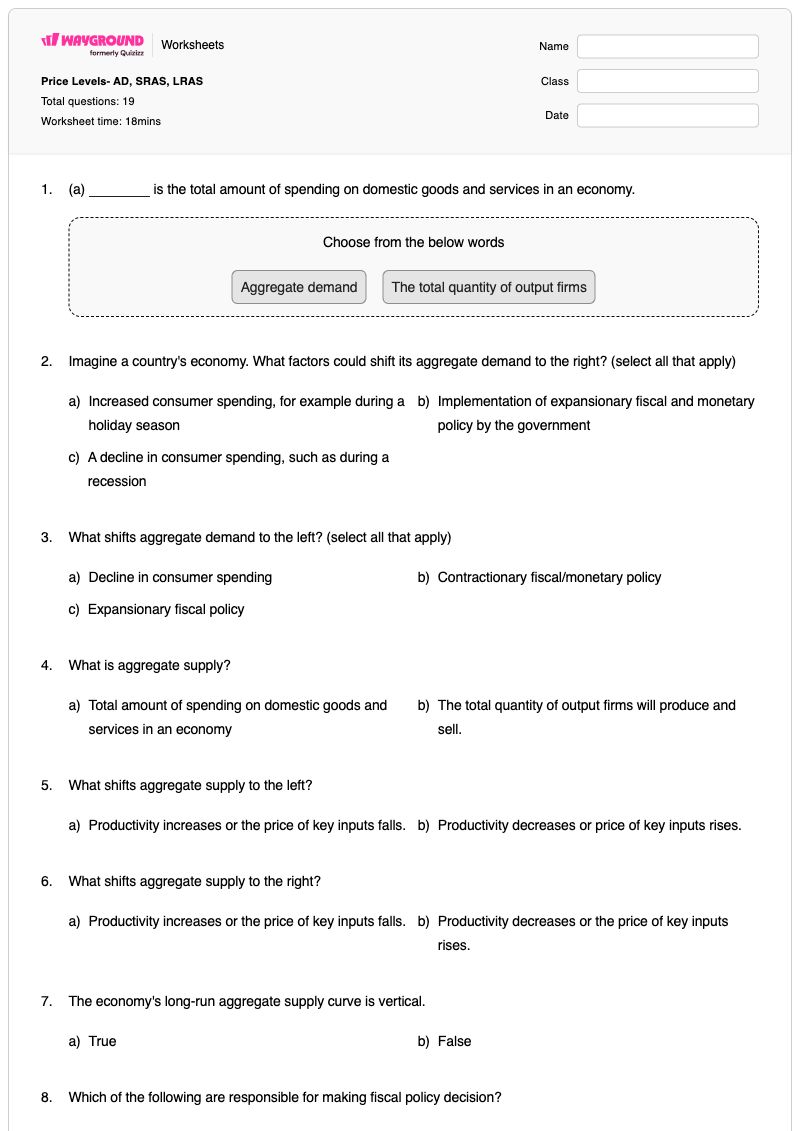
Price Levels- AD, SRAS, LRAS is a Grade 12 social studies worksheet on how aggregate demand, short-run aggregate supply, and long-run aggregate supply shape the economy’s price level and output. Students distinguish aggregate demand as total spending from aggregate supply as the quantity firms produce, identify factors that shift each curve, and recognize why the long-run aggregate supply curve is vertical. The 19 questions use one drag-and-drop item, four multiple-select questions, and 14 multiple-choice questions. The worksheet also connects fiscal and monetary policy to economic outcomes, including expansionary and contractionary policy, government spending and taxation, money supply, inflation, unemployment, and the business cycle. This free printable worksheet includes an answer key, making it useful for guided instruction, independent practice, or assessment of students’ understanding of AD, SRAS, LRAS, and related policy decisions.

Worksheet settings

Font size

S
M
L
XL
WaygroundWorksheets

Price Levels- AD, SRAS, LRAS

Total questions: 19

Name
Class
Date
1.

(a)   is the total amount of spending on domestic goods and services in an economy.

Choose from the below words
Aggregate demand
The total quantity of output firms
2.

Imagine a country's economy. What factors could shift its aggregate demand to the right? (select all that apply)

a)

Increased consumer spending, for example during a holiday season

b)

Implementation of expansionary fiscal and monetary policy by the government

c)

A decline in consumer spending, such as during a recession

3.

What shifts aggregate demand to the left? (select all that apply)

a)

Decline in consumer spending

b)

Contractionary fiscal/monetary policy

c)

Expansionary fiscal policy

4.

What is aggregate supply?

a)

Total amount of spending on domestic goods and services in an economy

b)

The total quantity of output firms will produce and sell.

5.

What shifts aggregate supply to the left?

a)

Productivity increases or the price of key inputs falls.

b)

Productivity decreases or price of key inputs rises.

6.

What shifts aggregate supply to the right?

a)

Productivity increases or the price of key inputs falls.

b)

Productivity decreases or the price of key inputs rises.

7.

The economy's long-run aggregate supply curve is vertical.

a)

True

b)

False

8.
Which of the following are responsible for making fiscal policy decision? 
a)
The President and Congress
b)
The Federal Reserve System
c)
The National Council of Economic Advisors
d)
The commerce Department
9.

The federal government's overall approach to spending and taxes is called

a)

Physical Policy

b)

Fiscal Policy

c)

вежба

d)

Monetary Policy

10.
Fiscal Policy is concerned with
a)
Government Spending and taxation
b)
Consumer spending and productivity
c)
Government spending and the money supply
d)
Taxation and inflation
11.

Examples of contractionary fiscal policy includes which of the following (choose all correct answers)?

a)

Raise taxes on corporations

b)

Lower the corporate tax rate

c)

Government increases spending on research in Antarctica

d)

Government cuts spending on education

12.

The goals of monetary policy include (more than one answer - pick all correct answers for credit):

a)

regulating the amount of money circulating in the economy

b)

Keep inflation high

c)

Keep inflation low

d)

Keep unemployment low

e)

Raise the unemployment levels

13.
Taxing & spending to help the economy grow is referred to as
a)
expansionary policy
b)
monetary policy
c)
contractionary policy
d)
budget deficit
14.
An example of expansionary fiscal policy would be
a)
cutting taxes.
b)
cutting government spending.
c)
cutting production of consumer goods.
d)
cutting prices of consumer goods.
15.
Which phase of the business cycle is marked by inflation?
a)
expansion
b)
peak
c)
contraction
d)
trough
16.
The systematic ups and downs of the economy are best demonstrated by looking at the ___________________.
a)
rate of inflation
b)
business cycle
c)
unemployment rate
d)
tax schedule
17.
Which type of unemployment occurs during a recession or you were recently laid off due to tough financial times in your community?
a)
structural
b)
frictional
c)
cyclical
d)
seasonal
18.
What does the vertical axis represent on the aggregate demand curve?
a)
Total Input
b)
Total Output
c)
Price Level
d)
Both A&B
19.
The intersection of the aggregate demand and aggregate supply curve occurs at the economy’s equilibrium level of
a)
Nominal investment and the interest rate       
b)
Government taxes and employment
c)
Real disposable income and unemployment     
d)
Real domestic output and the price level
WaygroundAnswer Key

Price Levels- AD, SRAS, LRAS

Total questions: 19

1.
Aggregate demand
2.
b)

Implementation of expansionary fiscal and monetary policy by the government

, a)

Increased consumer spending, for example during a holiday season

3.
a)

Decline in consumer spending

, b)

Contractionary fiscal/monetary policy

4.
b)

The total quantity of output firms will produce and sell.

5.
b)

Productivity decreases or price of key inputs rises.

6.
a)

Productivity increases or the price of key inputs falls.

7.
a)

True

8.
a) The President and Congress
9.
b)

Fiscal Policy

10.
a) Government Spending and taxation
11.
a)

Raise taxes on corporations

, d)

Government cuts spending on education

12.
a)

regulating the amount of money circulating in the economy

, c)

Keep inflation low

, d)

Keep unemployment low

13.
a) expansionary policy
14.
a) cutting taxes.
15.
a) expansion
16.
b) business cycle
17.
c) cyclical
18.
c) Price Level
19.
d) Real domestic output and the price level

FAQs

What does the Price Levels- AD, SRAS, LRAS worksheet cover?

This Grade 12 worksheet covers aggregate demand, aggregate supply, long-run aggregate supply, and the factors that shift these curves. Through one drag-and-drop item, four multiple-select questions, and 14 multiple-choice questions, students classify spending and production concepts, identify rightward and leftward shifts, and connect fiscal and monetary policy to inflation, unemployment, and economic growth.

How can I use this worksheet to teach shifts in AD and AS?

Introduce aggregate demand as total spending and aggregate supply as the quantity firms produce, then have students explain why each example shifts a curve right or left. Use the multiple-select items as discussion prompts: ask students to justify how consumer spending, fiscal or monetary policy, productivity, and input prices affect the economy before they complete the remaining policy and business-cycle questions.

What mistakes should I watch for when students complete this worksheet?

Students may confuse aggregate demand with aggregate supply, select a recession-related decline in consumer spending as a rightward AD shift, or reverse the effects of productivity and input prices on aggregate supply. In the multiple-select questions, check that students choose every correct factor without selecting distractors, and watch for confusion between fiscal policy decisions by the President and Congress and monetary policy goals such as controlling inflation and unemployment.

How do I assign and grade this AD, SRAS, and LRAS worksheet?

The worksheet is available as a printable PDF and as a digital quiz on Wayground, with a complete answer key for all 19 items. Printable submissions can be graded by scanning student work with the Wayground for Teachers app, while the digital version supports online assignment and grading.

How can I differentiate this aggregate demand and supply worksheet for my students?

In the worksheet’s Advanced Settings, adjust font spacing and font size to make the curve-shift, policy, and business-cycle questions easier to read. You can also apply a dyslexia-friendly font or translate the worksheet into another language while keeping its drag-and-drop, multiple-select, and multiple-choice format.

Where can I find more worksheets like this on Wayground?

Wayground offers a comprehensive collection of free printable worksheets and practice problems across subjects, with downloadable PDFs and answer keys to help students master essential skills and concepts. Browse more resources at https://wayground.com/en-us/worksheets.