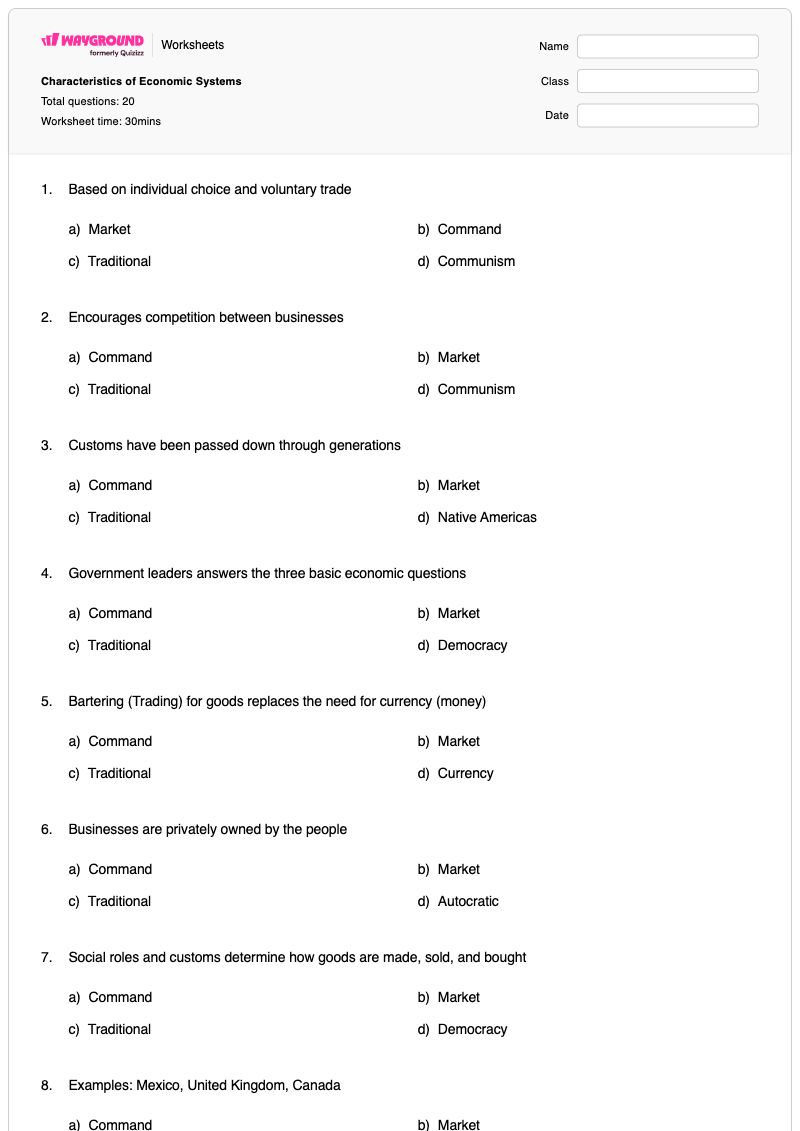
Characteristics of Economic Systems is a Grade 6 Social Studies worksheet that helps students distinguish among market, command, and traditional economies. Through 20 multiple-choice questions, students identify systems from defining features such as individual choice and voluntary trade, competition, private business ownership, government control, customs passed through generations, bartering, and supply and demand.
The questions also ask students to connect economic systems with examples, including Mexico, the United Kingdom, Canada, Cuba, North Korea, the former Soviet Union, Amish communities, and villages in Africa and South America. This free printable worksheet supports vocabulary review, independent practice, or a quick check of students’ ability to classify economic characteristics. A complete answer key is included for efficient review and grading.
Worksheet settings
Font size
S
M
L
XL
Worksheets
Characteristics of Economic Systems
Total questions: 20
Name
Class
Date
1.
Based on individual choice and voluntary trade
a)
Market
b)
Command
c)
Traditional
d)
Communism
2.
Encourages competition between businesses
a)
Command
b)
Market
c)
Traditional
d)
Communism
3.
Customs have been passed down through generations
a)
Command
b)
Market
c)
Traditional
d)
Native Americas
4.
Government leaders answers the three basic economic questions
a)
Command
b)
Market
c)
Traditional
d)
Democracy
5.
Bartering (Trading) for goods replaces the need for currency (money)
a)
Command
b)
Market
c)
Traditional
d)
Currency
6.
Businesses are privately owned by the people
a)
Command
b)
Market
c)
Traditional
d)
Autocratic
7.
Social roles and customs determine how goods are made, sold, and bought
a)
Command
b)
Market
c)
Traditional
d)
Democracy
8.
Examples: Mexico, United Kingdom, Canada
a)
Command
b)
Market
c)
Traditional
d)
Autocratic
9.
Type of economy in communist countries
a)
Command
b)
Market
c)
Traditional
d)
Democracy
10.
Examples: Cuba, North Korea, and the former Soviet Union
a)
Command
b)
Market
c)
Traditional
d)
Democracy
11.
Children often do the same job as their parents
a)
Command
b)
Market
c)
Traditional
d)
Natives
12.
Consumers determine what will or will not be sold based on supply and demand
a)
Democracy
b)
Command
c)
Market
d)
Traditional
13.
Examples: The Amish Community, villages in Africa & South America
a)
Command
b)
Capitalism
c)
Traditional
d)
Market
14.
No incentives for workers or equal pay
a)
Command
b)
Market
c)
Autocratic
d)
Traditional
15.
Limited government role
a)
Traditional
b)
Command
c)
Supply and Demand
d)
Market
16.
There are no pure command economies.
a)
True
b)
False
17.
All economies are either command or market. None are mixed.
a)
True
b)
False
18.
There are no pure market economies.
a)
False
b)
True
19.
Market economies are typically found in countries with a democratic government.
a)
True
b)
False
20.
Economics is the study of the past and how it affects the future.
a)
False
b)
True
Answer Key
Characteristics of Economic Systems
Total questions: 20
1.
a)
Market
2.
b)
Market
3.
c)
Traditional
4.
a)
Command
5.
c)
Traditional
6.
b)
Market
7.
c)
Traditional
8.
b)
Market
9.
a)
Command
10.
a)
Command
11.
c)
Traditional
12.
c)
Market
13.
c)
Traditional
14.
a)
Command
15.
d)
Market
16.
a)
True
17.
b)
False
18.
b)
True
19.
a)
True
20.
a)
False
140 %
Browse by subjects
Browse by grades
Browse by format
FAQs
What does the Characteristics of Economic Systems worksheet cover?
This Grade 6 Social Studies worksheet uses 20 multiple-choice questions to assess whether students can identify market, command, and traditional economic systems from descriptions and examples. Students classify features such as voluntary trade, private ownership, government answers to economic questions, inherited customs, bartering, and supply and demand.
How can I use this worksheet to teach the characteristics of economic systems?
Introduce the three systems with a comparison chart, then have students underline the clue in each multiple-choice prompt that identifies the system. After students complete the worksheet, discuss why clues such as competition and consumer choice point to a market system, while government control or inherited customs point to command or traditional systems.
What mistakes should I watch for when students complete this economic systems worksheet?
Students may confuse a market economy’s limited government role and private ownership with a command economy, which is identified here by government leaders answering the three basic economic questions. They may also overlook traditional-economy clues such as customs passed through generations, children doing the same work as their parents, or bartering instead of using currency.
How do I assign and grade this economic systems worksheet?
You can assign Characteristics of Economic Systems as a printable PDF or as a digital quiz on Wayground. It includes a complete answer key, and printable student work can be graded by scanning it with the Wayground for Teachers app. The printable format also gives schools an option for reducing screen time.
How can I differentiate this worksheet for my students?
In the worksheet’s Advanced Settings, adjust font spacing or choose a larger font size to make the 20 multiple-choice items easier to read. You can also enable a dyslexia-friendly font or translate the worksheet into another language while students compare the economic-system clues and examples.
Where can I find more worksheets like this on Wayground?
Wayground offers a broad collection of free printable worksheets and practice problems across subjects, with downloadable PDFs and answer keys to support essential skills and concepts. Browse more resources at https://wayground.com/en-us/worksheets.


 Worksheets