

Wayground
Plant and Animal Cells - Printable Science Worksheets year 9 - Wayground

Plant and Animal Cells

21 questions

9th - 9th Grade

Science

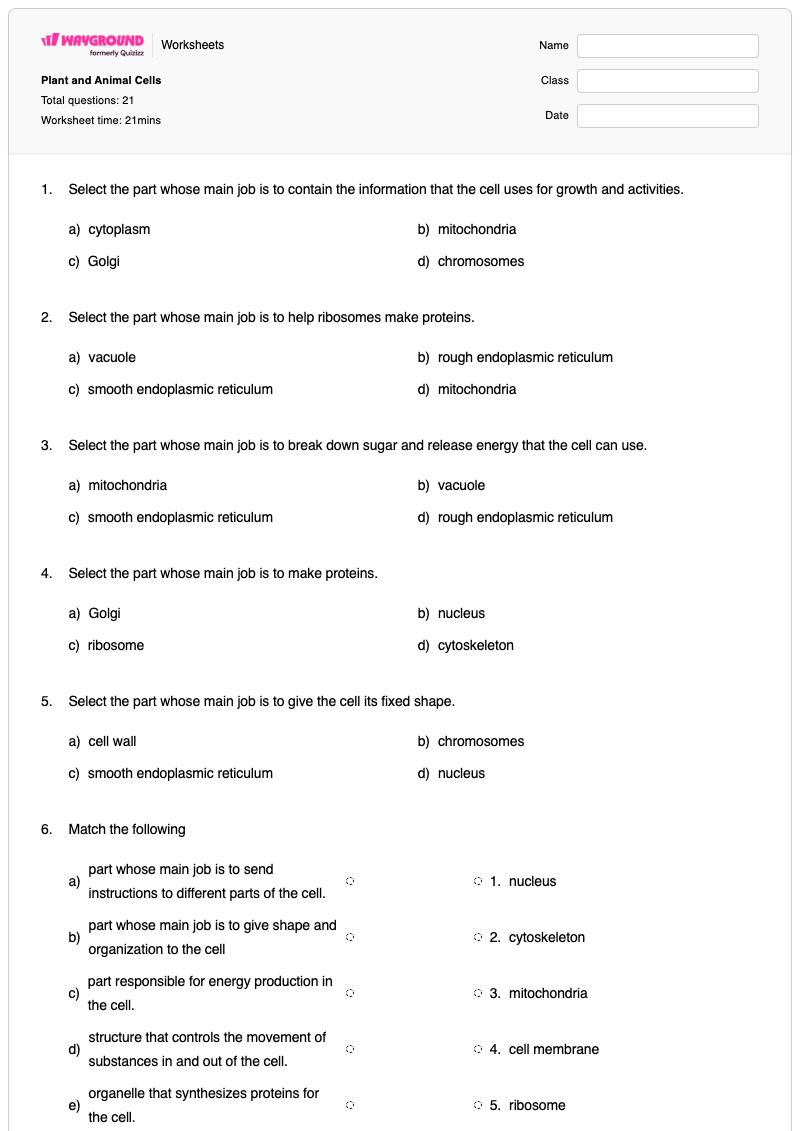
Plant and Animal Cells is a Grade 9 science worksheet that helps students connect cell structures with their main functions. Across 21 items, students identify chromosomes, rough endoplasmic reticulum, mitochondria, ribosomes, the cell wall, chloroplasts, vacuoles, and other cell parts through multiple-choice and matching questions. They also complete function-based fill-in-the-blank items and label structures on cell diagrams using drag-and-drop responses. This worksheet reinforces the relationship between an organelle’s name, location, and role in cell activities, including energy release, protein production, information storage, transport, support, and photosynthesis. It is useful for introducing or reviewing plant and animal cell structures in Grade 9 science, checking whether students can apply function clues rather than rely only on memorization, and identifying areas that need further instruction. The free printable worksheet includes a complete answer key for efficient review and grading.

Worksheet settings

Font size

S
M
L
XL
Worksheets

Plant and Animal Cells

Total questions: 21

Name
Class
Date
1.

Select the part whose main job is to contain the information that the cell uses for growth and activities.

a)

cytoplasm

b)

mitochondria

c)

Golgi

d)

chromosomes

2.

Select the part whose main job is to help ribosomes make proteins.

a)

vacuole

b)

rough endoplasmic reticulum

c)

smooth endoplasmic reticulum

d)

mitochondria

3.

Select the part whose main job is to break down sugar and release energy that the cell can use.

a)

mitochondria

b)

vacuole

c)

smooth endoplasmic reticulum

d)

rough endoplasmic reticulum

4.

Select the part whose main job is to make proteins.

a)

Golgi

b)

nucleus

c)

ribosome

d)

cytoskeleton

5.

Select the part whose main job is to give the cell its fixed shape.

a)

cell wall

b)

chromosomes

c)

smooth endoplasmic reticulum

d)

nucleus

6.

Match the following

part whose main job is to send instructions to different parts of the cell.

nucleus

part whose main job is to give shape and organization to the cell

cytoskeleton

part responsible for energy production in the cell.

mitochondria

structure that controls the movement of substances in and out of the cell.

cell membrane

organelle that synthesizes proteins for the cell.

ribosome

7.

Match the following

part whose main job is to make lipids.

smooth endoplasmic reticulum

part whose main job is to send proteins and other substances to different parts of the cell.

Golgi apparatus

part whose main job is to fill the space between the cell membrane and the nucleus.

cytoplasm

part whose main job is to control which substances enter and leave the cell.

cell membrane

part whose main job is to store sugar and other nutrients in the cell.

vacuole

8.

Select the part whose main job is to use energy from sunlight to make sugar.

a)

chloroplast

b)

ribosome

c)

chromosomes

d)

cell wall

9.

What is the main function of the vacuole in a plant cell?

a)

to store waste in the cell

b)

to make proteins

c)

to produce steroid hormones

d)

to package proteins and other substances and send them to different parts of the cell

10.

What is the main function of the mitochondria in a plant cell?

a)

to break down sugar and release energy that the cell can use

b)

to use energy from sunlight to make sugar

c)

to control which substances enter and leave the cell

d)

to produce steroid hormones

11.

What is the main function of the cell wall in a plant cell?

a)

to use energy from sunlight to make sugar

b)

to direct cell activities by sending instructions to different parts of the cell

c)

to fill the space between the cell membrane and the nucleus

d)

to give strength and stiffness to the cell

12.

The main function of the (a)   in a plant cell is to direct cell activities by sending instructions to different parts of the cell.

13.

The major function of the (a)   in a plant cell is to make proteins.

14.

Label the three cell parts on the diagram.

15.

Label the three cell parts on the diagram below.

16.

Label the three cell parts on the diagram below.

17.

Label the three parts of the plant cell.

18.

Match the following

the part whose main job is to break down waste

lysosome

the part whose main job is to direct cell activities by sending instructions to different parts of the cell.


nucleus

the part whose main job is to store water in the cell

vacuole

the part whose main job is to make proteins.

ribosome

the part whose main job is to send proteins and other substances to the cell membrane to be released

golgi apparatus

19.

Match the following

the part whose main job is to break down worn-out cell parts

lysosome

the part whose main job is to pull the replicated chromosomes apart during cell division

centrioles

the part whose main job is to transport proteins

rough endoplasmic reticulum

the part whose main job is to control which substances enter and leave the cell

plasma membrane

the part whose main job is to break down sugar and release energy that the cell can use

mitochondria

20.

Label the three parts of the animal cell.

21.
Question Image

Match the following

A

Cell Membrane

B

Cell Wall

E

Nucleus

J

Chloroplast

L

Central Vacuole

Answer Key

Plant and Animal Cells

Total questions: 21

1.
d)

chromosomes

2.
b)

rough endoplasmic reticulum

3.
a)

mitochondria

4.
c)

ribosome

5.
a)

cell wall

6.

part whose main job is to send instructions to different parts of the cell.

 - 

nucleus

, 

part whose main job is to give shape and organization to the cell

 - 

cytoskeleton

, 

part responsible for energy production in the cell.

 - 

mitochondria

, 

structure that controls the movement of substances in and out of the cell.

 - 

cell membrane

, 

organelle that synthesizes proteins for the cell.

 - 

ribosome

7.

part whose main job is to make lipids.

 - 

smooth endoplasmic reticulum

, 

part whose main job is to send proteins and other substances to different parts of the cell.

 - 

Golgi apparatus

, 

part whose main job is to fill the space between the cell membrane and the nucleus.

 - 

cytoplasm

, 

part whose main job is to control which substances enter and leave the cell.

 - 

cell membrane

, 

part whose main job is to store sugar and other nutrients in the cell.

 - 

vacuole

8.
a)

chloroplast

9.
a)

to store waste in the cell

10.
a)

to break down sugar and release energy that the cell can use

11.
d)

to give strength and stiffness to the cell

12.
nucleus
13.
ribosome
14.
15.
16.
17.
18.

the part whose main job is to break down waste

 - 

lysosome

, 

the part whose main job is to direct cell activities by sending instructions to different parts of the cell.


 - 

nucleus

, 

the part whose main job is to store water in the cell

 - 

vacuole

, 

the part whose main job is to make proteins.

 - 

ribosome

, 

the part whose main job is to send proteins and other substances to the cell membrane to be released

 - 

golgi apparatus

19.

the part whose main job is to break down worn-out cell parts

 - 

lysosome

, 

the part whose main job is to pull the replicated chromosomes apart during cell division

 - 

centrioles

, 

the part whose main job is to transport proteins

 - 

rough endoplasmic reticulum

, 

the part whose main job is to control which substances enter and leave the cell

 - 

plasma membrane

, 

the part whose main job is to break down sugar and release energy that the cell can use

 - 

mitochondria

20.
21.

A

 - 

Cell Membrane

, 

B

 - 

Cell Wall

, 

E

 - 

Nucleus

, 

J

 - 

Chloroplast

, 

L

 - 

Central Vacuole

FAQs

What does the Plant and Animal Cells worksheet cover?

This Grade 9 science worksheet asks students to identify cell parts from function clues, match structures with descriptions, complete two function-based blanks, and label cell diagrams with drag-and-drop responses. It specifically practices distinguishing roles such as chromosomes storing information, ribosomes making proteins, mitochondria releasing usable energy, chloroplasts using sunlight to make sugar, and the cell wall providing strength.

How can I use this worksheet to teach plant and animal cell functions?

Introduce the worksheet by reviewing a cell diagram and asking students to explain what each organelle does before they see the answer choices. Then have students complete the multiple-choice and matching items, using the function descriptions to justify choices, before assigning the fill-in-the-blank and diagram-labeling sections as an application check. Discuss contrasts that appear in the worksheet, such as chloroplasts using sunlight to make sugar and mitochondria breaking down sugar to release energy.

What mistakes should I watch for on the Plant and Animal Cells worksheet?

Watch for students choosing an organelle based on a familiar name instead of its stated function, especially confusing ribosomes with rough endoplasmic reticulum or mitochondria with chloroplasts. In the plant-cell items, students may confuse the cell wall’s role in strength and stiffness with the cell membrane’s role in controlling movement, or confuse the nucleus with chromosomes. Review diagram labels carefully, since students must identify structures spatially as well as recognize their functions.

How do I assign and grade this Plant and Animal Cells worksheet?

The worksheet is available as a printable PDF and as a digital quiz on Wayground, with a complete answer key for all 21 multiple-choice, matching, fill-in-the-blank, and drag-and-drop image items. Assign the digital version for online completion, or print the PDF and grade student responses using the answer key; printable submissions can also be graded by scanning student work with the Wayground for Teachers app. The printable option can support schools that are reducing screen time.

How can I differentiate this cell organelles worksheet for my students?

Use the worksheet’s Advanced Settings to increase font size or spacing when students need more room to read function descriptions, match structures, or work with the diagram labels. You can also enable a dyslexia-friendly font or translate the worksheet into another language to make the organelle names and function prompts more accessible. These adjustments apply to the worksheet itself, including its matching, fill-in-the-blank, and labeling items.

Where can I find more worksheets like this on Wayground?

Wayground offers a broad collection of free printable worksheets and practice problems across subjects, with downloadable PDFs and answer keys to help students master essential skills and concepts. Browse more resources at https://wayground.com/en-us/worksheets.