

Wayground
Gallopade Chapter 2 Quiz - Influences on Colonial Life - Printable Social studies Worksheets year 8 - Wayground

Gallopade Chapter 2 Quiz - Influences on Colonial Life

Cuyler Lanier

Created by Cuyler Lanier

17 questions

8th Grade

Social studies

Updated Sept 2026

Gallopade Chapter 2 Quiz – Influences on Colonial Life is a Grade 8 social studies worksheet that reviews how Spanish, French, and British goals shaped settlement in North America. Students compare motivations such as gaining gold, spreading Catholicism, expanding empires, escaping religious persecution, and supporting mercantilism, while identifying differences in colonial locations and economic activity, including French fur trading ports and British Navigation Acts. This 17-question quiz uses multiple-choice, multiple-select, and fill-in-the-blank items to assess cause-and-effect reasoning and accurate use of historical terms. Questions also address the development of slavery, passive forms of resistance, the Middle Passage, Thomas Hooker’s views on voting, and the First Great Awakening’s influence on colonial unity and religious tolerance. It is a free printable worksheet with a complete answer key for Grade 8 review, independent practice, or assessment.

Worksheet settings

Font size

S
M
L
XL
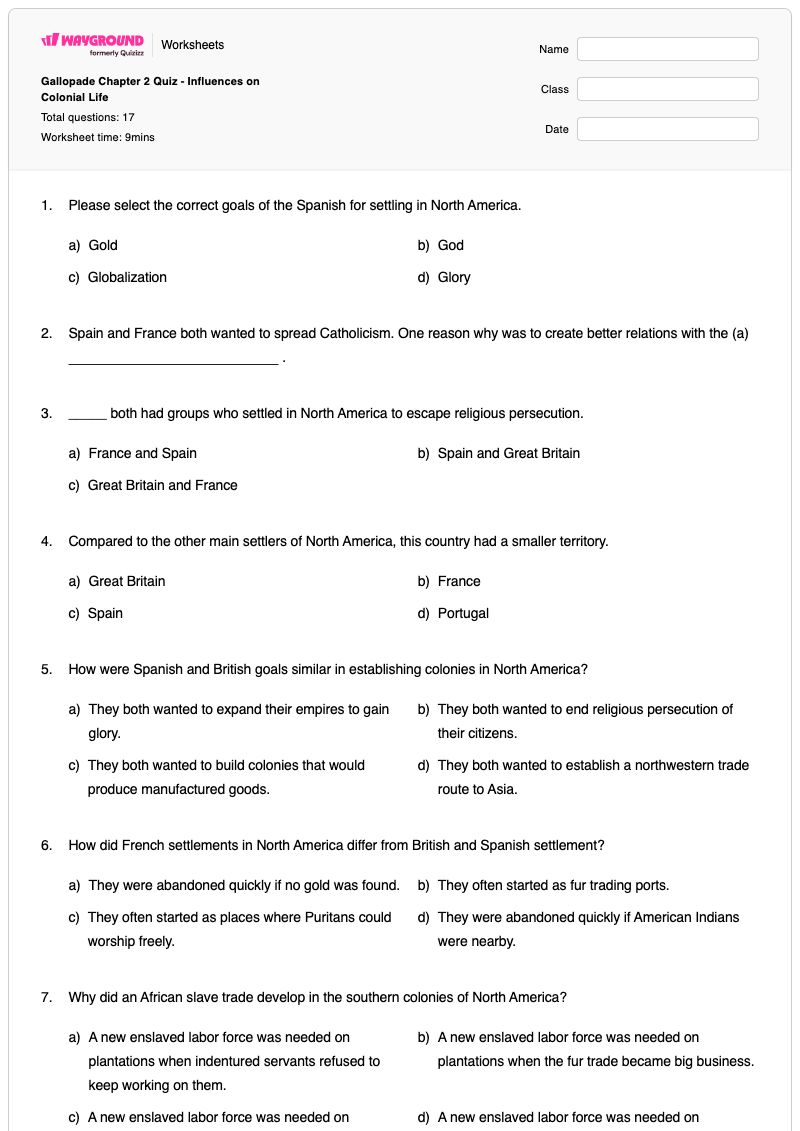
WaygroundWorksheets

Gallopade Chapter 2 Quiz - Influences on Colonial Life

Total questions: 17

Name
Class
Date
1.

Please select the correct goals of the Spanish for settling in North America.

a)

Gold

b)

God

c)

Globalization

d)

Glory

2.

Spain and France both wanted to spread Catholicism. One reason why was to create better relations with the (a)   .

3.

_____ both had groups who settled in North America to escape religious persecution.

a)

France and Spain

b)

Spain and Great Britain

c)

Great Britain and France

4.

Compared to the other main settlers of North America, this country had a smaller territory.

a)

Great Britain

b)

France

c)

Spain

d)

Portugal

5.

How were Spanish and British goals similar in establishing colonies in North America?

a)

They both wanted to expand their empires to gain glory.

b)

They both wanted to end religious persecution of their citizens.

c)

They both wanted to build colonies that would produce manufactured goods.

d)

They both wanted to establish a northwestern trade route to Asia.

6.

How did French settlements in North America differ from British and Spanish settlement?

a)

They were abandoned quickly if no gold was found.

b)

They often started as fur trading ports.

c)

They often started as places where Puritans could worship freely.

d)

They were abandoned quickly if American Indians were nearby.

7.

Why did an African slave trade develop in the southern colonies of North America?

a)

A new enslaved labor force was needed on plantations when indentured servants refused to keep working on them.

b)

A new enslaved labor force was needed on plantations when the fur trade became big business.

c)

A new enslaved labor force was needed on plantations when the original cash crop failed.

d)

A new enslaved labor force was needed on plantations when European diseases killed large numbers of indigenous people.

8.

How did the location of French colonies differ from the location of Spanish colonies in North America?

a)

French colonies were farther west

b)

French colonies were farther east

c)

French colonies were farther north

d)

French colonies were farther south

9.

How did slavery first develop in the American colonies?

a)

Plantations owners tricked indentured servants into signing slavery contracts.

b)

Plantation owners forced indigenous people to provide labor growing cash crops.

c)

Plantation owners brought African slaves with them from Europe to provide labor growing cash crops.

d)

Plantation owners enslaved poor European immigrants who could not pay their debts.

10.

Which of these examples were passive forms of resistance to enslavement? (Choose three)

a)

appealing to judges for freedom

b)

pretending to be ill

c)

leading rebellions and running away

d)

working slowly or breaking tools needed to do work

e)

remaining strong and using music and religion for self-expression

11.

Throwback Question: Who did Thomas Hooker think should have the right to vote?

a)

all men who owned land

b)

all men

c)

all Puritan men who owned land

d)

all Puritan men

12.

Choose the correct title to complete the outline:

1. ________________________

A. Millions of slaves were transported across the Atlantic Ocean.

B. journey across a section of a major trade route between Africa and the Americas

C. featured cruel and inhumane conditions on slave ships

a)

Mercantilism

b)

Middle Passage

c)

Slave Smuggling

d)

Triangular Trade

13.

Why did Great Britain pass the Navigation Acts?

a)

To finance American plantation owners

b)

To support the policy of mercantilism

c)

to prohibit the African slave trade

d)

to discourage the growth of cash crops

e)

to encourage exploration of the Americas

14.

How did the First Great Awakening influence the American colonies? (Choose 2)

a)

It led to fewer fiery sermons by preachers and more quiet prayer at home since individual faith was emphasized.

b)

It led to the growth of more religious tolerance as many new churches developed.

c)

it weakened many colonists' religious faith since the revival failed.

d)

It created a sense of unity and common identity among the colonies since it was a shared event.

e)

It caused more colonists to join the established churches of the time since new churches failed.

15.
Random Trivia: Which middle school in our county has this type of bird as their mascot?

Random Trivia: Which middle school in our county has this type of bird as their mascot?

a)

Stewart's Creek Middle

b)

Rockvale Middle

c)

Blackman Middle

d)

Smyrna Middle

16.

Which of the following descriptions were implemented by the Navigation Acts? Select all that apply.

a)

Colonists had to pay high taxes on goods that they imported from France and the Netherlands.

b)

Goods shipped from England such as cotton, tobacco, and sugar had to be transported on English ships.

c)

England controlled all trade between the colonies and Europe

d)

All colonial goods that were not being shipped to England received a tax.

17.

How did Great Britain use the policy of mercantilism?

a)

Great Britain passed the Navigation Acts to make a profit from the slave trade.

b)

Great Britain controlled colonial trade to secure profits and markets for British goods.

c)

Great Britain smuggled colonial goods out of the colonies to avoid paying colonial taxes.

d)

Great Britain determined what cash crops would be allowed on colonial plantations.

WaygroundAnswer Key

Gallopade Chapter 2 Quiz - Influences on Colonial Life

Total questions: 17

1.
d)

Glory

, b)

God

, a)

Gold

2.
American Indians, Native Americans, Indians, Native Indians
3.
c)

Great Britain and France

4.
a)

Great Britain

5.
a)

They both wanted to expand their empires to gain glory.

6.
b)

They often started as fur trading ports.

7.
d)

A new enslaved labor force was needed on plantations when European diseases killed large numbers of indigenous people.

8.
c)

French colonies were farther north

9.
b)

Plantation owners forced indigenous people to provide labor growing cash crops.

10.
b)

pretending to be ill

, d)

working slowly or breaking tools needed to do work

, e)

remaining strong and using music and religion for self-expression

11.
b)

all men

12.
b)

Middle Passage

13.
b)

To support the policy of mercantilism

14.
b)

It led to the growth of more religious tolerance as many new churches developed.

, d)

It created a sense of unity and common identity among the colonies since it was a shared event.

15.
b)

Rockvale Middle

16.
a)

Colonists had to pay high taxes on goods that they imported from France and the Netherlands.

, c)

England controlled all trade between the colonies and Europe

, d)

All colonial goods that were not being shipped to England received a tax.

17.
b)

Great Britain controlled colonial trade to secure profits and markets for British goods.

FAQs

What does the Gallopade Chapter 2 Quiz cover?

This Grade 8 social studies quiz covers how Spanish, French, and British goals influenced colonial life in North America. Its 17 multiple-choice, multiple-select, and fill-in-the-blank questions ask students to compare settlement motivations and locations, identify the role of fur trading and mercantilism, and connect slavery, resistance, the Middle Passage, and the First Great Awakening to colonial development.

How can I use this worksheet to teach influences on colonial life?

Use the quiz after students study European colonial goals and ask them to explain each answer with evidence from a chart, map, or class notes. Have students compare the Spanish, French, and British motivations first, then discuss how those choices related to fur trading, plantation labor, the Navigation Acts, and religious change. The multiple-select items are useful for requiring students to defend more than one supporting idea.

What mistakes should I watch for when students complete this colonial life quiz?

Watch for students selecting “Globalization” instead of the Spanish goals of Gold, God, and Glory, or confusing French fur-trading settlements with British and Spanish settlement patterns. Students may also mistake active resistance for passive resistance, confuse the Middle Passage with Triangular Trade, or choose an effect of the First Great Awakening that contradicts the quiz’s focus on religious tolerance and colonial unity.

How do I assign and grade this worksheet?

This colonial life quiz is available as a printable PDF and as a digital quiz on Wayground, and it includes a complete answer key for all question types. Printable submissions can be graded by scanning student work with the Wayground for Teachers app. The printable format also gives schools an option for reducing screen time.

How can I differentiate this worksheet for my students?

Use the worksheet’s Advanced Settings to adjust font spacing and font size for the history questions and answer choices, including the multiple-select items with several options. You can also enable a dyslexia-friendly font or translate the quiz into another language to make the colonial life content more accessible.

Where can I find more worksheets like this on Wayground?

Wayground offers a comprehensive collection of free printable worksheets and practice problems across subjects, with downloadable PDFs and answer keys to help students master essential skills and concepts. Browse more resources at https://wayground.com/en-us/worksheets.