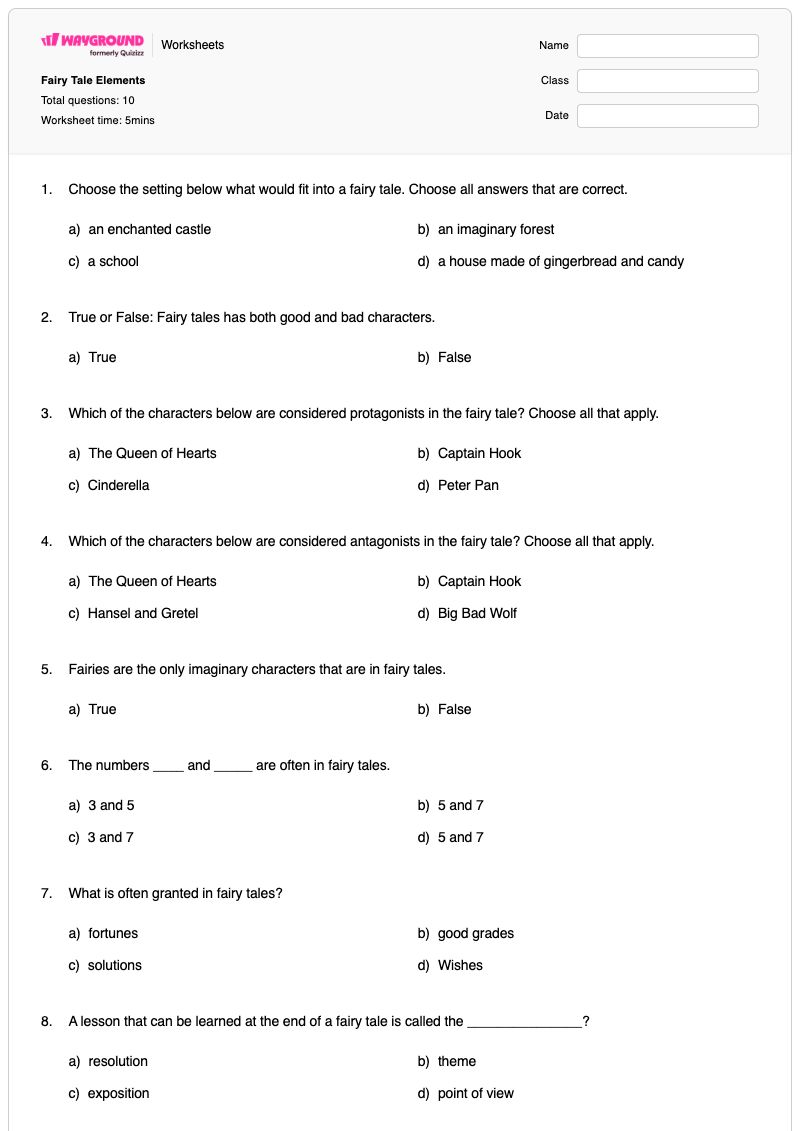
This Grade 7 English worksheet helps students identify the defining elements and conventions of fairy tales. Through 10 questions—4 multiple-select and 6 multiple-choice—students examine typical settings, distinguish protagonists from antagonists, recognize imaginary characters, identify recurring numbers such as 3 and 7, and identify wishes, themes, and the familiar ending associated with the genre. The worksheet also asks students to recognize well-known fairy tales, including Sleeping Beauty, Aladdin, Pinocchio, and Alice in Wonderland.
Use this resource to check students’ understanding of fairy-tale structure and vocabulary after a literature lesson or while introducing genre characteristics. The multiple-select items require students to evaluate several options rather than rely on a single guess, while the multiple-choice items reinforce key terms and conventions. This is a free printable worksheet with a complete answer key for convenient classroom practice, homework, or review.
Worksheet settings
Font size
S
M
L
XL
Worksheets
Fairy Tale Elements
Total questions: 10
Name
Class
Date
1.
Choose the setting below what would fit into a fairy tale. Choose all answers that are correct.
a)
an enchanted castle
b)
an imaginary forest
c)
a school
d)
a house made of gingerbread and candy
2.
True or False: Fairy tales has both good and bad characters.
a)
True
b)
False
3.
Which of the characters below are considered protagonists in the fairy tale? Choose all that apply.
a)
The Queen of Hearts
b)
Captain Hook
c)
Cinderella
d)
Peter Pan
4.
Which of the characters below are considered antagonists in the fairy tale? Choose all that apply.
a)
The Queen of Hearts
b)
Captain Hook
c)
Hansel and Gretel
d)
Big Bad Wolf
5.
Fairies are the only imaginary characters that are in fairy tales.
a)
True
b)
False
6.
The numbers ____ and _____ are often in fairy tales.
a)
3 and 5
b)
5 and 7
c)
3 and 7
d)
5 and 7
7.
What is often granted in fairy tales?
a)
fortunes
b)
good grades
c)
solutions
d)
Wishes
8.
A lesson that can be learned at the end of a fairy tale is called the _______________?
a)
resolution
b)
theme
c)
exposition
d)
point of view
9.
Fairy tales end with what popular phrase?
a)
That's All Folks!!
b)
That's the End.
c)
They all lived happily ever after.
d)
Wahoo! The story is over!!
10.
Pick all the stories below that are considered fairy tales.
a)
Sleeping Beauty
b)
Aladdin
c)
Pinocchio
d)
Alice and Wonderland
Answer Key
Fairy Tale Elements
Total questions: 10
1.
a)
an enchanted castle
, b)
an imaginary forest
, d)
a house made of gingerbread and candy
2.
a)
True
3.
c)
Cinderella
, d)
Peter Pan
4.
a)
The Queen of Hearts
, b)
Captain Hook
, d)
Big Bad Wolf
5.
b)
False
6.
c)
3 and 7
7.
d)
Wishes
8.
b)
theme
9.
c)
They all lived happily ever after.
10.
a)
Sleeping Beauty
, b)
Aladdin
, c)
Pinocchio
, d)
Alice and Wonderland
140 %
Browse by subjects
Browse by grades
Browse by format
FAQs
What does the Fairy Tale Elements worksheet cover?
This Grade 7 worksheet uses 4 multiple-select and 6 multiple-choice questions to assess fairy-tale elements and conventions. Students identify fitting settings, protagonists and antagonists, imaginary characters, recurring numbers, wishes, the theme or lesson, the traditional ending, and stories that qualify as fairy tales.
How can I use this worksheet to teach fairy-tale elements?
Introduce the worksheet by asking students to explain what makes a setting, character, or event feel like a fairy tale. Then have them complete the multiple-select items in pairs, discussing why an enchanted castle or a gingerbread house fits the genre and why Cinderella differs from an antagonist such as the Big Bad Wolf. Use the multiple-choice items afterward to reinforce terms such as theme and conventions such as wishes and the phrase “They all lived happily ever after.”
What mistakes should I watch for when students complete this fairy-tale worksheet?
Watch for students selecting only one response on the multiple-select questions, especially when identifying acceptable settings, protagonists, antagonists, or fairy-tale titles. Students may also confuse a story’s theme with its resolution, exposition, or point of view, or overlook that fairy tales can include imaginary characters besides fairies. Review the recurring numbers 3 and 7 and distinguish the traditional ending from other statements that merely indicate a story is finished.
How do I assign and grade the Fairy Tale Elements worksheet?
The Fairy Tale Elements worksheet is available as a printable PDF and as a digital quiz on Wayground, and it includes a complete answer key. For printable submissions, scan student work with the Wayground for Teachers app to streamline grading. The PDF option can also support classrooms that are reducing screen time.
How can I differentiate this fairy-tale worksheet for my students?
In the worksheet’s Advanced Settings, adjust font spacing or choose a larger font size to make the multiple-choice and multiple-select items easier to read. You can also apply a dyslexia-friendly font or translate the worksheet into another language, while keeping the fairy-tale settings, character classifications, and genre questions intact.
Where can I find more worksheets like this on Wayground?
Wayground offers a comprehensive collection of free printable worksheets and practice problems across all subjects, with downloadable PDFs and answer keys to help students master essential skills and concepts. Browse more resources at https://wayground.com/en-us/worksheets.


 Worksheets