Non-fiction Text Features is a free printable Grade 3 English worksheet that helps students identify common features found in informational texts. The 13 multiple-choice questions ask students to recognize and name captions, diagrams, photos or illustrations, timelines, tables of contents, headings, subheadings, graphs, maps, indexes, italic text, bold print, and glossaries.
This worksheet builds students’ nonfiction-reading vocabulary by having them distinguish among text features presented as visual examples. It is useful for introducing or reviewing feature names before students use informational books and articles more independently. Teachers can use the answer key to check whether students can accurately identify each feature and determine which terms need additional modeling. The worksheet is available as a free printable worksheet with a complete answer key, making it suitable for independent practice, small-group review, or a quick classroom assessment.
Worksheet settings
Font size
S
M
L
XL
Worksheets
Non-fiction Text Features
Total questions: 13
Name
Class
Date
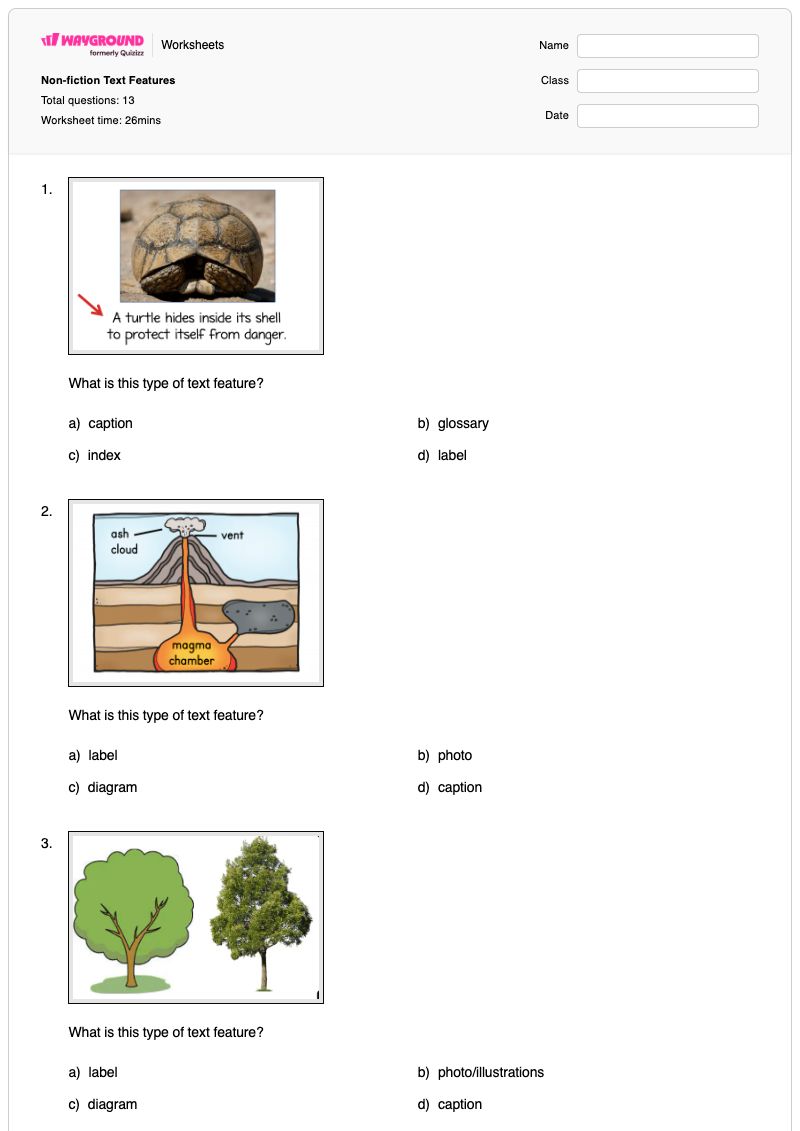
1.
What is this type of text feature?
a)
caption
b)
glossary
c)
index
d)
label
2.
What is this type of text feature?
a)
label
b)
photo
c)
diagram
d)
caption
3.
What is this type of text feature?
a)
label
b)
photo/illustrations
c)
diagram
d)
caption
4.
What is this type of text feature?
a)
label
b)
timeline
c)
diagram
d)
caption
5.
What is this type of text feature?
a)
index
b)
glossary
c)
table of contents
d)
caption
6.
What is this type of text feature?
a)
subheading
b)
heading
c)
table of contents
d)
label
7.
What is this type of text feature?
a)
graph
b)
photo
c)
timeline
d)
map
8.
What is this type of text feature?
a)
graph
b)
photo
c)
timeline
d)
map
9.
What is this type of text feature?
a)
subheading
b)
heading
c)
table of contents
d)
label
10.
What is this type of text feature?
a)
index
b)
heading
c)
table of contents
d)
glossary
11.
What is this type of text feature?
a)
caption
b)
heading
c)
bold print
d)
italic text
12.
What is this type of text feature?
a)
caption
b)
heading
c)
bold print
d)
italic text
13.
What is this type of text feature?
a)
table of contents
b)
glossary
c)
index
d)
subheading
Answer Key
Non-fiction Text Features
Total questions: 13
1.
a)
caption
2.
c)
diagram
3.
b)
photo/illustrations
4.
b)
timeline
5.
c)
table of contents
6.
a)
subheading
7.
a)
graph
8.
d)
map
9.
b)
heading
10.
a)
index
11.
d)
italic text
12.
c)
bold print
13.
b)
glossary
140 %
Browse by subjects
Browse by grades
Browse by format
FAQs
What does the Non-fiction Text Features worksheet cover?
This Grade 3 English worksheet covers identifying nonfiction text features through 13 multiple-choice questions. Students distinguish among features such as captions, diagrams, photos or illustrations, timelines, tables of contents, headings, subheadings, graphs, maps, indexes, bold print, italic text, and glossaries, building the vocabulary needed to recognize these features in informational texts.
How can I use this worksheet to teach nonfiction text features?
Introduce the worksheet by showing students examples of the feature types named in its questions, then model how to compare similar choices, such as a heading and subheading or an index and glossary. Have students explain which visual or text clue helped them choose an answer, and use the 13 multiple-choice items for guided practice before assigning independent review.
What mistakes should I watch for on the Non-fiction Text Features worksheet?
Students may confuse related features, including headings with subheadings, tables of contents with indexes, and indexes with glossaries. They may also mistake a graph for a map or timeline, or confuse a caption, label, and photo or illustration. Check that students are identifying the feature itself rather than choosing an answer based only on its surrounding image or text.
How do I assign and grade this worksheet?
You can assign Non-fiction Text Features as a printable PDF or as a digital quiz on Wayground. It includes a complete answer key, and printable submissions can be graded by scanning student work with the Wayground for Teachers app. The printable format also gives schools an option for reducing screen time.
How can I differentiate this nonfiction text-features worksheet for my students?
Use the worksheet’s Advanced Settings to adjust font spacing or choose a larger font size so the multiple-choice feature examples and answer choices are easier to read. You can also enable a dyslexia-friendly font or translate the worksheet into another language when helpful for students identifying terms such as glossary, index, heading, and caption.
Where can I find more worksheets like this on Wayground?
Wayground offers a broad collection of free printable worksheets and practice problems across subjects, with downloadable PDFs and answer keys to support essential skills and concepts. Browse more resources at https://wayground.com/en-us/worksheets.


 Worksheets


