

Wayground
Understanding Your Credit Card Statement - Printable Social studies Worksheets year 9 - Wayground

Understanding Your Credit Card Statement

Christina Velazquez

Created by Christina Velazquez

17 questions

9th Grade

Social studies

Updated Oct 2026

Understanding Your Credit Card Statement is a Grade 9 social studies worksheet that builds practical financial-literacy skills through 17 questions: 16 multiple-choice items and one fill-in-the-blank response. Students identify key sections of a credit card statement, including account details, payment information, transaction summaries, and year-to-date totals. They also interpret billing-cycle information and calculate updated balances after payments and new charges. The worksheet reinforces responsible credit use by asking students to explain the effects of minimum payments, late payments, paying more than the minimum, and paying the full balance by the due date. Students also apply statement-reading skills to identify unauthorized transactions and check for errors. This free printable worksheet includes a complete answer key, making it useful for independent practice, financial-literacy instruction, review, or assessment.

Worksheet settings

Font size

S
M
L
XL
WaygroundWorksheets

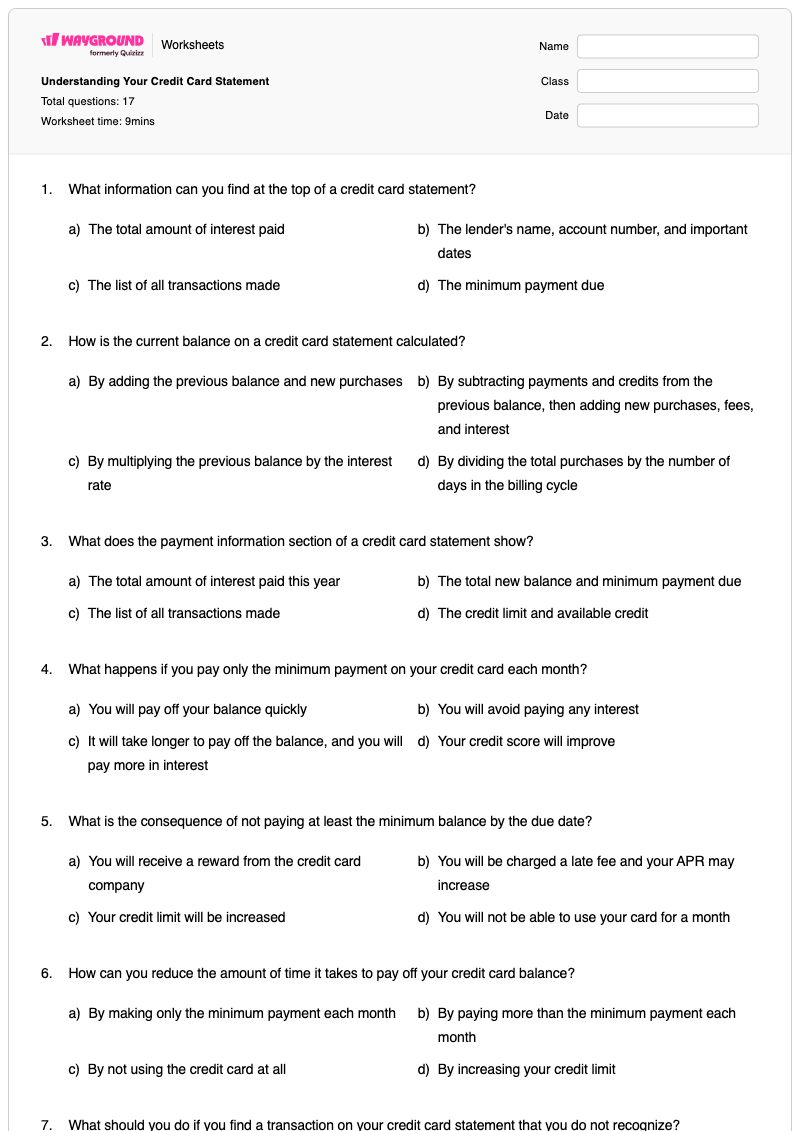
Understanding Your Credit Card Statement

Total questions: 17

Name
Class
Date
1.

What information can you find at the top of a credit card statement?

a)

The total amount of interest paid

b)

The lender's name, account number, and important dates

c)

The list of all transactions made

d)

The minimum payment due

2.

How is the current balance on a credit card statement calculated?

a)

By adding the previous balance and new purchases

b)

By subtracting payments and credits from the previous balance, then adding new purchases, fees, and interest

c)

By multiplying the previous balance by the interest rate

d)

By dividing the total purchases by the number of days in the billing cycle

3.

What does the payment information section of a credit card statement show?

a)

The total amount of interest paid this year

b)

The total new balance and minimum payment due

c)

The list of all transactions made

d)

The credit limit and available credit

4.

What happens if you pay only the minimum payment on your credit card each month?

a)

You will pay off your balance quickly

b)

You will avoid paying any interest

c)

It will take longer to pay off the balance, and you will pay more in interest

d)

Your credit score will improve

5.

What is the consequence of not paying at least the minimum balance by the due date?

a)

You will receive a reward from the credit card company

b)

You will be charged a late fee and your APR may increase

c)

Your credit limit will be increased

d)

You will not be able to use your card for a month

6.

How can you reduce the amount of time it takes to pay off your credit card balance?

a)

By making only the minimum payment each month

b)

By paying more than the minimum payment each month

c)

By not using the credit card at all

d)

By increasing your credit limit

7.

What should you do if you find a transaction on your credit card statement that you do not recognize?

a)

Ignore it, as it will likely resolve itself

b)

Report it immediately to your credit card issuer

c)

Wait until the next statement to see if it appears again

d)

Pay it off to avoid any issues

8.

What is the purpose of the transaction summary section in a credit card statement?

a)

To show the total interest paid this year

b)

To list all transactions made during the billing cycle

c)

To provide the lender's contact information

d)

To display the available credit

9.

What information is provided in the totals year-to-date section of a credit card statement?

a)

The total amount of purchases made this year

b)

The total fees and interest paid this year

c)

The total credit limit for the year

d)

The total number of transactions made this year

10.

How can you avoid paying interest on your credit card purchases?

a)

By paying only the minimum payment each month

b)

By paying the full balance by the due date

c)

By not using the credit card at all

d)

By increasing your credit limit

11.

Why is it important to review your credit card statement each month?

a)

To ensure there are no errors or unauthorized transactions

b)

To increase your credit limit

c)

To receive rewards from the credit card company

d)

To avoid paying any fees

12.

What is the benefit of paying more than the minimum payment on your credit card each month?

a)

It increases your credit limit

b)

It reduces the time and interest needed to pay off the balance

c)

It allows you to skip the next month's payment

d)

It improves your credit score immediately

13.

A credit card statement shows a previous balance of $500, a payment of $200, and new charges of $150. What is the new balance?

a)

$450

b)

$350

c)

$400

d)

$300

14.

A credit card statement shows a minimum payment due of $25 and a total balance of $500. If you only make the minimum payment, what will be your new balance assuming no interest or additional charges?

a)

$475

b)

$500

c)

$525

d)

$450

15.
Use the credit card statement to answer the questions below. How many days are in the billing cycle?

Use the credit card statement to answer the questions below. How many days are in the billing cycle?

a)

28 days

b)

30 days

c)

31 days

d)

29 days

16.
Use the credit card statement to answer the questions below. What is the previous balance?

Use the credit card statement to answer the questions below. What is the previous balance?

(a)  

17.
What is the total line of credit?

What is the total line of credit?

a)

$2,654.48

b)

$5,326.77

c)

$9,000.00

d)

$3,663.23

WaygroundAnswer Key

Understanding Your Credit Card Statement

Total questions: 17

1.
b)

The lender's name, account number, and important dates

2.
b)

By subtracting payments and credits from the previous balance, then adding new purchases, fees, and interest

3.
b)

The total new balance and minimum payment due

4.
c)

It will take longer to pay off the balance, and you will pay more in interest

5.
b)

You will be charged a late fee and your APR may increase

6.
b)

By paying more than the minimum payment each month

7.
b)

Report it immediately to your credit card issuer

8.
b)

To list all transactions made during the billing cycle

9.
b)

The total fees and interest paid this year

10.
b)

By paying the full balance by the due date

11.
a)

To ensure there are no errors or unauthorized transactions

12.
b)

It reduces the time and interest needed to pay off the balance

13.
a)

$450

14.
a)

$475

15.
b)

30 days

16.
$3,240.50
17.
c)

$9,000.00

FAQs

What does the Understanding Your Credit Card Statement worksheet cover?

This Grade 9 worksheet uses 16 multiple-choice questions and one fill-in-the-blank item to assess how students interpret credit card statement sections and apply the information they contain. Students identify account details, payment amounts, transaction summaries, year-to-date fees and interest, billing-cycle length, and updated balances after payments or new charges.

How can I use this worksheet to teach students to read a credit card statement?

Introduce the statement by having students locate the lender information, important dates, payment section, transaction summary, and year-to-date totals before they complete the questions. Then use the balance-calculation items to model how payments, credits, purchases, fees, and interest affect the current balance. Discuss why paying more than the minimum and reviewing unfamiliar transactions are important after students finish the multiple-choice items.

What mistakes should I watch for when students complete this credit card statement worksheet?

Students may confuse the minimum payment with the total new balance, or calculate the current balance without subtracting payments before adding new charges. They may also mistake the transaction summary for year-to-date totals, overlook the consequences of paying late, or choose to wait rather than report an unrecognized transaction. Check the numerical items carefully, especially the $500 balance adjusted by a $200 payment and $150 in new charges and the $500 balance reduced by a $25 minimum payment.

How do I assign and grade this credit card statement worksheet?

The worksheet is available as a printable PDF and as a digital quiz on Wayground, and it includes a complete answer key for the 17 items. You can assign the digital version for online responses or print it for students to complete by hand. Printable submissions can be graded by scanning student work with the Wayground for Teachers app.

How can I differentiate this credit card statement worksheet for my students?

In the worksheet’s Advanced Settings, adjust font spacing or choose a larger font size to make the statement-reading questions, calculations, and fill-in-the-blank response easier to follow. You can also apply a dyslexia-friendly font or translate the worksheet into another language when those options support access to its financial-literacy content.

Where can I find more worksheets like this on Wayground?

Wayground offers a comprehensive collection of free printable worksheets and practice problems across subjects, with downloadable PDFs and answer keys to help students master essential skills and concepts. Browse more resources at https://wayground.com/en-us/worksheets.