

Wayground
Fiscal Policy 2 - Printable Social studies Worksheets year 12 - Wayground

Fiscal Policy 2

Wally Salter

Created by Wally Salter

20 questions

12th Grade

Social studies

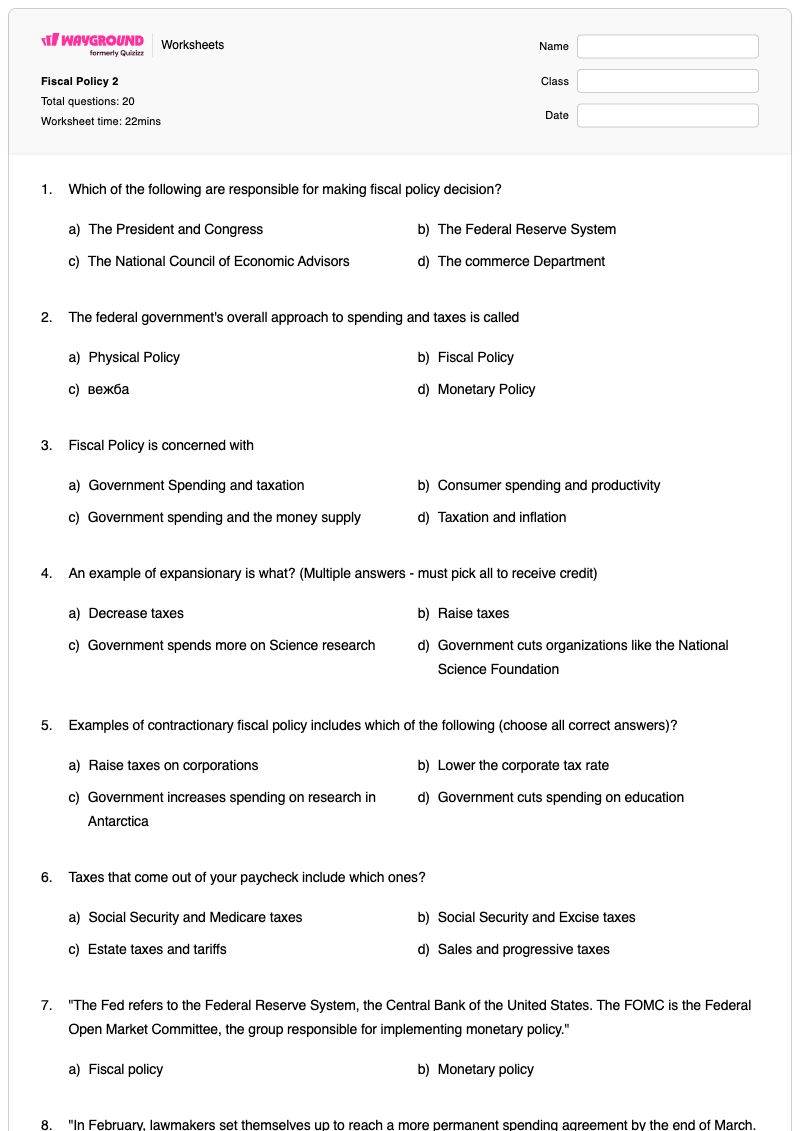
Designed for Grade 12 Social Studies, Fiscal Policy 2 helps students identify how the federal government uses spending and taxation to influence economic activity. The 20-question worksheet includes 17 multiple-choice items and 3 multiple-select items covering fiscal policy decision-making, payroll taxes, expansionary and contractionary fiscal actions, and the distinction between fiscal and monetary policy. Students classify real-world examples, such as changes in government spending, taxes, interest rates, and the money supply, as fiscal or monetary policy. They also determine whether economic conditions call for expansionary or contractionary action and identify related policy goals, including low inflation and low unemployment. This free printable worksheet includes a complete answer key for efficient review, independent practice, or assessment.

Worksheet settings

Font size

S
M
L
XL
WaygroundWorksheets

Fiscal Policy 2

Total questions: 20

Name
Class
Date
1.
Which of the following are responsible for making fiscal policy decision? 
a)
The President and Congress
b)
The Federal Reserve System
c)
The National Council of Economic Advisors
d)
The commerce Department
2.

The federal government's overall approach to spending and taxes is called

a)

Physical Policy

b)

Fiscal Policy

c)

вежба

d)

Monetary Policy

3.
Fiscal Policy is concerned with
a)
Government Spending and taxation
b)
Consumer spending and productivity
c)
Government spending and the money supply
d)
Taxation and inflation
4.

An example of expansionary is what? (Multiple answers - must pick all to receive credit)

a)

Decrease taxes

b)

Raise taxes

c)

Government spends more on Science research

d)

Government cuts organizations like the National Science Foundation

5.

Examples of contractionary fiscal policy includes which of the following (choose all correct answers)?

a)

Raise taxes on corporations

b)

Lower the corporate tax rate

c)

Government increases spending on research in Antarctica

d)

Government cuts spending on education

6.

Taxes that come out of your paycheck include which ones?

a)

Social Security and Medicare taxes

b)

Social Security and Excise taxes

c)

Estate taxes and tariffs

d)

Sales and progressive taxes

7.

"The Fed refers to the Federal Reserve System, the Central Bank of the United States. The FOMC is the Federal Open Market Committee, the group responsible for implementing monetary policy."

a)

Fiscal policy

b)

Monetary policy

8.

"In February, lawmakers set themselves up to reach a more permanent spending agreement by the end of March. Congress agreed to increases to domestic and defense spending over the next two years, raising funding for domestic programs by $128 billion and hiking defense budgets by $160 billion. But they didn’t actually decide where the money would go."

a)

Fiscal policy

b)

Monetary policy

9.

"The U.S. Federal Reserve is almost certain to hike interest rates Wednesday to the highest level in a decade: 1.5 to 1.75 percent. "

a)

Fiscal policy

b)

Monetary policy

10.

The goals of monetary policy include (more than one answer - pick all correct answers for credit):

a)

regulating the amount of money circulating in the economy

b)

Keep inflation high

c)

Keep inflation low

d)

Keep unemployment low

e)

Raise the unemployment levels

11.
Taxing & spending to help the economy grow is referred to as
a)
expansionary policy
b)
monetary policy
c)
contractionary policy
d)
budget deficit
12.
Taxing & spending to slow the economy is referred to as 
a)
budget surplus 
b)
monetary policy
c)
contractionary policy
d)
budget deficit
13.
An example of expansionary fiscal policy would be
a)
cutting taxes.
b)
cutting government spending.
c)
cutting production of consumer goods.
d)
cutting prices of consumer goods.
14.
If the unemployment rate is rising and GDP is falling, the fiscal policy action that the federal government should MOST likely follow is 
a)
decreasing taxes.
b)
decreasing spending.
c)
decreasing the money supply.
d)
decreasing the reserve requirement.
15.

Which are contractionary fiscal policies -- meant to slow down speedy economic growth?

a)

increased taxation and increased government spending

b)

increased taxation and decreased government spending

c)

decreased taxation and no change in government spending

d)

no change in taxation and increased government spending

16.
This is a tax that where you pay more the more money you make
a)
regressive
b)
proportional
c)
progressive
d)
flat
17.
When the government spends more money than they take in each year is called a _________?
a)
Debt
b)
Deficit
c)
Surplus
d)
Expansionary
18.
How could the Federal Reserve encourage banks to lend out more of their reserves?
a)
reduce the discount rate
b)
raise the required amount of reserve
c)
increase the prime rate
d)
reduce the money supply
19.
Open market operations are
a)
the processes by which money enters into circulation. 
b)
reserves greater than the required amounts
c)
the buying and selling of government securities to alter the supply of money.
d)
rates of interest banks charge on short-term loans to their best customers.
20.
The rate the Fed charges banks for a loan
a)
Prime rate
b)
Federal fund rate
c)
Reserve Ratio
d)
Discount rate
WaygroundAnswer Key

Fiscal Policy 2

Total questions: 20

1.
a) The President and Congress
2.
b)

Fiscal Policy

3.
a) Government Spending and taxation
4.
a)

Decrease taxes

, c)

Government spends more on Science research

5.
a)

Raise taxes on corporations

, d)

Government cuts spending on education

6.
a)

Social Security and Medicare taxes

7.
b)

Monetary policy

8.
a)

Fiscal policy

9.
b)

Monetary policy

10.
a)

regulating the amount of money circulating in the economy

, c)

Keep inflation low

, d)

Keep unemployment low

11.
a) expansionary policy
12.
c) contractionary policy
13.
a) cutting taxes.
14.
a) decreasing taxes.
15.
b)

increased taxation and decreased government spending

16.
c) progressive
17.
b) Deficit
18.
a) reduce the discount rate
19.
c) the buying and selling of government securities to alter the supply of money.
20.
d) Discount rate

FAQs

What does the Fiscal Policy 2 worksheet cover?

Fiscal Policy 2 asks Grade 12 students to classify fiscal and monetary policy examples and identify expansionary versus contractionary fiscal actions. Its 17 multiple-choice and 3 multiple-select questions require students to connect taxes, government spending, economic conditions, and policy goals such as low inflation and low unemployment.

How can I use this worksheet to teach fiscal policy?

Introduce the worksheet by having students sort the key actors and tools: Congress and the President make fiscal policy decisions, while the Federal Reserve implements monetary policy. Then use the multiple-choice examples to discuss whether changing taxes or government spending expands or slows the economy, and finish with the multiple-select items as a check for students who can identify all applicable policy actions.

What mistakes should I watch for when students complete Fiscal Policy 2?

Students may confuse Federal Reserve actions, such as changing interest rates or the money supply, with fiscal policy, which involves government spending and taxation. They may also reverse expansionary and contractionary actions or select only one correct option in the multiple-select questions about taxes, spending, and monetary-policy goals.

How do I assign and grade the Fiscal Policy 2 worksheet?

Fiscal Policy 2 is available as a printable PDF and as a digital quiz on Wayground, and it includes a complete answer key for the multiple-choice and multiple-select items. For printable submissions, teachers can scan student work with the Wayground for Teachers app to grade responses efficiently.

How can I differentiate the Fiscal Policy 2 worksheet for my students?

In the worksheet’s Advanced Settings, adjust font spacing and font size to make the policy definitions, examples, and answer choices easier to read. You can also apply a dyslexia-friendly font or translate the fiscal-policy questions and multiple-select directions into another language.

Where can I find more worksheets like this on Wayground?

Wayground offers a broad collection of free printable worksheets and practice problems across subjects, with downloadable PDFs and answer keys to support essential skills and concepts. Browse more resources at https://wayground.com/en-us/worksheets.