Adding Fractions w/Unlike Denominators is a Grade 5 math worksheet that builds fluency with finding common denominators and adding fractions with different denominators. Across 20 multiple-choice questions, students identify possible and impossible common denominators, determine least common denominators, recognize multiples, evaluate an incorrect addition strategy, and solve fraction sums such as 2/5 + 3/10 and 1/4 + 5/8. The questions require students to convert fractions to equivalent forms before combining numerators while keeping the denominator consistent.
This free printable worksheet is useful for independent practice, math centers, intervention, or a quick formative assessment after direct instruction. Its varied question set checks both prerequisite understanding—such as listing multiples and distinguishing a common denominator from the least common denominator—and accurate computation. The worksheet includes a complete answer key, making it easy to review choices, identify misconceptions, and discuss why adding unlike denominators directly produces an invalid result.
Worksheet settings
Font size
S
M
L
XL
Worksheets
Adding Fractions w/Unlike Denominators
Total questions: 20
Name
Class
Date
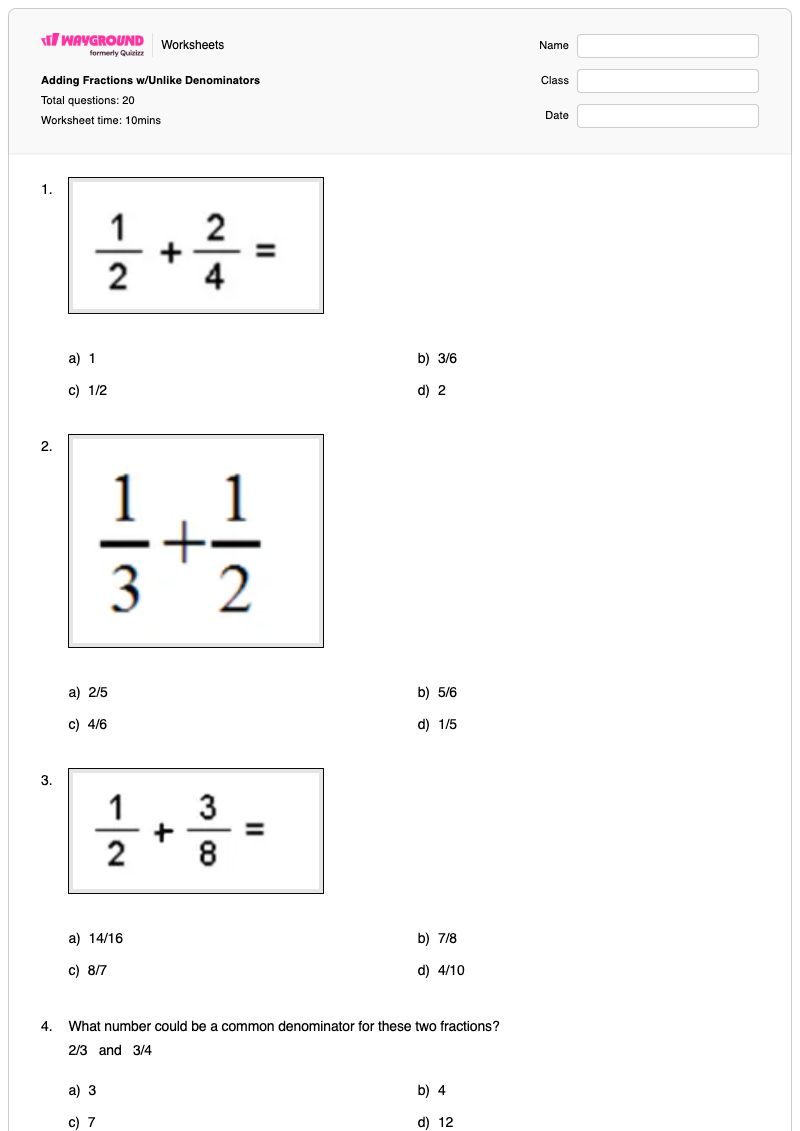
1.
a)
1
b)
3/6
c)
1/2
d)
2
2.
a)
2/5
b)
5/6
c)
4/6
d)
1/5
3.
a)
14/16
b)
7/8
c)
8/7
d)
4/10
4.
What number could be a common denominator for these two fractions? 2/3 and 3/4
a)
3
b)
4
c)
7
d)
12
5.
What number could be a common denominator for these two fractions? 1/5 and 5/6?
a)
30
b)
11
c)
6
d)
5
6.
What number could be a common denominator for these two fractions? 3/10 and 1/5
a)
5
b)
10
c)
15
d)
These numbers do not have a common denominator
7.
Which of these numbers could NOT be a common denominator for these three fractions? 1/3 and 2/5 and 3/10
a)
15
b)
30
c)
60
d)
90
8.
Which of these numbers could NOT be a common denominator for these two fractions? 1/6 and 1/4
a)
12
b)
18
c)
24
d)
36
9.
Which of these numbers could NOT be a common denominator for these two fractions? 2/4 and 3/8
a)
32
b)
12
c)
8
d)
24
10.
2/3 + 1/2 =
a)
6/7
b)
2/6
c)
3/5
d)
7/6
11.
Is this a correct answer?
a)
Yes, the student correctly added.
b)
No, you cannot add unlike denominators
c)
No, 5 + 7 is not 12
d)
No, 2 + 3 is not 5
12.
What is the least common denominator of 1/2 and 3/7?
a)
2
b)
14
c)
7
d)
28
13.
Joe has listed the first 4 multiples of 7 as: 7 14 22 28 Which one is incorrect?
a)
7
b)
14
c)
22
d)
28
14.
2/5 + 3/10
a)
7/10
b)
5/10
c)
1/2
d)
5/15
15.
2/3 + 1/2 =
a)
6/7
b)
2/6
c)
3/5
d)
7/6
16.
1/3 + 5/12
a)
6/12
b)
6/15
c)
3/4
d)
4/4
17.
3/5 + 7/10
a)
13/10
b)
10/15
c)
10/5
d)
15/15
18.
1/4 + 5/8
a)
6/8
b)
6/12
c)
7/8
d)
8/8
19.
Tim did 1/12 of a load of laundry on Sunday and 1/4 of a load of laundry on Saturday. What fraction of laundry did Tim do in total?
a)
2/16 loads done
b)
1/3 loads done
c)
2/3 loads done
d)
2/12 loads done
20.
2/6 + 1/2 =
a)
5/6
b)
3/6
c)
4/6
d)
3/8
Answer Key
Adding Fractions w/Unlike Denominators
Total questions: 20
1.
a) 1
2.
b) 5/6
3.
b) 7/8
4.
d) 12
5.
a) 30
6.
b) 10
7.
a) 15
8.
b) 18
9.
b) 12
10.
d) 7/6
11.
b) No, you cannot add unlike denominators
12.
b) 14
13.
c) 22
14.
a) 7/10
15.
d) 7/6
16.
c) 3/4
17.
a) 13/10
18.
c) 7/8
19.
b) 1/3 loads done
20.
a) 5/6
140 %
Browse by subjects
Browse by grades
Browse by format
FAQs
What does this worksheet cover, and how does it help students add fractions with unlike denominators?
This Grade 5 worksheet uses 20 multiple-choice questions to practice finding possible and least common denominators, identifying multiples, and adding fractions with unlike denominators. Students apply these steps to problems such as 2/3 + 1/2 and 1/4 + 5/8, strengthening their ability to rewrite fractions as equivalent fractions before adding the numerators.
How can I use this worksheet to teach adding fractions with unlike denominators?
Begin by modeling how to list multiples and select a common denominator, then show how each fraction is converted to an equivalent fraction before the numerators are added. Use the worksheet’s common-denominator questions first, discuss the item that rejects adding unlike denominators directly, and finish with the computation questions so students apply the process independently.
What mistakes should I watch for when students complete this fraction worksheet?
Watch for students choosing a number that is not a multiple of every denominator, confusing any common denominator with the least common denominator, or treating 22 as a multiple of 7. In the addition items, students may add unlike denominators directly or change the denominator without making the corresponding numerator equivalent; the answer choices are designed to reveal these errors.
How do I assign and grade this adding fractions worksheet?
On Wayground, assign it as a digital quiz or download the printable PDF for paper practice; the worksheet includes a complete answer key for grading either format. Printable submissions can also be graded by scanning student work with the Wayground for Teachers app.
How can I differentiate this worksheet for my students?
Use the worksheet’s Advanced Settings to adjust font spacing or font size so the multiple-choice fraction items have more visual space, and enable a dyslexia-friendly font when helpful. You can also translate the common-denominator and fraction-addition questions into another language while preserving the worksheet’s practice format.
Where can I find more free worksheets like this on Wayground?
Wayground offers a broad collection of free printable worksheets and practice problems across subjects, with downloadable PDFs and answer keys to support essential skills and concepts. Browse more resources at https://wayground.com/en-us/worksheets.

 Worksheets


