

Wayground
Magic & the Brain - Printable English Worksheets - Wayground

Magic & the Brain

10 questions

7th - 7th Grade

English

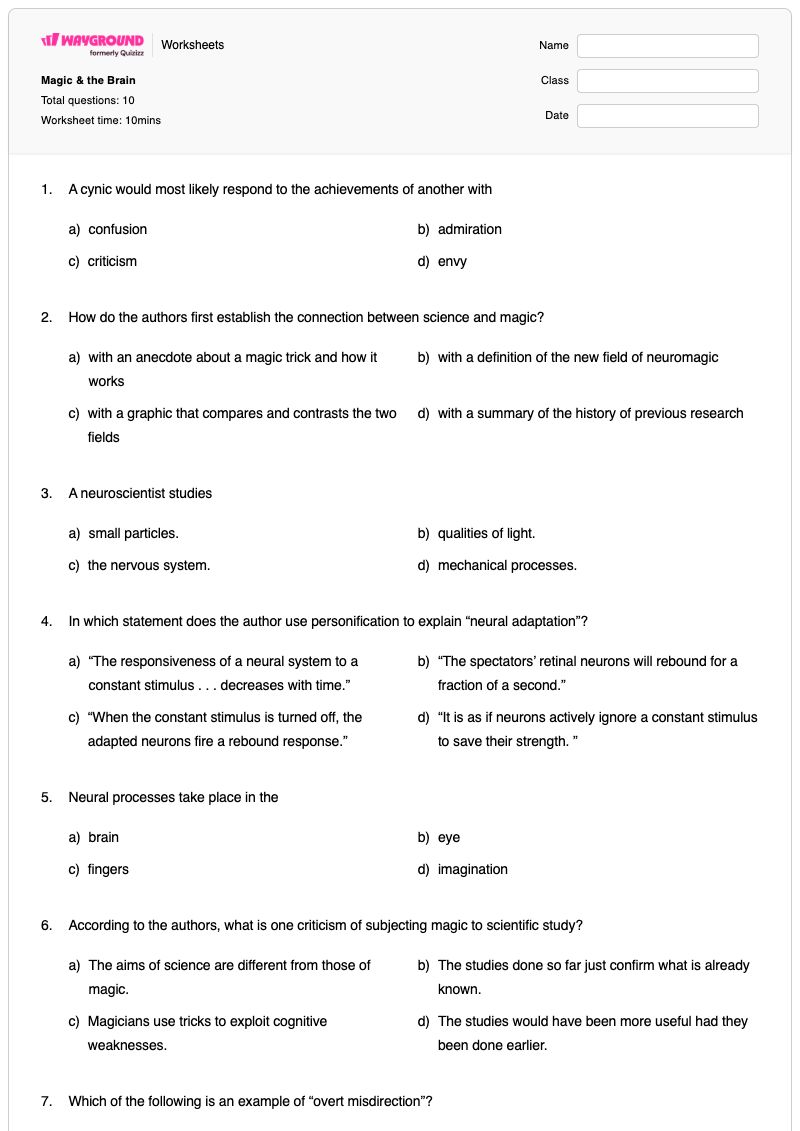
Magic & the Brain is a Grade 7 English reading worksheet that uses 10 multiple-choice questions to examine how magic connects with neuroscience. Students identify how the authors introduce the topic, determine the meanings of terms such as cynic and neuroscientist, and locate information about neural processes, neural adaptation, and overt misdirection. The questions also build close-reading skills by asking students to recognize personification, identify an author’s stated criticism and purpose, and interpret the purpose of a sidebar about brain-scanning technology. This free printable worksheet with an answer key supports independent practice, guided reading, or a quick comprehension check after students read the selection about magic and the brain.

Worksheet settings

Font size

S
M
L
XL
WaygroundWorksheets

Magic & the Brain

Total questions: 10

Name
Class
Date
1.

A cynic would most likely respond to the achievements of another with

a)

confusion

b)

admiration

c)

criticism

d)

envy

2.

How do the authors first establish the connection between science and magic?

a)

with an anecdote about a magic trick and how it works

b)

with a definition of the new field of neuromagic

c)

with a graphic that compares and contrasts the two fields

d)

with a summary of the history of previous research

3.

A neuroscientist studies

a)

small particles.

b)

qualities of light.

c)

the nervous system.

d)

mechanical processes.

4.

In which statement does the author use personification to explain “neural adaptation”?

a)

“The responsiveness of a neural system to a constant stimulus . . . decreases with time.”

b)

“The spectators’ retinal neurons will rebound for a fraction of a second.”

c)

“When the constant stimulus is turned off, the adapted neurons fire a rebound response.”

d)

“It is as if neurons actively ignore a constant stimulus to save their strength. ”

5.

Neural processes take place in the

a)

brain

b)

eye

c)

fingers

d)

imagination

6.

According to the authors, what is one criticism of subjecting magic to scientific study?

a)

The aims of science are different from those of magic.

b)

The studies done so far just confirm what is already known.

c)

Magicians use tricks to exploit cognitive weaknesses.

d)

The studies would have been more useful had they been done earlier.

7.

Which of the following is an example of “overt misdirection”?

a)

The magician tells the audience to look at his lovely assistant.

b)

The magician uses bright lights to create temporary blindness.

c)

The magician performs the trick when the audience least expects it.

d)

The magician uses special effects, such as an explosion or gunshot.

8.

According to the authors, what is the most important reason for neuroscientists to study the tools of magic?

a)

to gain a better understanding of how magic tricks work

b)

to help magicians develop new and better illusions

c)

to help people better control their own attention and awareness

d)

to help develop new diagnostic and treatment methods for brain disorders

9.

Which of the following is an example of “overt misdirection”?

a)

The magician tells the audience to look at his lovely assistant.

b)

The magician uses special effects, such as an explosion or gunshot.

c)

The magician performs the trick when the audience least expects it.

d)

The magician uses bright lights to create temporary blindness.

10.

What is the main purpose of the sidebar below line 119?

a)

to show what a normal brain looks like on an MRI scan

b)

to show how the techniques of magic can help scientists understand the brain

c)

to show how a cognitive illusion works in the brain

d)

to show how scientists can use technology to diagnose brain disorders

WaygroundAnswer Key

Magic & the Brain

Total questions: 10

1.
c)

criticism

2.
a)

with an anecdote about a magic trick and how it works

3.
c)

the nervous system.

4.
d)

“It is as if neurons actively ignore a constant stimulus to save their strength. ”

5.
a)

brain

6.
b)

The studies done so far just confirm what is already known.

7.
a)

The magician tells the audience to look at his lovely assistant.

8.
d)

to help develop new diagnostic and treatment methods for brain disorders

9.
a)

The magician tells the audience to look at his lovely assistant.

10.
d)

to show how scientists can use technology to diagnose brain disorders

FAQs

What does the Magic & the Brain worksheet cover?

This Grade 7 English worksheet uses 10 multiple-choice reading questions to assess comprehension of a text connecting magic with neuroscience. Students identify the authors’ evidence and purpose, interpret terms such as neural adaptation and overt misdirection, recognize personification, and determine what a sidebar explains. Completing these items develops close reading by requiring students to distinguish details, explanations, and central purposes in an informational text.

How can I use this worksheet to teach the connection between magic and neuroscience?

Have students read the selection first, then preview key terms such as cynic, neuroscientist, neural adaptation, and overt misdirection. Ask them to cite the part of the text that explains how a magic trick or misdirection relates to attention and brain processes before they answer the multiple-choice questions. Use the personification and sidebar items for discussion about how authors make scientific ideas understandable and show the practical value of studying the brain.

What mistakes should I watch for when students complete this worksheet?

Students may confuse a neuroscientist’s study of the nervous system with a narrower focus on mechanical processes or light, or confuse neural processes in the brain with the eye or imagination. They may also select a literal explanation instead of the personification describing neurons as if they actively ignore a constant stimulus. Watch for confusion between overtly directing an audience’s attention and using special effects, as well as answers that describe a sidebar’s image rather than its purpose in explaining brain-disorder diagnosis.

How do I assign and grade the Magic & the Brain worksheet?

The worksheet is available as a printable PDF and as a digital quiz on Wayground, and it includes a complete answer key for all 10 multiple-choice questions. You can review students’ selections to assess comprehension of the magic-and-neuroscience passage, or grade printable submissions by scanning student work with the Wayground for Teachers app. The printable format can also support schools that are reducing screen time.

How can I differentiate this Magic & the Brain worksheet for my students?

Use the worksheet’s Advanced Settings to adjust font spacing and font size so the 10 multiple-choice items are easier to navigate. You can also enable a dyslexia-friendly font for students who benefit from that presentation or translate the worksheet into another language to support comprehension of the neuroscience vocabulary and reading questions.

Where can I find more worksheets like this on Wayground?

Wayground offers a comprehensive collection of free printable worksheets and practice problems across subjects, with downloadable PDFs and answer keys to help students master essential skills and concepts. Browse more resources at https://wayground.com/en-us/worksheets.