This Grade 6 mathematics worksheet gives students focused practice ordering and comparing fractions through 15 multiple-choice questions. Students arrange fractions from least to greatest and greatest to least, identify equivalent fractions, choose fractions that are greater than or less than a given value, compare fractions using >, <, or =, and order mixed numbers with the same whole-number part. Items include unit fractions, fractions with different denominators, fractions equivalent to one, and values such as 6/6 and 1.
The worksheet supports pre-algebra instruction by requiring students to compare numerical values rather than rely only on the size of numerators or denominators. Use it for independent practice, review, or a quick formative assessment after modeling comparison strategies. It is a free printable worksheet with a complete answer key, making it convenient for checking individual understanding and identifying which comparison skills need reinforcement.
Worksheet settings
Font size
S
M
L
XL
Worksheets
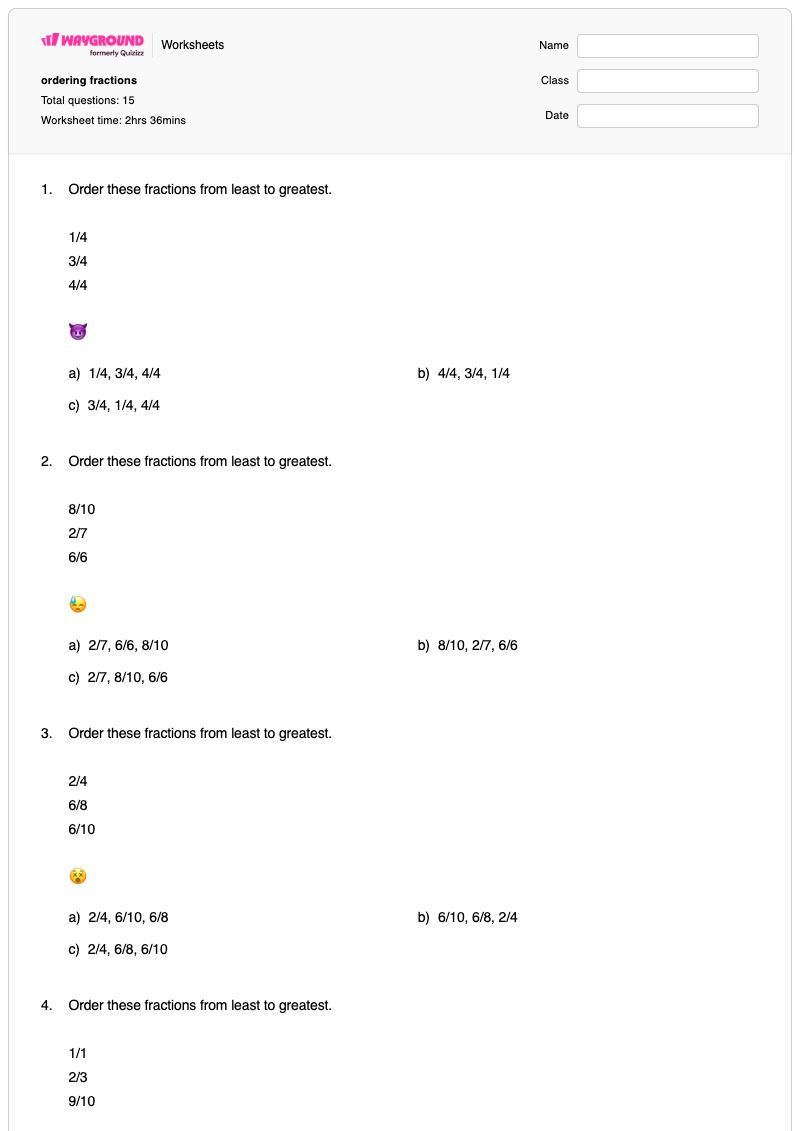
ordering fractions
Total questions: 15
Name
Class
Date
1.
Order these fractions from least to greatest.
1/4
3/4
4/4
😈
a)
1/4, 3/4, 4/4
b)
4/4, 3/4, 1/4
c)
3/4, 1/4, 4/4
2.
Order these fractions from least to greatest.
8/10
2/7
6/6
😓
a)
2/7, 6/6, 8/10
b)
8/10, 2/7, 6/6
c)
2/7, 8/10, 6/6
3.
Order these fractions from least to greatest.
2/4
6/8
6/10
😵
a)
2/4, 6/10, 6/8
b)
6/10, 6/8, 2/4
c)
2/4, 6/8, 6/10
4.
Order these fractions from least to greatest.
1/1
2/3
9/10
😍
a)
9/10, 1/1, 2/3
b)
2/3, 9/10, 1/1
c)
1/1, 9/10, 2/3
5.
Order these fractions from least to greatest.
4/8
9/12
1
😇
a)
9/12, 1, 4/8
b)
1, 9/12, 4/8
c)
4/8, 9/12, 1
6.
Select the fraction equivalent to 1/4.
a)
1/8
b)
3/16
c)
3/12
d)
4/2
7.
Fractions are shown. 1/3, 1/4, 5/8 Order the fractions from least to greatest.
a)
1/4, 5/8, 1/3
b)
1/4, 1/3, 5/8
c)
5/8, 1/3, 1/4
d)
1/3, 1/4, 5/8
8.
Paige rode her bike 4/5 mile. Megan rode her bike 1/3 mile. Which statement is true?
a)
4/5=1/3
b)
4/5 > 1/3
c)
1/3 > 4/5
d)
4/5 < 1/3
9.
Select the fraction greater than 7/9.
a)
4/5
b)
2/3
c)
1/2
d)
3/5
10.
Order the fractions from least to greatest. 9/10, 5/6, 14/15
a)
9/10, 5/6, 14/15
b)
5/6, 14/15, 9/10
c)
14/15, 9/10, 5/6
d)
5/6, 9/10, 14/15
11.
Which fraction is less than 8/15?
a)
4/7
b)
3/5
c)
17/30
d)
4/9
12.
Order the fractions from greatest to least.
a)
6/6, 2/6, 5/6
b)
2/6, 5/6, 6/6
c)
6/6, 5/6, 2/6
13.
Order the fractions from greatest to least.
a)
1/8, 1/4, 1/2
b)
1/2, 1/4, 1/8
14.
Place the correct symbol in the space provided: 1/2 ____ 3/8
a)
>
b)
<
c)
=
15.
List the following set of numbers in order from least to greatest: 2 ⅓, 2 ⅕, 2 ⅘
a)
2 ⅓, 2 ⅘, 2 ⅕
b)
2 ⅘, 2 ⅓, 2 ⅕
c)
2 ⅕, 2 ⅓, 2 ⅘
d)
2 ⅓, 2 ⅕, 2 ⅘
Answer Key
ordering fractions
Total questions: 15
1.
a)
1/4, 3/4, 4/4
2.
c)
2/7, 8/10, 6/6
3.
a)
2/4, 6/10, 6/8
4.
b)
2/3, 9/10, 1/1
5.
c)
4/8, 9/12, 1
6.
c) 3/12
7.
b) 1/4, 1/3, 5/8
8.
b) 4/5 > 1/3
9.
a) 4/5
10.
d) 5/6, 9/10, 14/15
11.
d) 4/9
12.
c) 6/6, 5/6, 2/6
13.
b) 1/2, 1/4, 1/8
14.
a) >
15.
c) 2 ⅕, 2 ⅓, 2 ⅘
140 %
Browse by subjects
Browse by grades
Browse by format
FAQs
What does this ordering fractions worksheet cover?
This Grade 6 worksheet uses 15 multiple-choice questions to practise ordering fractions from least to greatest and greatest to least, comparing fractions with >, <, or =, identifying an equivalent fraction, and ordering mixed numbers. Students work with different denominators, fractions equivalent to one, and values such as 6/6, so they must determine each number’s value before selecting an ordered set or comparison.
How can I use this worksheet to teach students to order fractions?
First model one item by representing or converting the fractions to comparable values, then ask students to explain why the smallest value comes first. Use the ordering items, such as 2/4, 6/8, and 6/10, to discuss equivalent fractions and benchmark values before students complete the remaining multiple-choice questions. Finish by having students justify a comparison such as 1/2 > 3/8 rather than relying only on answer choices.
What mistakes should I watch for when students complete this fraction worksheet?
Students may reverse least-to-greatest and greatest-to-least orders, especially because both directions appear in the 15 questions. They may also compare numerators or denominators separately, miss that 6/6 and 1 equal one whole, or treat 2 ⅕, 2 ⅓, and 2 ⅘ as if their whole-number parts were different. Check that students recognize equivalent values such as 3/12 and 1/4 before ordering them.
How do I assign and grade this ordering fractions worksheet?
You can assign this worksheet as a printable PDF or as a digital quiz on Wayground. It includes a complete answer key for all 15 multiple-choice items, and printable submissions can be graded by scanning student work with the Wayground for Teachers app. The printable format also gives schools an option for reducing screen time.
How can I differentiate this fraction-ordering worksheet for my students?
Use the worksheet’s Advanced Settings to adjust font spacing and font size so the fraction expressions and multiple-choice options are easier to scan. You can also select a dyslexia-friendly font or translate the worksheet into another language. These options can support access to the comparison, ordering, and mixed-number items without changing the mathematical content.
Where can I find more free worksheets like this on Wayground?
Wayground offers a comprehensive collection of free printable worksheets and practice problems across all subjects, with downloadable PDFs and answer keys to help students master essential skills and concepts. Browse more resources at https://wayground.com/en-us/worksheets.

 Worksheets