

Wayground
The Rise of the Christian Kingdoms - Printable Social studies Worksheets kindergarten - Wayground

The Rise of the Christian Kingdoms

Sarah Scott

Created by Sarah Scott

13 questions

7th Grade

Social studies

Updated Oct 2026

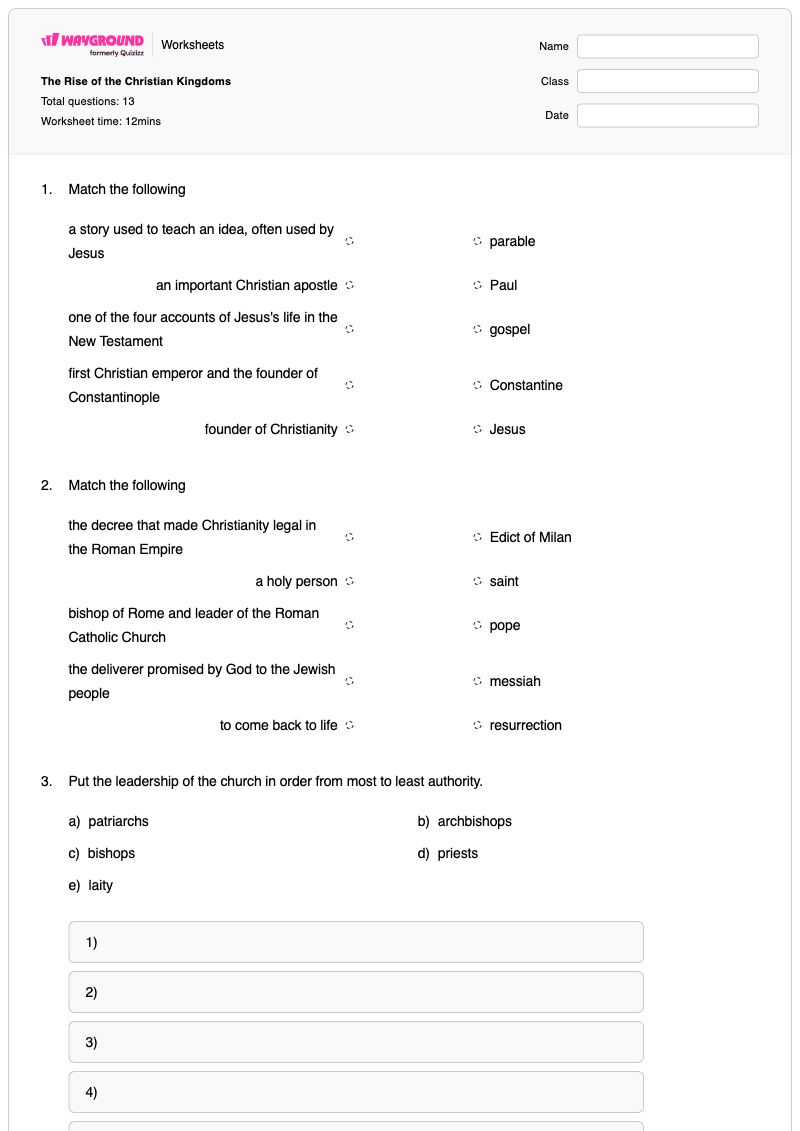
The Rise of the Christian Kingdoms is a Grade 7 social studies worksheet that examines how Christianity developed, spread, and became organized in the Roman and Byzantine worlds. Students match key terms and figures, order church leadership from patriarchs to laity, and answer multiple-choice questions about Christian beliefs, the Old Testament, Jesus’s teachings, persecution, missionaries, Roman roads, and the Byzantine Empire’s Greek influence and Justinian’s law code. A final classification activity asks students to distinguish imperial and papal leadership from missionary efforts among the Slavs and Anglo-Saxons. The varied 13-question format checks both vocabulary recall and understanding of cause, belief, leadership, and cultural influence. This free printable worksheet with an answer key is designed for Grade 7 instruction, review, or assessment of early Christian and Byzantine history.

Worksheet settings

Font size

S
M
L
XL
WaygroundWorksheets

The Rise of the Christian Kingdoms

Total questions: 13

Name
Class
Date
1.

Match the following

a story used to teach an idea, often used by Jesus

parable

an important Christian apostle

Paul

one of the four accounts of Jesus's life in the New Testament

gospel

first Christian emperor and the founder of Constantinople

Constantine

founder of Christianity

Jesus

2.

Match the following

the decree that made Christianity legal in the Roman Empire

Edict of Milan

a holy person

saint

bishop of Rome and leader of the Roman Catholic Church

pope

the deliverer promised by God to the Jewish people

messiah

to come back to life

resurrection

3.

Put the leadership of the church in order from most to least authority.

a)

patriarchs

b)

archbishops

c)

bishops

d)

priests

e)

laity

1)
2)
3)
4)
5)
4.

What did Jesus's followers believe happened to him just days after he was died on the cross?

a)

He went to heaven.

b)

He was resurrected.

c)

He was celebrated as a saint in Rome.

d)

He brought eggs to his followers.

5.

What makes up the Old Testament of the Christian bible?

a)

Jewish Sacred Writings

b)

Muslim Sacred Writings

c)

Hindu Sacred Writiings

d)

Buddhist Sacred Writings

6.

Which culture was the most influential in the Byzantine Empire? (think language)

a)

Egyptian

b)

Persian

c)

Roman

d)

Greek

7.

This Byzantine Emperor created a code of law to make the laws simpler, more organized, and less confusing.

a)

Constantine

b)

Justinian

c)

Nero

d)

Caligula

8.

These people spread Christianity as missionaries; cared for the poor, sick, and homeless; educated children; and preserved writings from Greece and Rome.

a)

nuns and monks

b)

apostles and disciples

c)

priests and rabbis

d)

zealots and sadducees

9.

Christianity was able to provide comfort to their followers because of the belief in an

a)

afterlife

b)

alternate universes

c)

inner peace

d)

all seeing eye

10.

Christianity spread because of peace in the area, shared languages, and Roman what?

a)

ships

b)

coliseums

c)

roads

d)

aqueducts

11.

Early Christians were persecuted by the Roman officials because they refused to worship the emperor or their gods AND they also refused to

a)

serve in the army

b)

sing the national anthem

c)

attend the gladiator fights

d)

speak Latin

12.

Jesus of Nazareth preached about God and the need for people to

a)

love one another

b)

fight the Romans

c)

rebuild the temple

d)

boycott Roman events

13.

Organize these options into the right categories

Categorize the following

The Emperor was in charge

The pope was in charge

Brought Christianity to the Slavs

Brought Christianity to the Anglo-Saxons

Roman Catholic Church
Eastern Orthodox Church
WaygroundAnswer Key

The Rise of the Christian Kingdoms

Total questions: 13

1.

a story used to teach an idea, often used by Jesus

 - 

parable

, 

an important Christian apostle

 - 

Paul

, 

one of the four accounts of Jesus's life in the New Testament

 - 

gospel

, 

first Christian emperor and the founder of Constantinople

 - 

Constantine

, 

founder of Christianity

 - 

Jesus

2.

the decree that made Christianity legal in the Roman Empire

 - 

Edict of Milan

, 

a holy person

 - 

saint

, 

bishop of Rome and leader of the Roman Catholic Church

 - 

pope

, 

the deliverer promised by God to the Jewish people

 - 

messiah

, 

to come back to life

 - 

resurrection

3.
a, b, c, d, e
4.
b)

He was resurrected.

5.
a)

Jewish Sacred Writings

6.
d)

Greek

7.
b)

Justinian

8.
a)

nuns and monks

9.
a)

afterlife

10.
c)

roads

11.
a)

serve in the army

12.
a)

love one another

13.
Roman Catholic Church

The pope was in charge

Brought Christianity to the Anglo-Saxons

Eastern Orthodox Church

The Emperor was in charge

Brought Christianity to the Slavs

FAQs

What does The Rise of the Christian Kingdoms worksheet cover?

This Grade 7 social studies worksheet uses two matching activities, an ordering task, nine multiple-choice questions, and a classification activity to assess early Christianity and Byzantine history. Students identify Christian terms and figures, connect beliefs and practices to Christianity’s spread, order church authority from patriarchs to laity, recognize Greek influence and Justinian’s law code, and classify imperial, papal, and missionary roles.

How can I use this worksheet to teach the rise of the Christian kingdoms?

Introduce the worksheet by building a brief sequence from Jesus’s teachings and early Christian beliefs to persecution, missionary work, and Christianity’s spread through the Roman Empire. Then use the matching items to preview vocabulary, have students justify the church hierarchy order, and discuss how roads, shared languages, and missionaries supported expansion. Finish by using the Byzantine multiple-choice and classification items to connect religious leadership with political and cultural developments.

What mistakes should I watch for when students complete this Christianity and Byzantine history worksheet?

Watch for students confusing resurrection with other events, the Old Testament with the sacred writings of another religion, or Greek influence with Roman influence in the Byzantine Empire. In the ordering task, students may reverse the church hierarchy or place laity among the clergy; in the classification task, they may confuse imperial or papal leadership with missionary work among the Slavs and Anglo-Saxons. Students may also overlook that the worksheet identifies Roman roads, refusal to serve in the army, and the work of nuns and monks as parts of Christianity’s history.

How do I assign and grade The Rise of the Christian Kingdoms worksheet?

On Wayground, assign this worksheet as a printable PDF or as a digital quiz, and use the complete answer key to grade the matching, ordering, multiple-choice, and classification items. Printable submissions can be graded by scanning student work with the Wayground for Teachers app. The printable option also supports schools that are reducing screen time.

How can I differentiate this worksheet for my students?

Use the worksheet’s Advanced Settings to adjust font spacing and font size so the matching definitions, church hierarchy list, and multiple-choice questions are easier to read. You can also apply a dyslexia-friendly font or translate the worksheet into another language, which can support access to its historical vocabulary and classification directions.

Where can I find more worksheets like this on Wayground?

Wayground offers a broad collection of free printable worksheets and practice problems across subjects, with downloadable PDFs and answer keys to help students master essential skills and concepts. Browse more resources at https://wayground.com/en-us/worksheets.