
Wayground
Geometric Proofs - Printable Mathematics Worksheets year 10 - Wayground

Geometric Proofs

21 questions

9th - 12th Grade

Mathematics

Geometric Proofs is a free printable mathematics worksheet for students in Grades 9–12 who are developing fluency with angle relationships, congruence, and rigid motions. Across 21 questions, students work through multiple-choice, fill-in-the-blank, and multiple-select items involving parallel lines cut by a transversal, vertical and corresponding angles, alternate interior angles, supplementary angles, linear pairs, and angle measures. The worksheet also asks students to solve for an unknown value, identify translations, reflections, and rotations as rigid motions, recognize what rigid motions preserve, and determine corresponding angles, congruent sides, and side lengths from geometric figures. The varied question formats require students to recall definitions, distinguish related angle relationships, select every valid statement, and apply geometric reasoning rather than rely on a single response pattern. It is a free printable worksheet with a complete answer key, making it useful for guided practice, independent review, or an assessment of foundational geometric reasoning.

Worksheet settings

Font size

S
M
L
XL
Worksheets

Geometric Proofs

Total questions: 21

Name
Class
Date
1.

If parallel lines are cut by a transversal, alternate interior angles are congruent.

a)

True

b)

False

2.

If the sum of two angles is 180o the angles are supplementary

a)

False

b)

True

3.

Angles 3 and 5 are congruent because they are (a)   .

4.

If angle 1 is congruent to angle 2, select all that are true

a)

Both angles are 90o

b)

The angles are complimentary

c)

The angles are supplementary

d)

The angles form a linear Pair

5.

If two angles form a (a)   , they are supplementary

6.

Corresponding angles are supplementary if two parallel lines are cut by a transversal

a)

True

b)

False

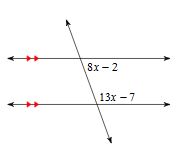
7.
Solve for x.
a)
7
b)
-4
c)
8
d)
9
8.

Select all that are true

a)

Angles D and E are Linear Pairs

b)

Angles A, B and C are supplementary

c)

Angles A and E are congruent

d)

Angles D and B are congruent

9.

Which of the following are rigid motions

a)

Translation

b)

Reflection

c)

Dilation

d)

Rotation

10.

Rigid motions preserve congruency. (shape, size, perimeter, area, side length, and angle measure)

a)

True

b)

False

11.

what is the corresponding angles of ∠T?

(a)  

12.

What is the congruent side of RY?

(a)  

13.

What is the measures of the side TY?

(a)  

14.

Given 

ΔABC ≅ΔDEF \Delta ABC\ \cong\Delta DEF\  
∠A ≅ ?\angle A\ \cong\ ?  

a)

∠D\angle D  

b)

∠E\angle E  

c)

∠F\angle F  

d)

∠C\angle C  

15.

Given 

ΔABC ≅ΔDEF \Delta ABC\ \cong\Delta DEF\  
BC‾ ≅ ?\overline{BC}\ \cong\ ?  

a)

DE‾\overline{DE}  

b)

EF‾\overline{EF}  

c)

DF‾\overline{DF}  

d)

FE‾\overline{FE}  

16.
When quadrilateral PRST is translated to create quadrilateral P'R'S'T', which statement is true?
a)
The side lengths of quadrilateral P'R'S'T' are twice the side lengths of quadrilateral PRST
b)
The angle measures of quadrilateral P'R'S'T' are equal to the corresponding angle measures of quadrilateral PRST
c)
The side lengths of quadrilateral P'R'S'T' are 9 units longer than side lengths of quadrilateral PRST
d)
The angle measures of quadrilateral P'R'S'T' are greater than the angle measures of quadrilateral PRST
17.

Are the figures congruent?

(What type of transformation is shown?)

a)

Congruent (rotation)

b)

Congruent (reflection)

c)

NOT Congruent (rotation)

d)

NOT Congruent (reflection)

18.

Are the figures congruent?

(What type of transformation is shown?)

a)

Congruent (rotation)

b)

Congruent (reflection)

c)

NOT Congruent (rotation)

d)

NOT Congruent (reflection)

19.

Are the figures congruent?

(What type of transformation is shown?)

a)

NOT Congruent (dilation)

b)

NOT Congruent (translation)

c)

Congruent (dilation)

d)

Congruent (translation)

20.

Which statement is true about the transformation?

a)

The transformation preserves congruency and maintains orientation.

b)

The transformation preserves congruency and does not maintains orientation.

c)

The transformation does not preserves congruency but maintains orientation.

d)

The transformation does not preserves congruency or maintains orientation.

21.

Are the figures congruent?

a)

Yes

b)

No

c)

Can not determine

Answer Key

Geometric Proofs

Total questions: 21

1.
a)

True

2.
b)

True

3.
vertical angles, vertical
4.
a)

Both angles are 90o

, c)

The angles are supplementary

, d)

The angles form a linear Pair

5.
linear pair
6.
b)

False

7.
d) 9
8.
a)

Angles D and E are Linear Pairs

, b)

Angles A, B and C are supplementary

, c)

Angles A and E are congruent

9.
a)

Translation

, b)

Reflection

, d)

Rotation

10.
a)

True

11.
B
12.
UY
13.
5, 5cm
14.
a)

∠D\angle D  

15.
b)

EF‾\overline{EF}  

16.
b) The angle measures of quadrilateral P'R'S'T' are equal to the corresponding angle measures of quadrilateral PRST
17.
a)

Congruent (rotation)

18.
b)

Congruent (reflection)

19.
d)

Congruent (translation)

20.
a)

The transformation preserves congruency and maintains orientation.

21.
b)

No

FAQs

What does the Geometric Proofs worksheet cover?

This Grade 9–12 worksheet builds skills in identifying angle relationships created by parallel lines and transversals, including vertical, alternate interior, corresponding, supplementary, and linear-pair relationships. Its 21 multiple-choice, fill-in-the-blank, and multiple-select questions also ask students to solve for an unknown, identify rigid motions, and use corresponding angles and sides to reason about congruence.

How can I use this worksheet to teach angle relationships and congruence?

Introduce the worksheet by reviewing how vertical, corresponding, and alternate interior angles are identified, then contrast supplementary and complementary relationships with examples. Have students explain why a selected statement is valid, especially in the multiple-select items, before completing the fill-in-the-blank questions on linear pairs, corresponding angles, and congruent sides. Finish by connecting rigid motions to preserved shape and size.

What mistakes should I watch for on the Geometric Proofs worksheet?

Students may confuse corresponding angles with alternate interior angles or incorrectly mark corresponding angles as supplementary when the worksheet distinguishes them from congruent relationships. Watch for confusion between complementary and supplementary angles, failure to select every correct option in multiple-select questions, and treating dilation as a rigid motion. Students may also match the wrong corresponding side or angle when reading the labeled figures.

How do I assign and grade this Geometric Proofs worksheet?

The worksheet is available as a printable PDF and as a digital quiz on Wayground, and it includes a complete answer key for all question formats. Printable submissions can be graded by scanning student work with the Wayground for Teachers app, while the digital version supports online assignment and grading.

How can I differentiate the Geometric Proofs worksheet for my students?

Use the worksheet’s Advanced Settings to adjust font spacing and font size so angle diagrams, labels, and fill-in-the-blank prompts are easier to read. You can also enable a dyslexia-friendly font or translate the worksheet into another language when helpful for students working with the geometric vocabulary and instructions.

Where can I find more worksheets like this on Wayground?

Wayground offers a comprehensive collection of free printable worksheets and practice problems across subjects, with downloadable PDFs and answer keys to help students master essential skills and concepts. Browse more resources at https://wayground.com/en-us/worksheets.