Gizmos | Measuring Volume is a free printable worksheet for Grade 9–10 chemistry and biology students. It uses approximately 10 multiple-choice questions to build practical graduated-cylinder reading skills, including identifying the meniscus, reading the bottom of the meniscus at eye level, determining a cylinder’s maximum capacity, and interpreting marked volume levels. Students also identify the liter as the base unit for volume, recognize that a graduated cylinder measures liquid volume, and apply the definition of volume as the amount of space an object occupies.
The worksheet is useful for introducing or reviewing measurement vocabulary before a laboratory activity, checking whether students can interpret graduated-cylinder readings, or reinforcing correct measurement procedures after instruction. Its focused questions help teachers identify whether students understand the difference between a container’s capacity and the amount of liquid it currently holds. A complete answer key is included for efficient checking and feedback.
Worksheet settings
Font size
S
M
L
XL
Worksheets
Gizmos | Measuring Volume
Total questions: 10
Name
Class
Date
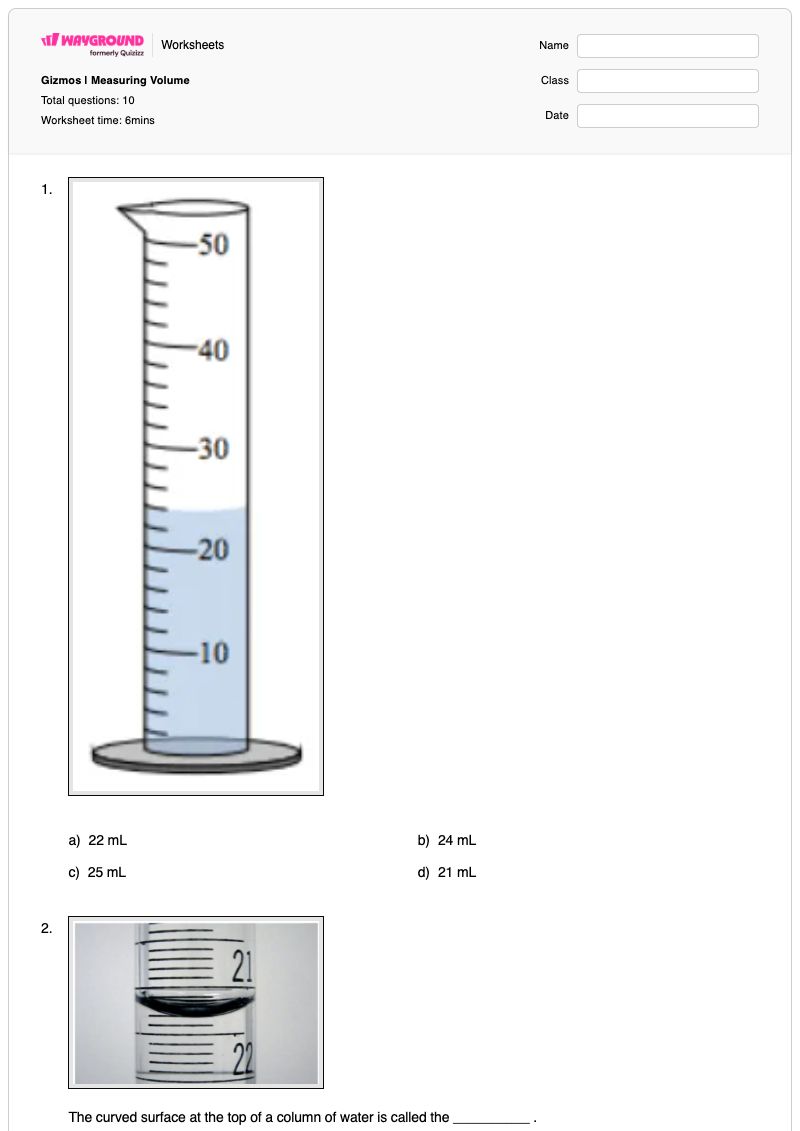
1.
a)
22 mL
b)
24 mL
c)
25 mL
d)
21 mL
2.
The curved surface at the top of a column of water is called the __________ .
a)
arch
b)
meniscus
c)
bowl
d)
scoop
3.
When reading a graduated cylinder, you should always read at eye level at the ___________ of the meniscus.
a)
top
b)
middle
c)
bottom
d)
side
4.
The base unit of measure for volume is the __________ .
a)
liter (L)
b)
gram (g)
c)
meter (m)
d)
Celsius ( °C)
5.
What is the maximum value this graduated cylinder can measure?
a)
1 ml
b)
10 ml
c)
25 ml
d)
50 ml
6.
What is the correct value?
a)
5 ml
b)
15 ml
c)
20 ml
d)
25 ml
7.
What is measured with a graduated cylinder?
a)
time
b)
distance
c)
weight
d)
liquid volume
8.
Volume is the amount of space an object takes up.
a)
True
b)
False
9.
Where should you read the level of water on the graduated cylinder?
a)
Level "A"
b)
Level "B"
c)
Level "C"
d)
None of these
10.
What is the volume of water in the graduated cylinder?
a)
34 mL
b)
30 mL
c)
40 mL
d)
32 mL
Answer Key
Gizmos | Measuring Volume
Total questions: 10
1.
b) 24 mL
2.
b) meniscus
3.
c) bottom
4.
a) liter (L)
5.
c) 25 ml
6.
b) 15 ml
7.
d)
liquid volume
8.
a) True
9.
a) Level "A"
10.
a) 34 mL
140 %
Browse by subjects
Browse by grades
Browse by format
FAQs
What does the Measuring Volume worksheet cover?
This worksheet helps Grade 9–10 students measure liquid volume with a graduated cylinder through approximately 10 multiple-choice questions. Students identify the meniscus, select the bottom of the meniscus as the correct reading point, interpret cylinder markings, determine capacity and liquid volume, and distinguish volume from other measurements such as weight and distance.
How can I use this worksheet to teach students to read a graduated cylinder?
Begin with a real or projected graduated cylinder and model how to view the liquid at eye level and read the bottom of the meniscus. Then have students complete the multiple-choice items, asking them to explain why a selected level or measurement is correct and why choices such as the top of the meniscus or the cylinder’s maximum capacity are not.
What mistakes should I watch for when students complete this graduated-cylinder worksheet?
Watch for students choosing the top or side of the meniscus instead of its bottom, or selecting a water level viewed from above or below eye level. Students may also confuse the cylinder’s maximum capacity with the liquid’s current volume, use grams or meters instead of liters or milliliters, or identify weight rather than liquid volume as the measurement.
How do I assign and grade this Measuring Volume worksheet?
Wayground provides this worksheet as a printable PDF and as a digital quiz, and it includes a complete answer key. You can grade printed submissions by scanning student work with the Wayground for Teachers app, while the digital quiz supports online completion and grading.
How can I differentiate this graduated-cylinder worksheet for my students?
Under the worksheet’s Advanced Settings, adjust font spacing or choose a larger font size so the measurement questions and answer choices are easier to follow. You can also enable a dyslexia-friendly font or translate the worksheet’s graduated-cylinder vocabulary and directions into another language.
Where can I find more worksheets like this on Wayground?
Wayground offers a broad collection of free printable worksheets and practice problems across subjects, with downloadable PDFs and answer keys to support essential skills and concepts. Browse more resources at https://wayground.com/en-us/worksheets.

 Worksheets


