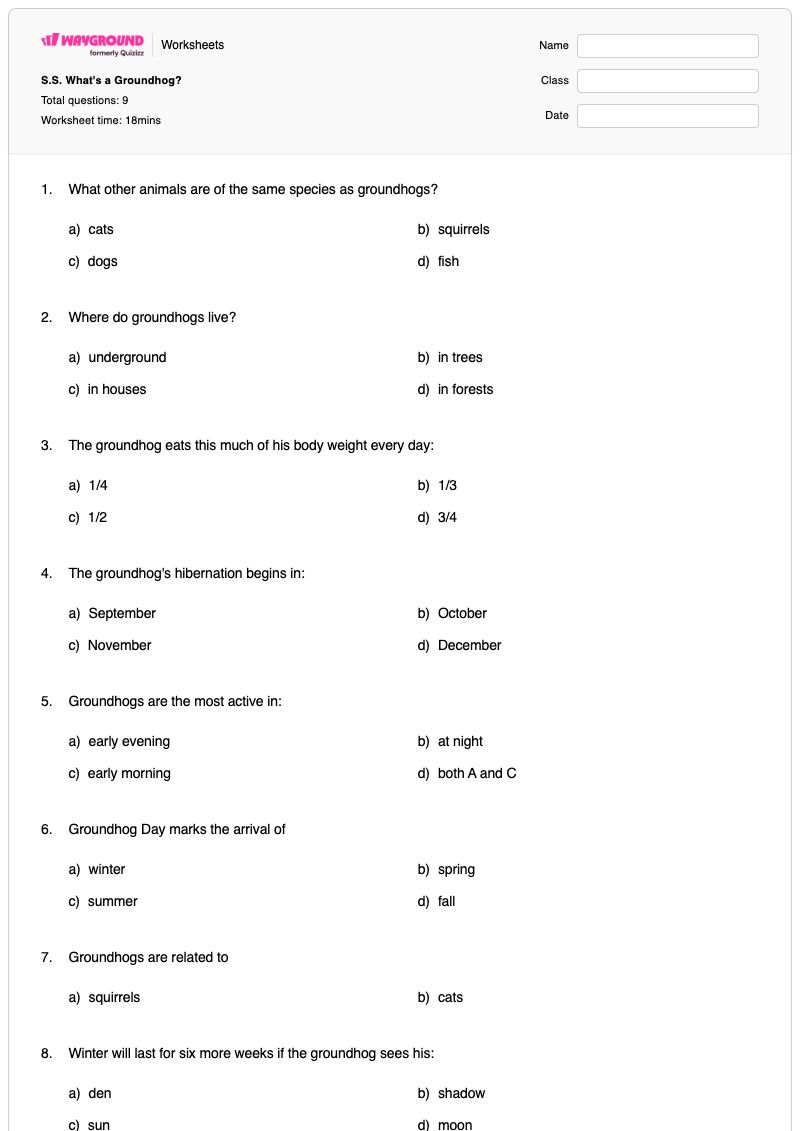
S.S. What's a Groundhog? is a Grade 3 social studies worksheet that builds knowledge of groundhog characteristics, habitats, eating habits, daily activity, hibernation, and Groundhog Day traditions. Students complete 9 multiple-choice questions, identifying groundhogs as squirrel relatives, recognizing that they live underground, recalling that hibernation begins in October, and connecting Groundhog Day with February 2, the arrival of spring, and the shadow tradition.
This worksheet helps students distinguish factual details about the animal from facts about the holiday associated with it. The selected-response format gives teachers a focused way to check whether students can recall specific information, including the groundhog’s one-third body-weight daily food intake and its activity during early morning and early evening. It is a free printable worksheet with an answer key for classroom practice, review, or a short social studies assessment.
Worksheet settings
Font size
S
M
L
XL
Worksheets
S.S. What's a Groundhog?
Total questions: 9
Name
Class
Date
1.
What other animals are of the same species as groundhogs?
a)
cats
b)
squirrels
c)
dogs
d)
fish
2.
Where do groundhogs live?
a)
underground
b)
in trees
c)
in houses
d)
in forests
3.
The groundhog eats this much of his body weight every day:
a)
1/4
b)
1/3
c)
1/2
d)
3/4
4.
The groundhog's hibernation begins in:
a)
September
b)
October
c)
November
d)
December
5.
Groundhogs are the most active in:
a)
early evening
b)
at night
c)
early morning
d)
both A and C
6.
Groundhog Day marks the arrival of
a)
winter
b)
spring
c)
summer
d)
fall
7.
Groundhogs are related to
a)
squirrels
b)
cats
8.
Winter will last for six more weeks if the groundhog sees his:
a)
den
b)
shadow
c)
sun
d)
moon
9.
Groundhog Day is celebrated on:
a)
January 2nd
b)
February 2nd
c)
March 2nd
d)
April 2nd
Answer Key
S.S. What's a Groundhog?
Total questions: 9
1.
b)
squirrels
2.
a)
underground
3.
b)
1/3
4.
b)
October
5.
d)
both A and C
6.
b)
spring
7.
a)
squirrels
8.
b)
shadow
9.
b)
February 2nd
140 %
Browse by subjects
Browse by grades
Browse by format
FAQs
What does the S.S. What's a Groundhog? worksheet cover?
This Grade 3 social studies worksheet uses 9 multiple-choice questions to review groundhog characteristics and Groundhog Day facts. Students identify the animal’s squirrel relationship, underground habitat, daily activity periods, one-third body-weight food intake, October hibernation start, and the holiday’s February 2 date and shadow tradition.
How can I use this worksheet to teach groundhog facts and Groundhog Day?
Introduce the worksheet by separating its content into two groups: groundhog biology and Groundhog Day traditions. After students answer the multiple-choice items, have them explain how details such as underground living, October hibernation, and activity in the early morning and early evening differ from the February 2 shadow tradition.
What mistakes should I watch for on this groundhog worksheet?
Students may confuse groundhogs with unrelated animals, even though the worksheet identifies them as related to squirrels, or select forests or trees instead of underground as their habitat. Watch for errors in precise details, especially choosing one-half instead of one-third for daily food intake, missing the October hibernation date, overlooking the “both A and C” activity answer, or confusing February 2 with another date.
How do I assign and grade the S.S. What's a Groundhog? worksheet?
Wayground provides this 9-question worksheet as both a printable PDF and a digital quiz, and it includes a complete answer key. You can grade printed submissions by scanning student work with the Wayground for Teachers app, while the digital quiz supports online assignment and scoring.
How can I differentiate this groundhog multiple-choice worksheet for my students?
Use the worksheet’s Advanced Settings to adjust font spacing and font size so the nine multiple-choice items are easier to read. You can also apply a dyslexia-friendly font or translate the groundhog questions into another language when those options better support access to the worksheet.
Where can I find more worksheets like this on Wayground?
Wayground offers a broad collection of free printable worksheets and practice problems across subjects, with downloadable PDFs and answer keys to support essential skills and concepts. Browse more resources at https://wayground.com/en-us/worksheets.

 Worksheets