Hair/Fiber/Fingerprint Re-Test is a Grade 11 science worksheet that reviews foundational forensic science and textile concepts through 15 questions: 14 multiple-choice items and one multiple-select item. Students identify the three basic fingerprint patterns, define hair structures such as the cuticle, recognize the telogen phase, and classify hair without a follicle and fibers as class evidence. They also distinguish fibers, yarns, textiles, natural fibers, and synthetic fibers, including classification questions about polyester and fiberglass and a burn-test application.
This free printable worksheet with an answer key helps teachers check whether students can recall terminology, interpret fingerprint pattern images, and apply classification rules to forensic materials. It works well as a review or re-test after instruction on hair, fiber, textile, and fingerprint evidence. The varied question formats reveal whether students can recognize visual patterns, select accurate definitions, and distinguish closely related evidence categories.
Worksheet settings
Font size
S
M
L
XL
Worksheets
Hair/Fiber/Fingerprint Re-Test
Total questions: 15
Name
Class
Date
1.
The basic unit of a textile structure is
a)
Fiber
b)
Fabric
c)
Yarn
2.
How many basic fingerprint patters are there?
a)
1
b)
2
c)
3
d)
4
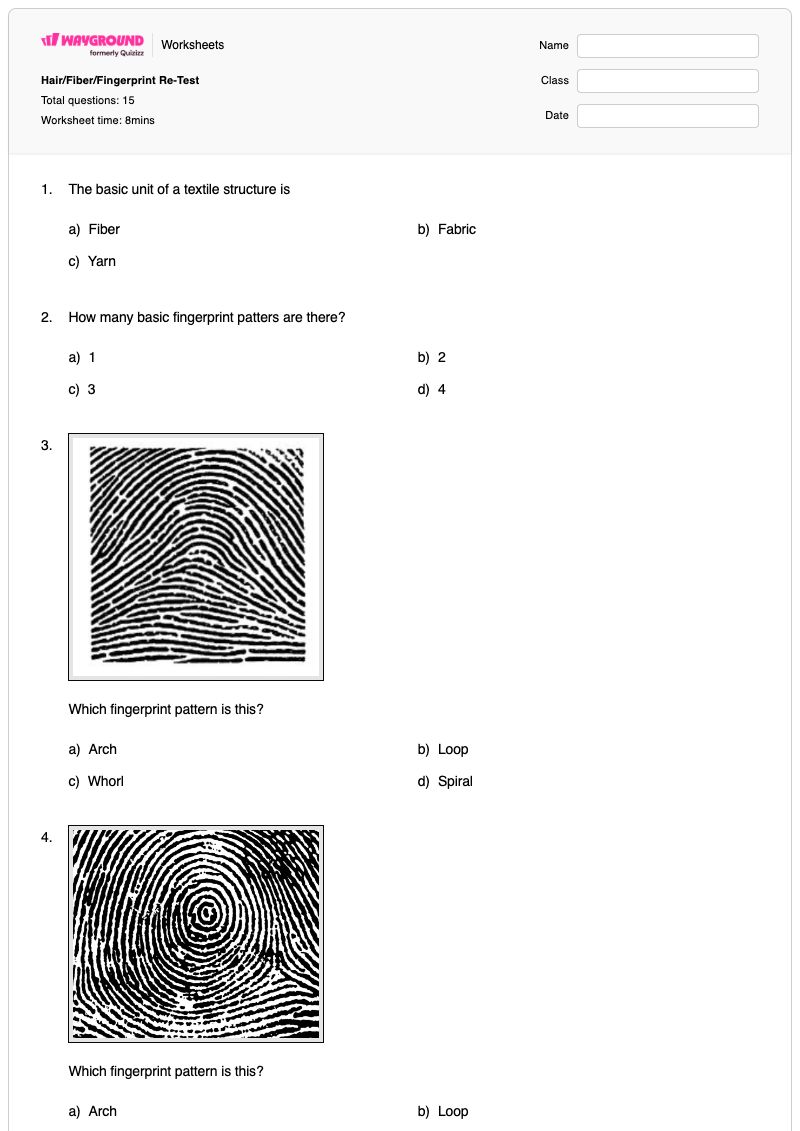
3.
Which fingerprint pattern is this?
a)
Arch
b)
Loop
c)
Whorl
d)
Spiral
4.
Which fingerprint pattern is this?
a)
Arch
b)
Loop
c)
Whorl
d)
Spiral
5.
What is the cuticle
a)
The protective coating that is made of overlapping scales
b)
a large structure at the base of the hair follicle
c)
nuclear DNA
d)
Tiny muscles that surrounds the base of the hair
6.
TRUE OR FALSE: The telogen phase is the most common hair sample found in crime scences
a)
YES
b)
NO
7.
What type of evidence is hair without a follicle?
a)
class evidence
b)
individual evidence
c)
direct evidence
8.
Check all descriptions appropriate for: Polyester
a)
Synthetic
b)
Natural
c)
Plant
d)
Animal
e)
Mineral
9.
A flexible, flat material made by interlacing yarns (or “threads”)
a)
monomer
b)
yarn
c)
fiber
d)
textile
10.
Fibers are considered what kind of evidence?
a)
Individual
b)
Class
c)
Direct
d)
Indirect
11.
Which of the answers describe natural fibers?
a)
rayon, nylon, wool
b)
cotton, polyester, cashmere
c)
linen, cotton, silk
d)
silk, spandex, polyester
12.
Fibers are classified as either:
a)
natural fibers or synthetic fibers.
b)
polymers or synthetic fibers.
c)
acrylic fibers or plant fibers.
d)
olefins or synthetic fibers.
13.
The smallest indivisible unit of a textile is a...
a)
Fiber
b)
Fabric
c)
Yarn
d)
Thread
14.
Fiberglass is considered this type of fiber.
a)
Synthetic
b)
Natural
15.
In a burn test, these fibers will often shrink back away from the flame.
a)
Synthetic
b)
Natural
Answer Key
Hair/Fiber/Fingerprint Re-Test
Total questions: 15
1.
a)
Fiber
2.
c)
3
3.
a)
Arch
4.
c)
Whorl
5.
a)
The protective coating that is made of overlapping scales
6.
a)
YES
7.
a)
class evidence
8.
a)
Synthetic
9.
d)
textile
10.
b) Class
11.
c)
linen, cotton, silk
12.
a)
natural fibers or synthetic fibers.
13.
a) Fiber
14.
b) Natural
15.
a) Synthetic
140 %
Browse by subjects
Browse by grades
Browse by format
FAQs
What does the Hair/Fiber/Fingerprint Re-Test worksheet cover?
This Grade 11 science worksheet uses 14 multiple-choice questions and one multiple-select question to review fingerprint pattern identification, hair anatomy and growth phases, forensic evidence types, and fiber and textile classification. Students identify arches and whorls, define the hair cuticle, distinguish class evidence from other evidence types, and classify materials such as polyester, natural fibers, fiberglass, and synthetic fibers.
How can I use this worksheet to teach hair, fiber, and fingerprint evidence?
Use the worksheet after direct instruction as a structured review: begin with the fingerprint pattern items, then model the difference between a fiber, yarn, and textile before moving to hair anatomy and evidence classification. Ask students to explain why hair without a follicle and fibers are classified as class evidence, and have them justify their natural-versus-synthetic choices using the worksheet’s examples, including polyester and the burn-test item.
What mistakes should I watch for when students complete this worksheet?
Students may confuse a fiber with a yarn or textile, or misidentify the pictured arch and whorl patterns. Watch for students labeling hair without a follicle or fibers as individual evidence, treating polyester as natural, or selecting multiple material categories when the polyester item requires only the synthetic description. The answer key also identifies fiberglass as natural, so review that classification if students apply a different rule.
How do I assign and grade the Hair/Fiber/Fingerprint Re-Test worksheet?
The worksheet is available as a printable PDF and as a digital quiz on Wayground, and it includes a complete answer key for all 15 items. Grade printable submissions by scanning student work with the Wayground for Teachers app, or use the digital quiz to collect responses electronically.
How can I differentiate this hair, fiber, and fingerprint worksheet for my students?
Use the worksheet’s Advanced Settings to adjust font spacing and font size so the fingerprint identification items and classification choices are easier to read. You can also apply a dyslexia-friendly font or translate the worksheet into another language while preserving its multiple-choice and multiple-select format.
Where can I find more worksheets like this on Wayground?
Wayground offers a broad collection of free printable worksheets and practice problems across all subjects, with downloadable PDFs and answer keys to help students master essential skills and concepts. Browse more resources at https://wayground.com/en-us/worksheets.


 Worksheets
