Anatomy and Physiology is a 13-question science worksheet for Grades 9–12 that reviews foundational human-body concepts through 11 multiple-choice questions, one fill-in-the-blank item, and one multiple-select question. Students identify the roles of digestive organs, explain peristalsis and chemical digestion, recognize how carbohydrates are broken down, and distinguish anatomy as the study of structure from physiology as the study of function. The worksheet also checks core facts about the human skeleton and heart.
Use this resource to reinforce vocabulary and organ-function knowledge after an introductory anatomy and physiology lesson or as a concise review assessment. The varied question formats require students to recall facts, match organs with their functions, complete a numerical fact, and evaluate a multiple-select statement. This free printable worksheet includes a complete answer key for efficient checking and feedback.
Worksheet settings
Font size
S
M
L
XL
Worksheets
Anatomy and Physiology
Total questions: 13
Name
Class
Date
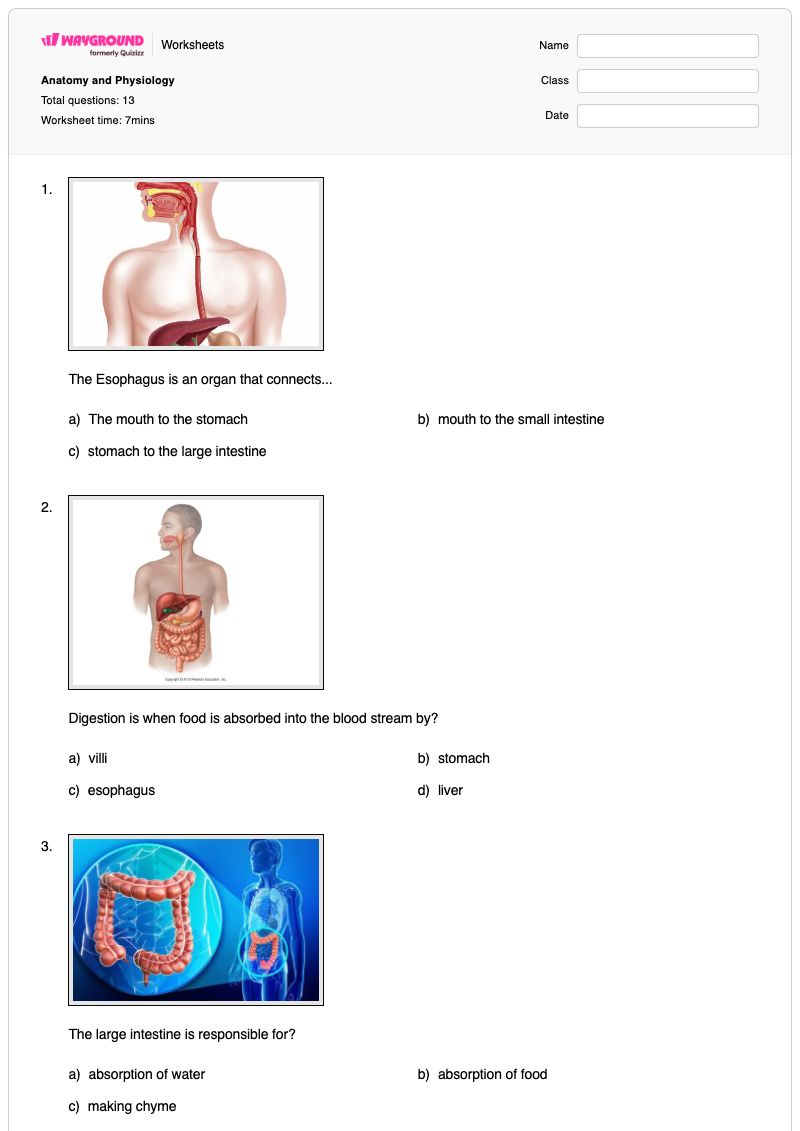
1.
The Esophagus is an organ that connects...
a)
The mouth to the stomach
b)
mouth to the small intestine
c)
stomach to the large intestine
2.
Digestion is when food is absorbed into the blood stream by?
a)
villi
b)
stomach
c)
esophagus
d)
liver
3.
The large intestine is responsible for?
a)
absorption of water
b)
absorption of food
c)
making chyme
4.
Which organ contains bacteria that helps with breaking down plant fiber?
a)
large intestine
b)
small intestine
c)
stomach
5.
Peristalsis is when?
a)
muscle contractions move the food along
b)
digestion begins
c)
stomach digests food
d)
muscle does nothing
6.
How many Bones are in the Human Body?
(a)
7.
How many chambers are there in the Human Heart?
a)
5
b)
7
c)
4
d)
3
8.
The Pancreas is responsible for?
a)
Creating enzymes for digestion
b)
Regulating the sugar levels in your body
c)
Both A & B
d)
Neither A & B
9.
Carbohydrates are broken down into?
a)
sugar
b)
protein
c)
amino acids
d)
lipids
10.
Anatomy is the study of?
a)
The "function" of body parts
b)
The "structure" between body parts
11.
Physiology is the study of
a)
The "function" of the body parts
b)
The "structure" of the body and organs
12.
Is water wet?
a)
Yes
b)
No
13.
Chemical digestions is?
a)
Enzymes from glands
b)
Chewing food
c)
Both A & B
d)
Neither A & B
Answer Key
Anatomy and Physiology
Total questions: 13
1.
a) The mouth to the stomach
2.
a) villi
3.
a) absorption of water
4.
a) large intestine
5.
a) muscle contractions move the food along
6.
206
7.
c)
4
8.
c) Both A & B
9.
a) sugar
10.
b) The "structure" between body parts
11.
a) The "function" of the body parts
12.
a)
Yes
, b)
No
13.
a) Enzymes from glands
140 %
Browse by subjects
Browse by grades
Browse by format
FAQs
What does this Anatomy and Physiology worksheet cover?
This worksheet reviews foundational anatomy and physiology through 13 items focused on digestive-organ functions, peristalsis, chemical digestion, carbohydrate breakdown, and the distinction between anatomy and physiology. Its 11 multiple-choice questions, fill-in-the-blank body-bone count, and multiple-select item give students practice recalling facts and connecting specific organs with their roles.
How can I use this worksheet to teach anatomy and physiology?
Introduce the worksheet after students have learned the digestive tract, using the esophagus, villi, large intestine, pancreas, and peristalsis as checkpoints for explaining how structure supports function. Have students justify each selected organ function, then use the anatomy-versus-physiology items to reinforce the difference between studying body structures and studying what those structures do.
What mistakes should I watch for when students complete this worksheet?
Watch for students confusing the esophagus with the intestines, identifying the stomach instead of villi for absorption into the bloodstream, or overlooking the large intestine’s role in water absorption and plant-fiber breakdown. Students may also mix up anatomy and physiology, choose only one pancreas function when the item requires both, or select chewing instead of enzymes from glands for chemical digestion.
How do I assign and grade this Anatomy and Physiology worksheet?
The worksheet is available as a printable PDF and as a digital quiz on Wayground, and it includes a complete answer key for all 13 items. For printable submissions, scan student work with the Wayground for Teachers app to help grade responses efficiently.
How can I differentiate this worksheet for my students?
Use the worksheet’s Advanced Settings to adjust font spacing or increase the font size so the multiple-choice options and fill-in-the-blank response are easier to read. You can also apply a dyslexia-friendly font or translate the digestive-system and anatomy-and-physiology questions into another language.
Where can I find more worksheets like this on Wayground?
Wayground offers a broad collection of free printable worksheets and practice problems across subjects, with downloadable PDFs and answer keys to support essential skills and concepts. Browse more resources at https://wayground.com/en-us/worksheets.

 Worksheets


