

Wayground
Proteins and Mutations - Printable Science Worksheets year 7 - Wayground

Proteins and Mutations

TARYN UPMANN-GRUNWALD

Created by TARYN UPMANN-GRUNWALD

10 questions

7th Grade

Science

Updated Feb 2026

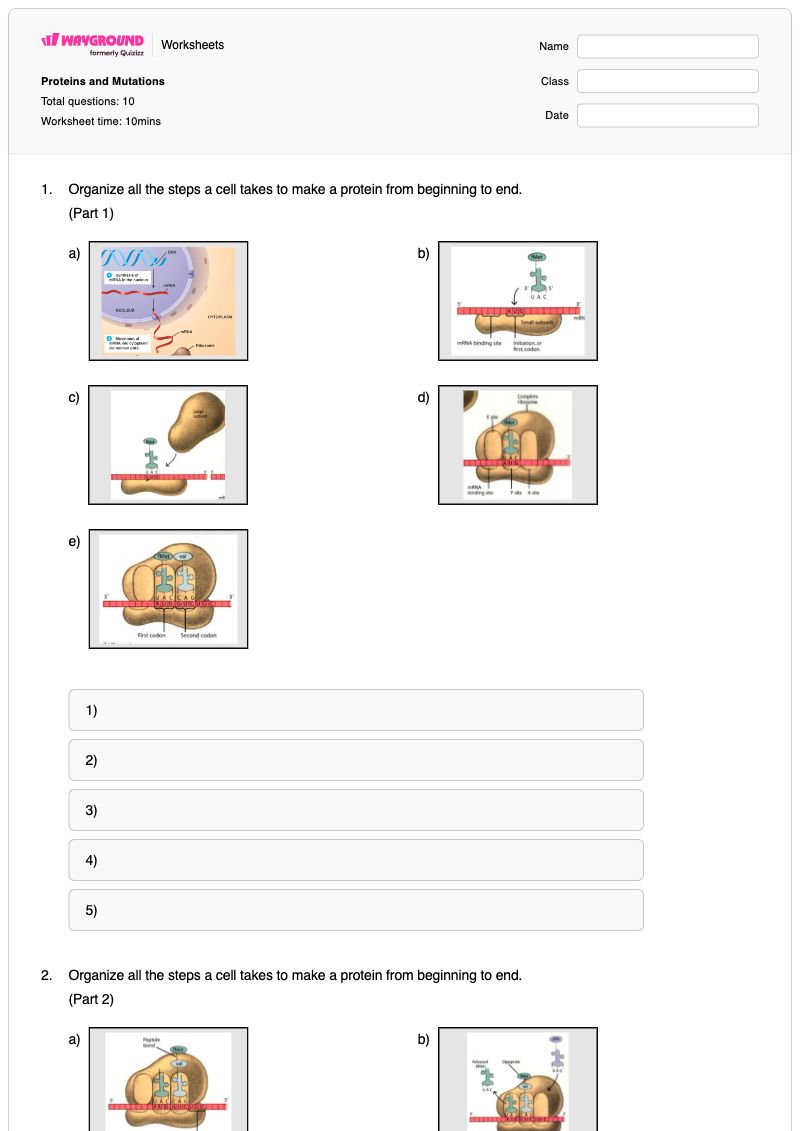
This Grade 7 science worksheet helps students connect protein production, DNA mutations, and cell function. Students sequence the steps a cell takes to make a protein, match cell parts to a product-making metaphor, define mutation, and identify how DNA changes can affect the way a protein is built, shaped, or produced. The worksheet includes 10 questions using ordering, matching, multiple-choice, multiple-select, and drag-and-drop formats. Students then apply the structure-and-function relationship to sickle cell disease. They identify hemoglobin as the affected molecule and trace how altered hemoglobin forms rods, changes red blood cells into a sickle shape, and interferes with oxygen delivery through blocked blood vessels. This free printable worksheet with an answer key is designed for Grade 7 science instruction, review, or assessment of how changes in DNA can lead to changes in proteins and cell behavior.

Worksheet settings

Font size

S
M
L
XL
WaygroundWorksheets

Proteins and Mutations

Total questions: 10

Name
Class
Date
1.

Organize all the steps a cell takes to make a protein from beginning to end.

(Part 1)

a)
Organize all the steps a cell takes to make a protein from beginning to end. (Part 1)

b)
Organize all the steps a cell takes to make a protein from beginning to end. (Part 1)

c)
Organize all the steps a cell takes to make a protein from beginning to end. (Part 1)

d)
Organize all the steps a cell takes to make a protein from beginning to end. (Part 1)

e)
Organize all the steps a cell takes to make a protein from beginning to end. (Part 1)

1)
2)
3)
4)
5)
2.

Organize all the steps a cell takes to make a protein from beginning to end.

(Part 2)

a)
Organize all the steps a cell takes to make a protein from beginning to end. (Part 2)

b)
Organize all the steps a cell takes to make a protein from beginning to end. (Part 2)

c)
Organize all the steps a cell takes to make a protein from beginning to end. (Part 2)

d)
Organize all the steps a cell takes to make a protein from beginning to end. (Part 2)

e)
Organize all the steps a cell takes to make a protein from beginning to end. (Part 2)

1)
2)
3)
4)
5)
3.

In class we made a metaphor for how making proteins is like making a product.

Match each cell part with what it acts like

The Instructions

mRNA

The Delivery Truck

tRNA

The Factory

Ribosome

The Supplies

Amino Acids

The Product

Protein

4.

What is a mutation?

a)

A mutation is a type protein inside a cell

b)

A mutation is a disease that people can get

c)

A mutation is a new strand of DNA made in a baby

d)
A mutation is a change in the DNA sequence of an organism.
5.
What can a mutation cause in a cell?

What can a mutation cause in a cell?

a)

It can make a protein be built the wrong way

b)

It can make a protein be the wrong shape

c)

It can stop a protein from being made at all

6.

The shape or ​ (a)   of a body part is very important for it to be able to do its job or ​ (b)  

Choose from the below words
structure
function
color
size
design
purpose
7.

In sickle cell disease a mutation in the DNA causes a change in which molecule?

a)
glucose
b)
insulin
c)
cholesterol
d)
hemoglobin
8.

How does the mutation change how the hemoglobin works inside the red blood cell?

a)

It makes the Hemoglobin stick to itself in rods

b)

It makes it easier for the Hemoglobin to hold onto oxygen

c)

It makes the Hemoglobin much larger and swells the cell

d)

It makes the hemoglobin turn blue instead of yellow

9.

How does this mutation change the red blood cell?

The sticky hemoglobin forms rods which . . .

a)

makes the cell a sickle or half moon shape

b)

makes the cell a spikey ball shape

c)

makes the cell completely flat

d)

makes the cell into a square shape

10.

Because the mutation ​ (a)   the protein, it affected the ​ (b)   of the red blood cell. That, in turn prevents it from doing its ​ (c)   of delivering oxygen to the body because it gets caught in the ​ (d)   and makes blockages.

Choose from the below words
changed
structure
function
blood vessels
WaygroundAnswer Key

Proteins and Mutations

Total questions: 10

1.
a, b, c, d, e
2.
a, b, c, d, e
3.

 - 

mRNA

, 

 - 

tRNA

, 

 - 

Ribosome

, 

 - 

Amino Acids

, 

 - 

Protein

4.
d) A mutation is a change in the DNA sequence of an organism.
5.
a)

It can make a protein be built the wrong way

, b)

It can make a protein be the wrong shape

, c)

It can stop a protein from being made at all

6.
structure, function
7.
d) hemoglobin
8.
a)

It makes the Hemoglobin stick to itself in rods

9.
a)

makes the cell a sickle or half moon shape

10.
changed, structure, function, blood vessels

FAQs

What does the Proteins and Mutations worksheet cover?

This Grade 7 worksheet covers how cells make proteins and how mutations can change protein production, protein shape, and cell function. Its 10 items ask students to order protein-making steps, match cell parts to a product-making metaphor, answer multiple-choice and multiple-select questions, and complete drag-and-drop statements. Students also apply the relationship between DNA, hemoglobin, red blood cell structure, and oxygen delivery in sickle cell disease.

How can I use this worksheet to teach protein production and mutation effects?

Use the two ordering items first to have students reconstruct the sequence a cell follows to make a protein, then use the matching item to discuss the role of each cell part in the product-making metaphor. After that, ask students to explain how a change in DNA can alter a protein before they complete the sickle cell questions. Have students justify the chain from changed hemoglobin to altered red blood cell structure and reduced oxygen delivery.

What mistakes should I watch for when students complete this worksheet?

Watch for students placing the protein-making steps out of order or matching a cell part to the wrong role in the product-making metaphor. In the multiple-select item, some may choose only one effect of a mutation instead of recognizing that it can cause a protein to be built incorrectly, have the wrong shape, or stop being made. Students may also confuse structure with function or miss the sequence linking altered hemoglobin to sickle-shaped cells and blocked blood vessels.

How do I assign and grade the Proteins and Mutations worksheet?

The worksheet is available as a printable PDF and as a digital quiz on Wayground, and it includes a complete answer key for all 10 items. Printable submissions can be graded by scanning student work with the Wayground for Teachers app. The printable option also supports instruction in settings that are reducing screen time.

How does this worksheet show the effect of a mutation on cell function?

The sickle cell sequence in this worksheet asks students to connect a DNA mutation to a change in hemoglobin, the formation of sticky rods, and a sickle or half-moon red blood cell shape. Students then identify how that structural change affects the cell's function by causing blockages that prevent effective oxygen delivery. This helps them trace the structure-function relationship across multiple levels of organization.

Where can I find more worksheets like this on Wayground?

Wayground offers a comprehensive collection of free printable worksheets and practice problems across subjects, with downloadable PDFs and answer keys to help students master essential skills and concepts. Browse more resources at https://wayground.com/en-us/worksheets.