

Wayground
Levels of Organization in Ecology - Printable Science Worksheets year 7 - Wayground

Levels of Organization in Ecology

21 questions

7th - 7th Grade

Science

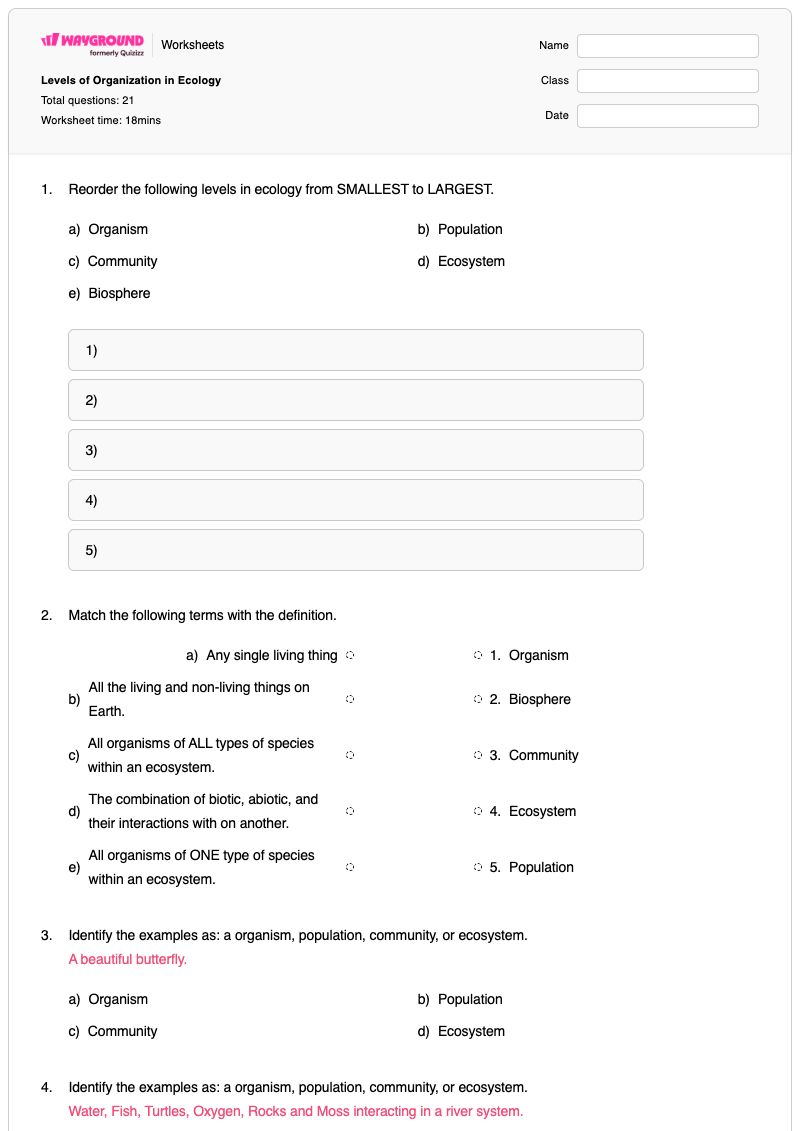
Levels of Organization in Ecology is a Grade 7 science worksheet that helps students distinguish organism, population, community, ecosystem, and biosphere. Students begin by ordering these levels from smallest to largest and matching each term to its definition, then apply the vocabulary to examples such as a butterfly, sting rays in the Pacific Ocean, and organisms living on farmland. The 21-question worksheet combines ordering, matching, multiple-choice, and multiple-select items. Students identify ecology as the study of organism–environment interactions, classify biotic and abiotic factors, interpret visual examples of population and ecosystem levels, and distinguish what belongs in a community versus an ecosystem. This free printable worksheet with an answer key is designed for Grade 7 science instruction, guided practice, review, or a formative check of students’ understanding of ecological organization.

Worksheet settings

Font size

S
M
L
XL
Worksheets

Levels of Organization in Ecology

Total questions: 21

Name
Class
Date
1.

Reorder the following levels in ecology from SMALLEST to LARGEST.

a)

Organism

b)

Population

c)

Community

d)

Ecosystem

e)

Biosphere

1)
2)
3)
4)
5)
2.

Match the following terms with the definition.

Any single living thing

Organism

All the living and non-living things on Earth.

Biosphere

All organisms of ALL types of species within an ecosystem.

Community

The combination of biotic, abiotic, and their interactions with on another.

Ecosystem

All organisms of ONE type of species within an ecosystem.

Population

3.
Identify the examples as: a organism, population, community, or ecosystem.
A beautiful butterfly.
a)
Organism
b)
Population
c)
Community
d)
Ecosystem
4.
Identify the examples as: a organism, population, community, or ecosystem.
Water, Fish, Turtles, Oxygen, Rocks and Moss interacting in a river system.
a)
Organism
b)
Population
c)
Community
d)
Ecosystem
5.
Identify the examples as: a organism, population, community, or ecosystem.
Chicken, Cow, Grass, Buffalo, and Mouse living on farmland.
a)
Organism
b)
Community
c)
Population
d)
Ecosystem
6.
All organisms of the same species living in the same area.
a)
Population
b)
Community
c)
Ecosystem
d)
Organism
7.
All of the different biotic organisms found in the same area.
a)
Organism
b)
Population
c)
Community
d)
Ecosystem
8.
Identify the examples as: a organism, population, community, or ecosystem.
All speckled sting-ray that live in the Pacific Ocean
a)
Organism
b)
Population
c)
Community
d)
Ecosystem
9.
The study of organisms and how they interact with one another and their environment is best described as
a)
Biology
b)
Ecology
c)
Zoology
d)
Botany
10.
What level of organization can be seen here?
a)
Species
b)
Population
c)
Community
d)
Ecosystem
11.
TRUE or FALSE: A community includes all abiotic and biotic factors.
a)
TRUE
b)
FASLE
12.
TRUE or FALSE: An ecosystem contains only biotic factors.
a)
TRUE
b)
FALSE
13.
What level of organization can be observed in the image?
a)
Species
b)
Population
c)
Community
d)
Ecosystem
14.

Select examples of abiotic things

a)

Soil

b)

Air

c)

Rocks

d)

Water

e)

Animals

15.

Select the examples of biotic things

a)

Plants

b)

Soil

c)

Sun

d)

Animals

16.

Lizards and cacti are biotic factors in a desert ecosystem that would rely on which abiotic factors?

a)

insects and sun

b)

water and insects

c)

snakes and temperature

d)

water and soil

17.

Which is a biotic factor that affects the size of a population in a specific ecosystem?

a)

average temperature

b)

type of soil

c)

number and kinds of predators

d)

concentration of oxygen

18.
Which example shows a relationship between a living thing and a non-living thing?
a)
An insect is food for salmon.
b)
Water carries a rock downstream.
c)
A tree gets nutrients from the soil.
d)
A flower makes food for a butterfly.
19.
Which of these is an example of one living thing depending on another living thing?
a)
Cat walking on the sand
b)
Bird building a nest in a tree
c)
Dog warming in the sunlight
d)
Squirrel drinking water
20.
A place where plants and animals live and grow is called a ____________. It provides, food, water, shelter, and air.
a)
shelter
b)
tree
c)
habitat
d)
organism
21.
Temperature, light, air, water, and soil are all  _____  parts of the environment
a)
alive
b)
biotic 
c)
abiotic
d)
living
Answer Key

Levels of Organization in Ecology

Total questions: 21

1.
a, b, c, d, e
2.

Any single living thing

 - 

Organism

, 

All the living and non-living things on Earth.

 - 

Biosphere

, 

All organisms of ALL types of species within an ecosystem.

 - 

Community

, 

The combination of biotic, abiotic, and their interactions with on another.

 - 

Ecosystem

, 

All organisms of ONE type of species within an ecosystem.

 - 

Population

3.
a) Organism
4.
d) Ecosystem
5.
b) Community
6.
a) Population
7.
c) Community
8.
b) Population
9.
b) Ecology
10.
b) Population
11.
b) FASLE
12.
b) FALSE
13.
d) Ecosystem
14.
a)

Soil

, b)

Air

, c)

Rocks

, d)

Water

15.
a)

Plants

, d)

Animals

16.
d)

water and soil

17.
c)

number and kinds of predators

18.
c) A tree gets nutrients from the soil.
19.
b) Bird building a nest in a tree
20.
c) habitat
21.
c) abiotic

FAQs

What does this Levels of Organization in Ecology worksheet cover?

This Grade 7 science worksheet practices ordering and defining the ecological levels organism, population, community, ecosystem, and biosphere. Through matching, multiple-choice classification, visual examples, and multiple-select questions, students determine whether examples represent a single organism, one species, multiple species, or interacting biotic and abiotic factors.

How can I use this worksheet to teach levels of organization in ecology?

Introduce the five levels by having students arrange organism, population, community, ecosystem, and biosphere from smallest to largest. Then use the matching and example-classification items to discuss why a single butterfly is an organism, sting rays of one species form a population, and a river system containing living and nonliving components is an ecosystem. Finish by asking students to justify their biotic and abiotic selections.

What mistakes should I watch for when students complete this ecology worksheet?

Students may confuse a population with a community by overlooking whether an example contains one species or several species. They may also label all living things as an ecosystem, even though an ecosystem includes both biotic and abiotic factors, or classify soil, air, rocks, and water as biotic. Check that students also keep the levels in the correct smallest-to-largest order.

How do I assign and grade this Levels of Organization in Ecology worksheet?

The worksheet is available as a printable PDF and as a digital quiz on Wayground, with a complete answer key for the ordering, matching, multiple-choice, and multiple-select items. Printable submissions can be graded by scanning student work with the Wayground for Teachers app. The PDF option can also support classrooms that are reducing screen time.

How can I differentiate this ecology worksheet for my students?

Use the worksheet’s Advanced Settings to adjust font spacing or select a larger font size so the ecological-level definitions and classification choices are easier to read. You can also enable a dyslexia-friendly font or translate the worksheet into another language, which can support access to terms such as population, community, ecosystem, biotic, and abiotic.

Where can I find more worksheets like this on Wayground?

Wayground offers a broad collection of free printable worksheets and practice problems across subjects, including downloadable PDFs and answer keys to help students build essential skills and concepts. Browse more resources at https://wayground.com/en-us/worksheets.